

24
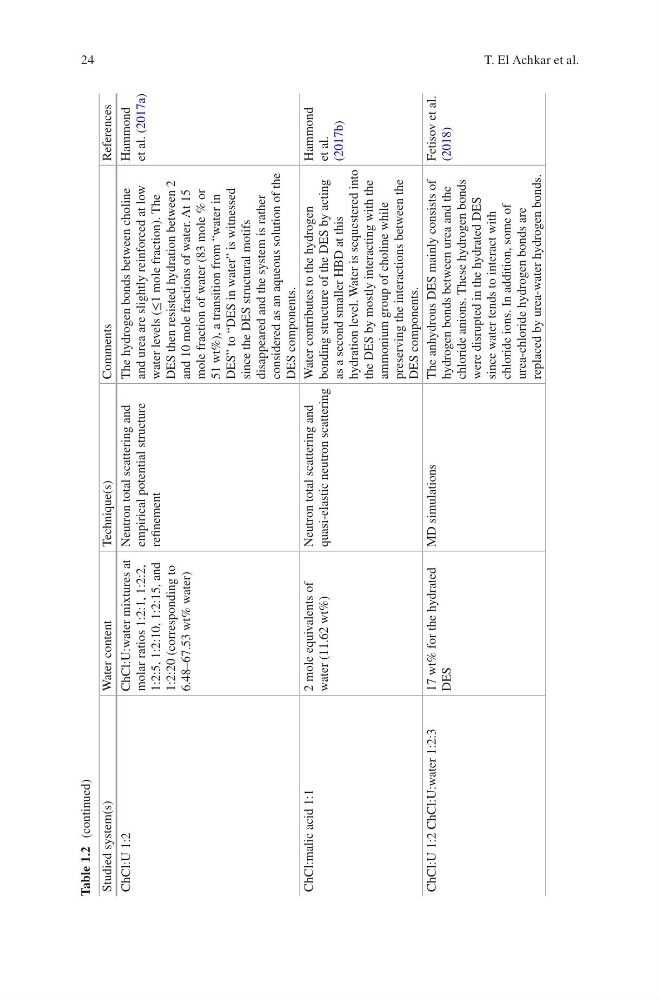
Table 1.2 (continued)
Studied system(s)
Water content
Technique(s)
Comments
References
ChCl:U 1:2
ChCl:U:water mixtures at
molar ratios 1:2:1, 1:2:2,
1:2:5, 1:2:10, 1:2:15, and
1:2:20 (corresponding to
6.48–67.53 wt% water)
Neutron total scattering and
empirical potential structure
refinement
The hydrogen bonds between choline
and urea are slightly reinforced at low
water levels (≤1 mole fraction). The
DES then resisted hydration between 2
and 10 mole fractions of water. At 15
mole fraction of water (83 mole % or
51 wt%), a transition from “water in
DES” to “DES in water” is witnessed
since the DES structural motifs
disappeared and the system is rather
considered as an aqueous solution of the
DES components.
Hammond
et al. (2017a)
ChCl:malic acid 1:1
2 mole equivalents of
water (11.62 wt%)
Neutron total scattering and
quasi-elastic neutron scattering
Water contributes to the hydrogen
bonding structure of the DES by acting
as a second smaller HBD at this
hydration level. Water is sequestered into
the DES by mostly interacting with the
ammonium group of choline while
preserving the interactions between the
DES components.
Hammond
et al.
(2017b)
ChCl:U 1:2 ChCl:U:water 1:2:3
17 wt% for the hydrated
DES
MD simulations
The anhydrous DES mainly consists of
hydrogen bonds between urea and the
chloride anions. These hydrogen bonds
were disrupted in the hydrated DES
since water tends to interact with
chloride ions. In addition, some of
urea-chloride hydrogen bonds are
replaced by urea-water hydrogen bonds.
Fetisov et al.
(2018)
T. El Achkar et al.
Table 1.2 (continued)
Studied system(s)
Water content
Technique(s)
Comments
References
ChCl:U 1:2
ChCl:U:water mixtures at
molar ratios 1:2:1, 1:2:2,
1:2:5, 1:2:10, 1:2:15, and
1:2:20 (corresponding to
6.48–67.53 wt% water)
Neutron total scattering and
empirical potential structure
refinement
The hydrogen bonds between choline
and urea are slightly reinforced at low
water levels (≤1 mole fraction). The
DES then resisted hydration between 2
and 10 mole fractions of water. At 15
mole fraction of water (83 mole % or
51 wt%), a transition from “water in
DES” to “DES in water” is witnessed
since the DES structural motifs
disappeared and the system is rather
considered as an aqueous solution of the
DES components.
Hammond
et al. (2017a)
ChCl:malic acid 1:1
2 mole equivalents of
water (11.62 wt%)
Neutron total scattering and
quasi-elastic neutron scattering
Water contributes to the hydrogen
bonding structure of the DES by acting
as a second smaller HBD at this
hydration level. Water is sequestered into
the DES by mostly interacting with the
ammonium group of choline while
preserving the interactions between the
DES components.
Hammond
et al.
(2017b)
ChCl:U 1:2 ChCl:U:water 1:2:3
17 wt% for the hydrated
DES
MD simulations
The anhydrous DES mainly consists of
hydrogen bonds between urea and the
chloride anions. These hydrogen bonds
were disrupted in the hydrated DES
since water tends to interact with
chloride ions. In addition, some of
urea-chloride hydrogen bonds are
replaced by urea-water hydrogen bonds.
Fetisov et al.
(2018)
T. El Achkar et al.