

22
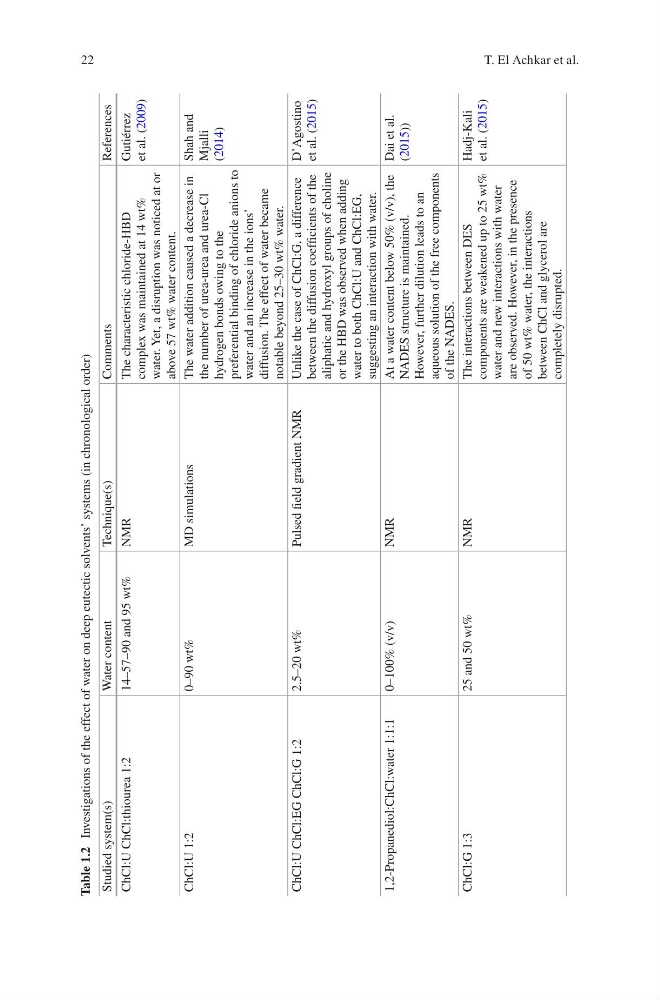
Table 1.2 Investigations of the effect of water on deep eutectic solvents’ systems (in chronological order)
Studied system(s)
Water content
Technique(s)
Comments
References
ChCl:U ChCl:thiourea 1:2
14–57–90 and 95 wt%
NMR
The characteristic chloride-HBD
complex was maintained at 14 wt%
water. Yet, a disruption was noticed at or
above 57 wt% water content.
Gutiérrez
et al. (2009)
ChCl:U 1:2
0–90 wt%
MD simulations
The water addition caused a decrease in
the number of urea-urea and urea-Cl
hydrogen bonds owing to the
preferential binding of chloride anions to
water and an increase in the ions’
diffusion. The effect of water became
notable beyond 25–30 wt% water.
Shah and
Mjalli
(2014)
ChCl:U ChCl:EG ChCl:G 1:2
2.5–20 wt%
Pulsed field gradient NMR
Unlike the case of ChCl:G, a difference
between the diffusion coefficients of the
aliphatic and hydroxyl groups of choline
or the HBD was observed when adding
water to both ChCl:U and ChCl:EG,
suggesting an interaction with water.
D’Agostino
et al. (2015)
1,2-Propanediol:ChCl:water 1:1:1
0–100% (v/v)
NMR
At a water content below 50% (v/v), the
NADES structure is maintained.
However, further dilution leads to an
aqueous solution of the free components
of the NADES.
Dai et al.
(2015))
ChCl:G 1:3
25 and 50 wt%
NMR
The interactions between DES
components are weakened up to 25 wt%
water and new interactions with water
are observed. However, in the presence
of 50 wt% water, the interactions
between ChCl and glycerol are
completely disrupted.
Hadj-Kali
et al. (2015)
T. El Achkar et al.
Table 1.2 Investigations of the effect of water on deep eutectic solvents’ systems (in chronological order)
Studied system(s)
Water content
Technique(s)
Comments
References
ChCl:U ChCl:thiourea 1:2
14–57–90 and 95 wt%
NMR
The characteristic chloride-HBD
complex was maintained at 14 wt%
water. Yet, a disruption was noticed at or
above 57 wt% water content.
Gutiérrez
et al. (2009)
ChCl:U 1:2
0–90 wt%
MD simulations
The water addition caused a decrease in
the number of urea-urea and urea-Cl
hydrogen bonds owing to the
preferential binding of chloride anions to
water and an increase in the ions’
diffusion. The effect of water became
notable beyond 25–30 wt% water.
Shah and
Mjalli
(2014)
ChCl:U ChCl:EG ChCl:G 1:2
2.5–20 wt%
Pulsed field gradient NMR
Unlike the case of ChCl:G, a difference
between the diffusion coefficients of the
aliphatic and hydroxyl groups of choline
or the HBD was observed when adding
water to both ChCl:U and ChCl:EG,
suggesting an interaction with water.
D’Agostino
et al. (2015)
1,2-Propanediol:ChCl:water 1:1:1
0–100% (v/v)
NMR
At a water content below 50% (v/v), the
NADES structure is maintained.
However, further dilution leads to an
aqueous solution of the free components
of the NADES.
Dai et al.
(2015))
ChCl:G 1:3
25 and 50 wt%
NMR
The interactions between DES
components are weakened up to 25 wt%
water and new interactions with water
are observed. However, in the presence
of 50 wt% water, the interactions
between ChCl and glycerol are
completely disrupted.
Hadj-Kali
et al. (2015)
T. El Achkar et al.