

16
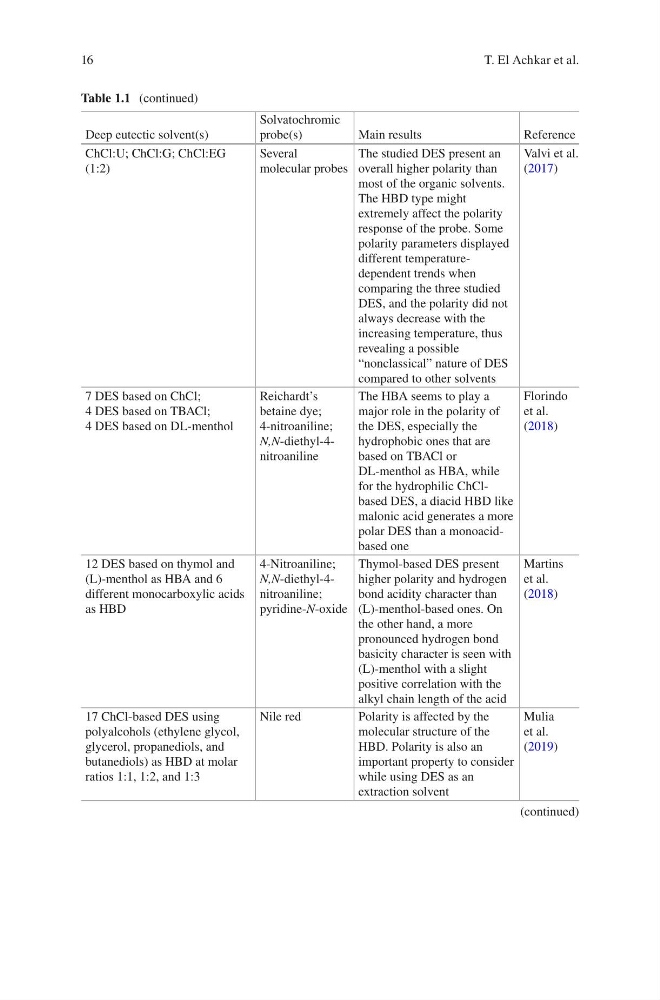
Table 1.1 (continued)
Deep eutectic solvent(s)
Solvatochromic
probe(s)
Main results
Reference
ChCl:U; ChCl:G; ChCl:EG
(1:2)
Several
molecular probes
The studied DES present an
overall higher polarity than
most of the organic solvents.
The HBD type might
extremely affect the polarity
response of the probe. Some
polarity parameters displayed
different temperaturedependent trends when
comparing the three studied
DES, and the polarity did not
always decrease with the
increasing temperature, thus
revealing a possible
“nonclassical” nature of DES
compared to other solvents
Valvi et al.
(2017)
7 DES based on ChCl;
4 DES based on TBACl;
4 DES based on DL-menthol
Reichardt’s
betaine dye;
4-nitroaniline;
N,N-diethyl-4nitroaniline
The HBA seems to play a
major role in the polarity of
the DES, especially the
hydrophobic ones that are
based on TBACl or
DL-menthol as HBA, while
for the hydrophilic ChClbased DES, a diacid HBD like
malonic acid generates a more
polar DES than a monoacidbased one
Florindo
et al.
(2018)
12 DES based on thymol and
(L)-menthol as HBA and 6
different monocarboxylic acids
as HBD
4-Nitroaniline;
N,N-diethyl-4nitroaniline;
pyridine-N-oxide
Thymol-based DES present
higher polarity and hydrogen
bond acidity character than
(L)-menthol-based ones. On
the other hand, a more
pronounced hydrogen bond
basicity character is seen with
(L)-menthol with a slight
positive correlation with the
alkyl chain length of the acid
Martins
et al.
(2018)
17 ChCl-based DES using
polyalcohols (ethylene glycol,
glycerol, propanediols, and
butanediols) as HBD at molar
ratios 1:1, 1:2, and 1:3
Nile red
Polarity is affected by the
molecular structure of the
HBD. Polarity is also an
important property to consider
while using DES as an
extraction solvent
Mulia
et al.
(2019)
(continued)
T. El Achkar et al.
Table 1.1 (continued)
Deep eutectic solvent(s)
Solvatochromic
probe(s)
Main results
Reference
ChCl:U; ChCl:G; ChCl:EG
(1:2)
Several
molecular probes
The studied DES present an
overall higher polarity than
most of the organic solvents.
The HBD type might
extremely affect the polarity
response of the probe. Some
polarity parameters displayed
different temperaturedependent trends when
comparing the three studied
DES, and the polarity did not
always decrease with the
increasing temperature, thus
revealing a possible
“nonclassical” nature of DES
compared to other solvents
Valvi et al.
(2017)
7 DES based on ChCl;
4 DES based on TBACl;
4 DES based on DL-menthol
Reichardt’s
betaine dye;
4-nitroaniline;
N,N-diethyl-4nitroaniline
The HBA seems to play a
major role in the polarity of
the DES, especially the
hydrophobic ones that are
based on TBACl or
DL-menthol as HBA, while
for the hydrophilic ChClbased DES, a diacid HBD like
malonic acid generates a more
polar DES than a monoacidbased one
Florindo
et al.
(2018)
12 DES based on thymol and
(L)-menthol as HBA and 6
different monocarboxylic acids
as HBD
4-Nitroaniline;
N,N-diethyl-4nitroaniline;
pyridine-N-oxide
Thymol-based DES present
higher polarity and hydrogen
bond acidity character than
(L)-menthol-based ones. On
the other hand, a more
pronounced hydrogen bond
basicity character is seen with
(L)-menthol with a slight
positive correlation with the
alkyl chain length of the acid
Martins
et al.
(2018)
17 ChCl-based DES using
polyalcohols (ethylene glycol,
glycerol, propanediols, and
butanediols) as HBD at molar
ratios 1:1, 1:2, and 1:3
Nile red
Polarity is affected by the
molecular structure of the
HBD. Polarity is also an
important property to consider
while using DES as an
extraction solvent
Mulia
et al.
(2019)
(continued)
T. El Achkar et al.