

17
content that can naturally be present in the deep eutectic solvent, and others considered a full range of water content. After being in contact with the atmosphere for 3
weeks, ChCl:U deep eutectic solvent absorbed up to 20 wt% water. That said, Meng
et al. tested the effect of water (up to 10 wt%), which can be naturally absorbed by
the deep eutectic solvents, on the melting point of ChCl:U. The latter was determined via three different and complementary techniques: a thermostated bath, optical microscopy, and differential scanning calorimetry (DSC). A linear decrease of
the melting point was observed as a function of the water content. The melting point
of the mixture dropped from 30 °C for the dry deep eutectic solvent to 15 °C in the
presence of 5 wt% of water. This tremendous water effect can explain the dissimilarities obtained by different studies for the same deep eutectic solvent (Meng et al.
2016). These results were somehow in accordance with the findings of Smith et al.
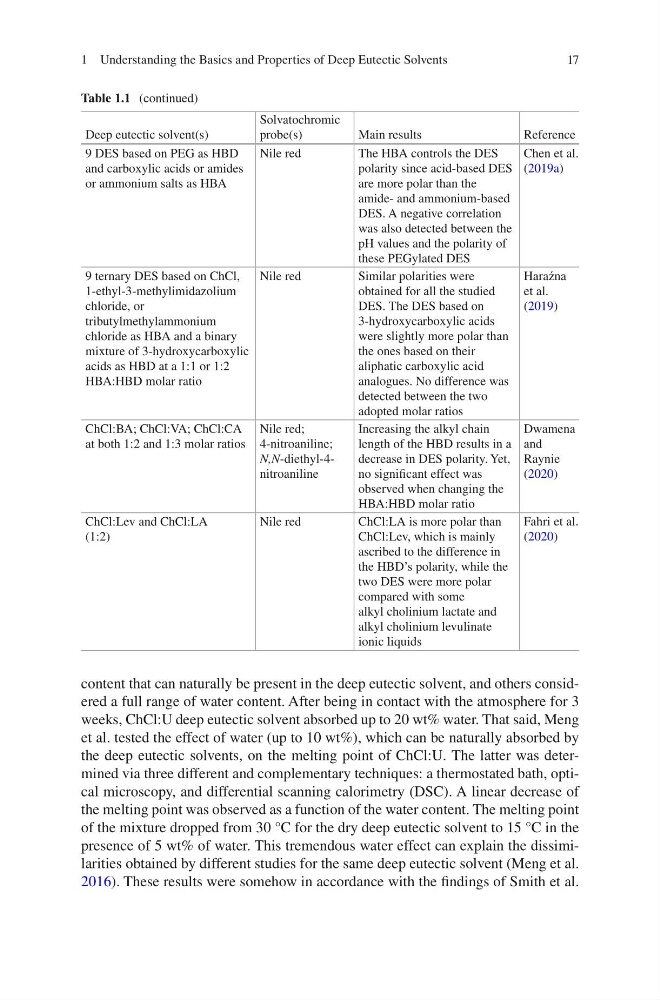
Table 1.1 (continued)
Deep eutectic solvent(s)
Solvatochromic
probe(s)
Main results
Reference
9 DES based on PEG as HBD
and carboxylic acids or amides
or ammonium salts as HBA
Nile red
The HBA controls the DES
polarity since acid-based DES
are more polar than the
amide- and ammonium-based
DES. A negative correlation
was also detected between the
pH values and the polarity of
these PEGylated DES
Chen et al.
(2019a)
9 ternary DES based on ChCl,
1-ethyl-3-methylimidazolium
chloride, or
tributylmethylammonium
chloride as HBA and a binary
mixture of 3-hydroxycarboxylic
acids as HBD at a 1:1 or 1:2
HBA:HBD molar ratio
Nile red
Similar polarities were
obtained for all the studied
DES. The DES based on
3-hydroxycarboxylic acids
were slightly more polar than
the ones based on their
aliphatic carboxylic acid
analogues. No difference was
detected between the two
adopted molar ratios
Haraźna
et al.
(2019)
ChCl:BA; ChCl:VA; ChCl:CA
at both 1:2 and 1:3 molar ratios
Nile red;
4-nitroaniline;
N,N-diethyl-4nitroaniline
Increasing the alkyl chain
length of the HBD results in a
decrease in DES polarity. Yet,
no significant effect was
observed when changing the
HBA:HBD molar ratio
Dwamena
and
Raynie
(2020)
ChCl:Lev and ChCl:LA
(1:2)
Nile red
ChCl:LA is more polar than
ChCl:Lev, which is mainly
ascribed to the difference in
the HBD’s polarity, while the
two DES were more polar
compared with some
alkyl cholinium lactate and
alkyl cholinium levulinate
ionic liquids
Fahri et al.
(2020)
1 Understanding the Basics and Properties of Deep Eutectic Solvents
content that can naturally be present in the deep eutectic solvent, and others considered a full range of water content. After being in contact with the atmosphere for 3
weeks, ChCl:U deep eutectic solvent absorbed up to 20 wt% water. That said, Meng
et al. tested the effect of water (up to 10 wt%), which can be naturally absorbed by
the deep eutectic solvents, on the melting point of ChCl:U. The latter was determined via three different and complementary techniques: a thermostated bath, optical microscopy, and differential scanning calorimetry (DSC). A linear decrease of
the melting point was observed as a function of the water content. The melting point
of the mixture dropped from 30 °C for the dry deep eutectic solvent to 15 °C in the
presence of 5 wt% of water. This tremendous water effect can explain the dissimilarities obtained by different studies for the same deep eutectic solvent (Meng et al.
2016). These results were somehow in accordance with the findings of Smith et al.
Table 1.1 (continued)
Deep eutectic solvent(s)
Solvatochromic
probe(s)
Main results
Reference
9 DES based on PEG as HBD
and carboxylic acids or amides
or ammonium salts as HBA
Nile red
The HBA controls the DES
polarity since acid-based DES
are more polar than the
amide- and ammonium-based
DES. A negative correlation
was also detected between the
pH values and the polarity of
these PEGylated DES
Chen et al.
(2019a)
9 ternary DES based on ChCl,
1-ethyl-3-methylimidazolium
chloride, or
tributylmethylammonium
chloride as HBA and a binary
mixture of 3-hydroxycarboxylic
acids as HBD at a 1:1 or 1:2
HBA:HBD molar ratio
Nile red
Similar polarities were
obtained for all the studied
DES. The DES based on
3-hydroxycarboxylic acids
were slightly more polar than
the ones based on their
aliphatic carboxylic acid
analogues. No difference was
detected between the two
adopted molar ratios
Haraźna
et al.
(2019)
ChCl:BA; ChCl:VA; ChCl:CA
at both 1:2 and 1:3 molar ratios
Nile red;
4-nitroaniline;
N,N-diethyl-4nitroaniline
Increasing the alkyl chain
length of the HBD results in a
decrease in DES polarity. Yet,
no significant effect was
observed when changing the
HBA:HBD molar ratio
Dwamena
and
Raynie
(2020)
ChCl:Lev and ChCl:LA
(1:2)
Nile red
ChCl:LA is more polar than
ChCl:Lev, which is mainly
ascribed to the difference in
the HBD’s polarity, while the
two DES were more polar
compared with some
alkyl cholinium lactate and
alkyl cholinium levulinate
ionic liquids
Fahri et al.
(2020)
1 Understanding the Basics and Properties of Deep Eutectic Solvents