

15
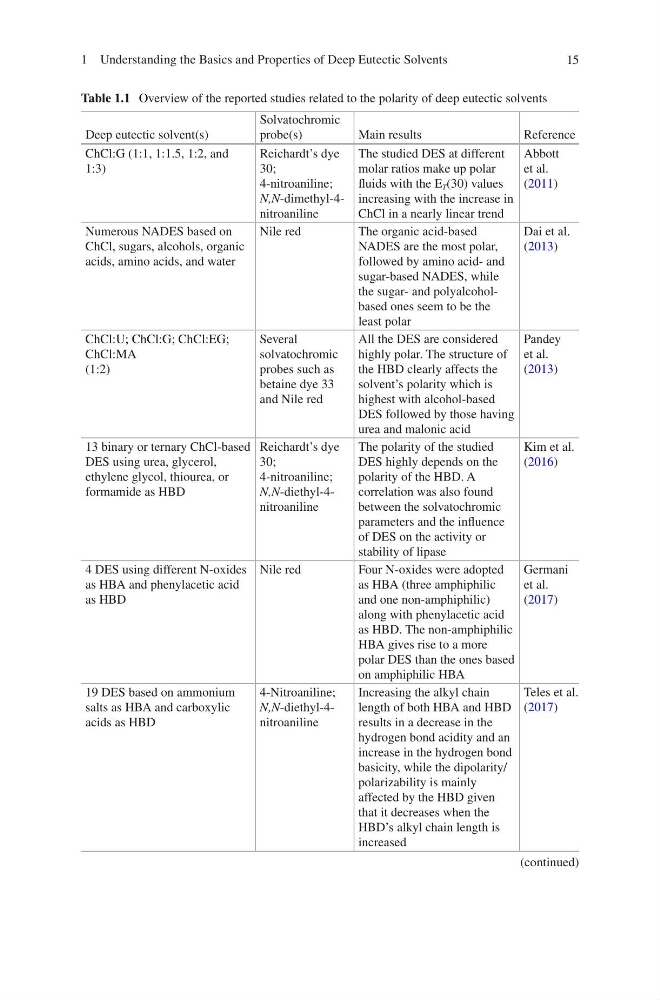
Table 1.1 Overview of the reported studies related to the polarity of deep eutectic solvents
Deep eutectic solvent(s)
Solvatochromic
probe(s)
Main results
Reference
ChCl:G (1:1, 1:1.5, 1:2, and
1:3)
Reichardt’s dye
30;
4-nitroaniline;
N,N-dimethyl-4nitroaniline
The studied DES at different
molar ratios make up polar
fluids with the E T (30) values
increasing with the increase in
ChCl in a nearly linear trend
Abbott
et al.
(2011)
Numerous NADES based on
ChCl, sugars, alcohols, organic
acids, amino acids, and water
Nile red
The organic acid-based
NADES are the most polar,
followed by amino acid- and
sugar-based NADES, while
the sugar- and polyalcoholbased ones seem to be the
least polar
Dai et al.
(2013)
ChCl:U; ChCl:G; ChCl:EG;
ChCl:MA
(1:2)
Several
solvatochromic
probes such as
betaine dye 33
and Nile red
All the DES are considered
highly polar. The structure of
the HBD clearly affects the
solvent’s polarity which is
highest with alcohol-based
DES followed by those having
urea and malonic acid
Pandey
et al.
(2013)
13 binary or ternary ChCl-based
DES using urea, glycerol,
ethylene glycol, thiourea, or
formamide as HBD
Reichardt’s dye
30;
4-nitroaniline;
N,N-diethyl-4nitroaniline
The polarity of the studied
DES highly depends on the
polarity of the HBD. A
correlation was also found
between the solvatochromic
parameters and the influence
of DES on the activity or
stability of lipase
Kim et al.
(2016)
4 DES using different N-oxides
as HBA and phenylacetic acid
as HBD
Nile red
Four N-oxides were adopted
as HBA (three amphiphilic
and one non-amphiphilic)
along with phenylacetic acid
as HBD. The non-amphiphilic
HBA gives rise to a more
polar DES than the ones based
on amphiphilic HBA
Germani
et al.
(2017)
19 DES based on ammonium
salts as HBA and carboxylic
acids as HBD
4-Nitroaniline;
N,N-diethyl-4nitroaniline
Increasing the alkyl chain
length of both HBA and HBD
results in a decrease in the
hydrogen bond acidity and an
increase in the hydrogen bond
basicity, while the dipolarity/
polarizability is mainly
affected by the HBD given
that it decreases when the
HBD’s alkyl chain length is
increased
Teles et al.
(2017)
(continued)
1 Understanding the Basics and Properties of Deep Eutectic Solvents
Table 1.1 Overview of the reported studies related to the polarity of deep eutectic solvents
Deep eutectic solvent(s)
Solvatochromic
probe(s)
Main results
Reference
ChCl:G (1:1, 1:1.5, 1:2, and
1:3)
Reichardt’s dye
30;
4-nitroaniline;
N,N-dimethyl-4nitroaniline
The studied DES at different
molar ratios make up polar
fluids with the E T (30) values
increasing with the increase in
ChCl in a nearly linear trend
Abbott
et al.
(2011)
Numerous NADES based on
ChCl, sugars, alcohols, organic
acids, amino acids, and water
Nile red
The organic acid-based
NADES are the most polar,
followed by amino acid- and
sugar-based NADES, while
the sugar- and polyalcoholbased ones seem to be the
least polar
Dai et al.
(2013)
ChCl:U; ChCl:G; ChCl:EG;
ChCl:MA
(1:2)
Several
solvatochromic
probes such as
betaine dye 33
and Nile red
All the DES are considered
highly polar. The structure of
the HBD clearly affects the
solvent’s polarity which is
highest with alcohol-based
DES followed by those having
urea and malonic acid
Pandey
et al.
(2013)
13 binary or ternary ChCl-based
DES using urea, glycerol,
ethylene glycol, thiourea, or
formamide as HBD
Reichardt’s dye
30;
4-nitroaniline;
N,N-diethyl-4nitroaniline
The polarity of the studied
DES highly depends on the
polarity of the HBD. A
correlation was also found
between the solvatochromic
parameters and the influence
of DES on the activity or
stability of lipase
Kim et al.
(2016)
4 DES using different N-oxides
as HBA and phenylacetic acid
as HBD
Nile red
Four N-oxides were adopted
as HBA (three amphiphilic
and one non-amphiphilic)
along with phenylacetic acid
as HBD. The non-amphiphilic
HBA gives rise to a more
polar DES than the ones based
on amphiphilic HBA
Germani
et al.
(2017)
19 DES based on ammonium
salts as HBA and carboxylic
acids as HBD
4-Nitroaniline;
N,N-diethyl-4nitroaniline
Increasing the alkyl chain
length of both HBA and HBD
results in a decrease in the
hydrogen bond acidity and an
increase in the hydrogen bond
basicity, while the dipolarity/
polarizability is mainly
affected by the HBD given
that it decreases when the
HBD’s alkyl chain length is
increased
Teles et al.
(2017)
(continued)
1 Understanding the Basics and Properties of Deep Eutectic Solvents