

246
Sargassaceae) have recently gained strong interest because of their biological properties (Creis n.d.; Wang et al. 2014), hence contributing to the recent focus toward
marine algae as a source of polyphenols. In contrast to marine algae, very little is
known about the phenolic composition of microalgae extracts, with hydroxycinnamic acids or hydroxybenzoic acids being mostly identified. But some works have
shown that a variety of phenolic compounds are present in Scenedesmus microalgae
(Kováčik et al. 2010; Klejdus et al. 2010), meaning that further work is required to
better understand the phenolic composition and consequently the difference in properties of microalgae species. Starting from these few introductive words, it may be
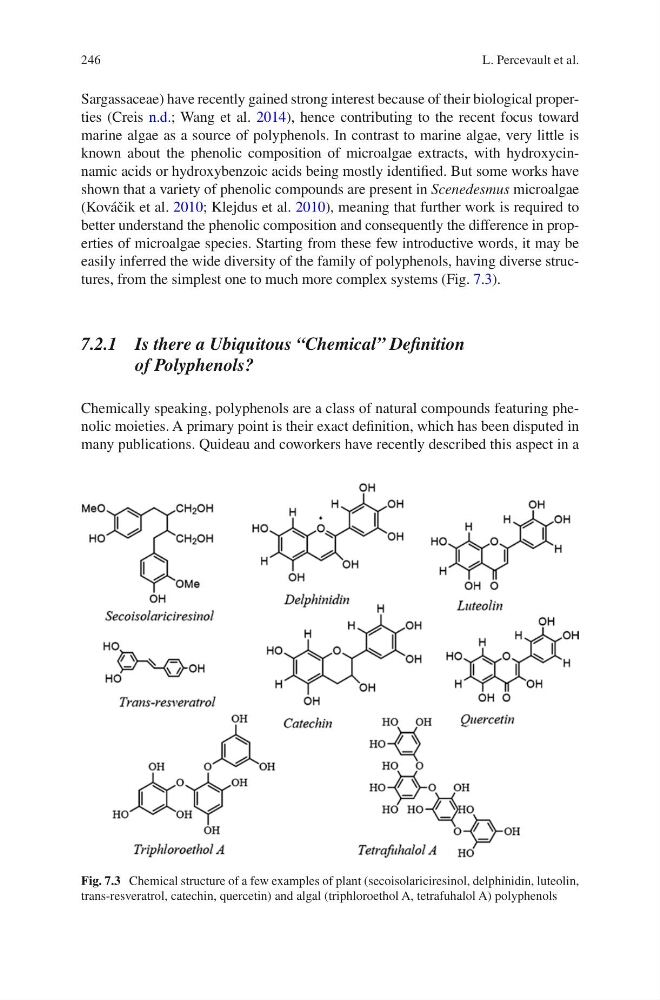
easily inferred the wide diversity of the family of polyphenols, having diverse structures, from the simplest one to much more complex systems (Fig. 7.3).
7.2.1 Is there a Ubiquitous “Chemical” Definition
of Polyphenols?
Chemically speaking, polyphenols are a class of natural compounds featuring phenolic moieties. A primary point is their exact definition, which has been disputed in
many publications. Quideau and coworkers have recently described this aspect in a
Fig. 7.3 Chemical structure of a few examples of plant (secoisolariciresinol, delphinidin, luteolin,
trans-resveratrol, catechin, quercetin) and algal (triphloroethol A, tetrafuhalol A) polyphenols
L. Percevault et al.
Sargassaceae) have recently gained strong interest because of their biological properties (Creis n.d.; Wang et al. 2014), hence contributing to the recent focus toward
marine algae as a source of polyphenols. In contrast to marine algae, very little is
known about the phenolic composition of microalgae extracts, with hydroxycinnamic acids or hydroxybenzoic acids being mostly identified. But some works have
shown that a variety of phenolic compounds are present in Scenedesmus microalgae
(Kováčik et al. 2010; Klejdus et al. 2010), meaning that further work is required to
better understand the phenolic composition and consequently the difference in properties of microalgae species. Starting from these few introductive words, it may be
easily inferred the wide diversity of the family of polyphenols, having diverse structures, from the simplest one to much more complex systems (Fig. 7.3).
7.2.1 Is there a Ubiquitous “Chemical” Definition
of Polyphenols?
Chemically speaking, polyphenols are a class of natural compounds featuring phenolic moieties. A primary point is their exact definition, which has been disputed in
many publications. Quideau and coworkers have recently described this aspect in a
Fig. 7.3 Chemical structure of a few examples of plant (secoisolariciresinol, delphinidin, luteolin,
trans-resveratrol, catechin, quercetin) and algal (triphloroethol A, tetrafuhalol A) polyphenols
L. Percevault et al.