

247
very nice verbatim review (Quideau et al. 2011). Considering that the original
WBSSH (from White, Bate-Smith, Swain, Haslam) definition of polyphenols
(Swain and Bate-Smith 1962; Haslam and Cai 1994) is (too) restrictive, they propose a new definition: “The term polyphenol should be used to define plant secondary metabolites derived exclusively from the shikimate-derived phenylpropanoid
and/or polyketide pathway(s), featuring more than one phenolic ring and being
devoid of any nitrogen-based functional group in their most basic structural expression” (Quideau et al. 2011). This definition takes into account structural features
and biosynthetic routes, while the former WBSSH one is based on the capacity of
“polyphenols” to engage interaction with other biomolecules, thus practically considering only water-soluble compounds that can be divided into only three classes.
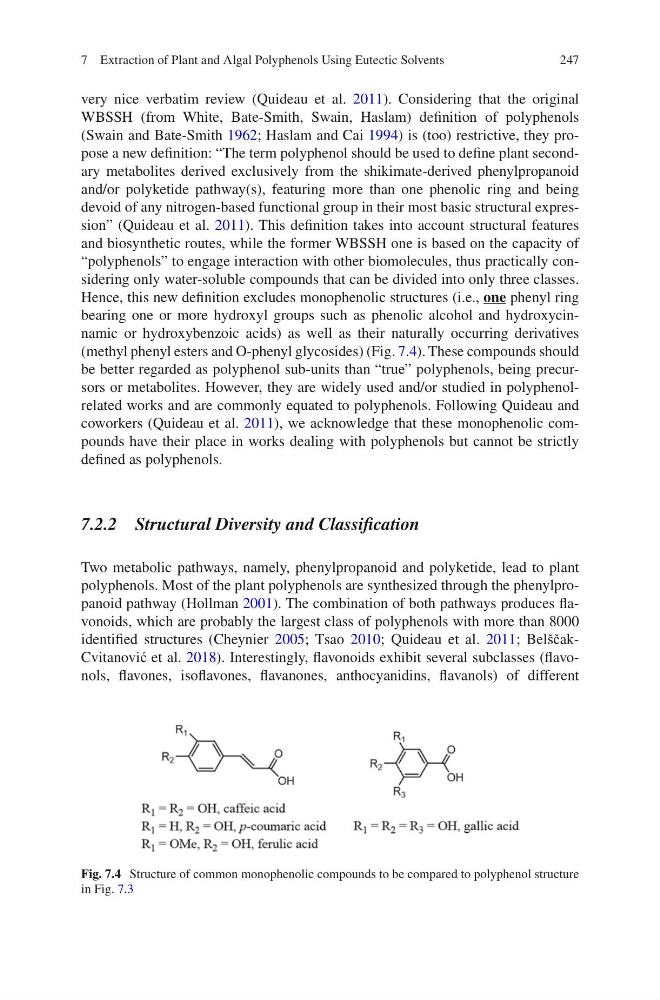
Hence, this new definition excludes monophenolic structures (i.e., one phenyl ring
bearing one or more hydroxyl groups such as phenolic alcohol and hydroxycinnamic or hydroxybenzoic acids) as well as their naturally occurring derivatives
(methyl phenyl esters and O-phenyl glycosides) (Fig. 7.4). These compounds should
be better regarded as polyphenol sub-units than “true” polyphenols, being precursors or metabolites. However, they are widely used and/or studied in polyphenolrelated works and are commonly equated to polyphenols. Following Quideau and
coworkers (Quideau et al. 2011), we acknowledge that these monophenolic compounds have their place in works dealing with polyphenols but cannot be strictly
defined as polyphenols.
7.2.2 Structural Diversity and Classification
Two metabolic pathways, namely, phenylpropanoid and polyketide, lead to plant
polyphenols. Most of the plant polyphenols are synthesized through the phenylpropanoid pathway (Hollman 2001). The combination of both pathways produces flavonoids, which are probably the largest class of polyphenols with more than 8000
identified structures (Cheynier 2005; Tsao 2010; Quideau et al. 2011; BelščakCvitanović et al. 2018). Interestingly, flavonoids exhibit several subclasses (flavonols, flavones, isoflavones, flavanones, anthocyanidins, flavanols) of different
Fig. 7.4 Structure of common monophenolic compounds to be compared to polyphenol structure
in Fig. 7.3
7 Extraction of Plant and Algal Polyphenols Using Eutectic Solvents
very nice verbatim review (Quideau et al. 2011). Considering that the original
WBSSH (from White, Bate-Smith, Swain, Haslam) definition of polyphenols
(Swain and Bate-Smith 1962; Haslam and Cai 1994) is (too) restrictive, they propose a new definition: “The term polyphenol should be used to define plant secondary metabolites derived exclusively from the shikimate-derived phenylpropanoid
and/or polyketide pathway(s), featuring more than one phenolic ring and being
devoid of any nitrogen-based functional group in their most basic structural expression” (Quideau et al. 2011). This definition takes into account structural features
and biosynthetic routes, while the former WBSSH one is based on the capacity of
“polyphenols” to engage interaction with other biomolecules, thus practically considering only water-soluble compounds that can be divided into only three classes.
Hence, this new definition excludes monophenolic structures (i.e., one phenyl ring
bearing one or more hydroxyl groups such as phenolic alcohol and hydroxycinnamic or hydroxybenzoic acids) as well as their naturally occurring derivatives
(methyl phenyl esters and O-phenyl glycosides) (Fig. 7.4). These compounds should
be better regarded as polyphenol sub-units than “true” polyphenols, being precursors or metabolites. However, they are widely used and/or studied in polyphenolrelated works and are commonly equated to polyphenols. Following Quideau and
coworkers (Quideau et al. 2011), we acknowledge that these monophenolic compounds have their place in works dealing with polyphenols but cannot be strictly
defined as polyphenols.
7.2.2 Structural Diversity and Classification
Two metabolic pathways, namely, phenylpropanoid and polyketide, lead to plant
polyphenols. Most of the plant polyphenols are synthesized through the phenylpropanoid pathway (Hollman 2001). The combination of both pathways produces flavonoids, which are probably the largest class of polyphenols with more than 8000
identified structures (Cheynier 2005; Tsao 2010; Quideau et al. 2011; BelščakCvitanović et al. 2018). Interestingly, flavonoids exhibit several subclasses (flavonols, flavones, isoflavones, flavanones, anthocyanidins, flavanols) of different
Fig. 7.4 Structure of common monophenolic compounds to be compared to polyphenol structure
in Fig. 7.3
7 Extraction of Plant and Algal Polyphenols Using Eutectic Solvents