

10
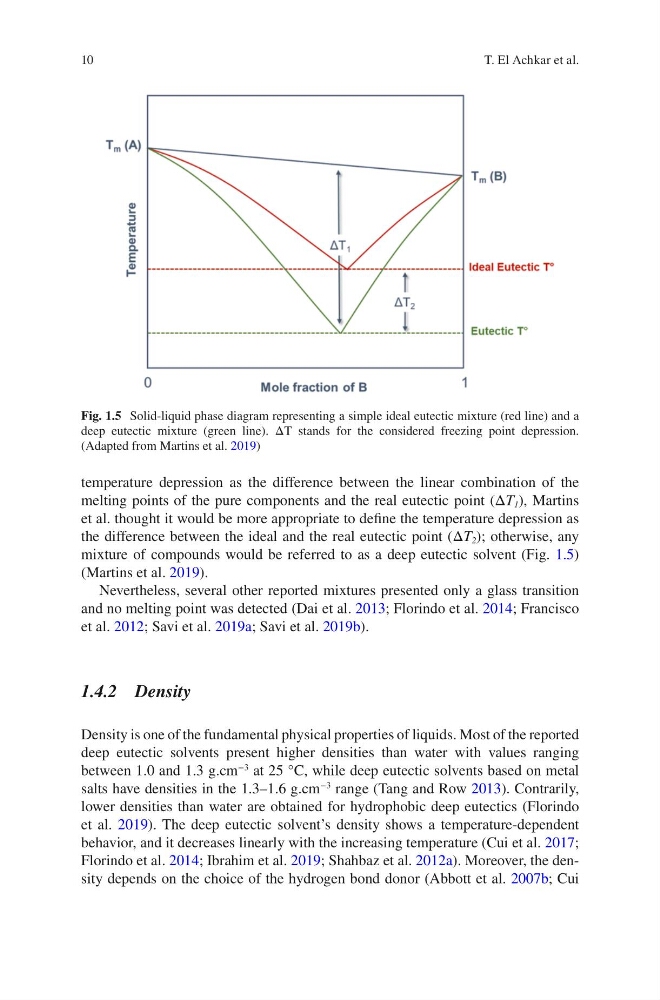
temperature depression as the difference between the linear combination of the
melting points of the pure components and the real eutectic point (ΔT 1 ), Martins
et al. thought it would be more appropriate to define the temperature depression as
the difference between the ideal and the real eutectic point (ΔT 2 ); otherwise, any
mixture of compounds would be referred to as a deep eutectic solvent (Fig. 1.5)
(Martins et al. 2019).
Nevertheless, several other reported mixtures presented only a glass transition
and no melting point was detected (Dai et al. 2013; Florindo et al. 2014; Francisco
et al. 2012; Savi et al. 2019a; Savi et al. 2019b).
1.4.2 Density
Density is one of the fundamental physical properties of liquids. Most of the reported
deep eutectic solvents present higher densities than water with values ranging
between 1.0 and 1.3 g.cm
−3
at 25 °C, while deep eutectic solvents based on metal
salts have densities in the 1.3–1.6 g.cm
−3
range (Tang and Row 2013). Contrarily,
lower densities than water are obtained for hydrophobic deep eutectics (Florindo
et al. 2019). The deep eutectic solvent’s density shows a temperature-dependent
behavior, and it decreases linearly with the increasing temperature (Cui et al. 2017;
Florindo et al. 2014; Ibrahim et al. 2019; Shahbaz et al. 2012a). Moreover, the density depends on the choice of the hydrogen bond donor (Abbott et al. 2007b; Cui
Fig. 1.5 Solid-liquid phase diagram representing a simple ideal eutectic mixture (red line) and a
deep eutectic mixture (green line). ΔT stands for the considered freezing point depression.
(Adapted from Martins et al. 2019)
T. El Achkar et al.
temperature depression as the difference between the linear combination of the
melting points of the pure components and the real eutectic point (ΔT 1 ), Martins
et al. thought it would be more appropriate to define the temperature depression as
the difference between the ideal and the real eutectic point (ΔT 2 ); otherwise, any
mixture of compounds would be referred to as a deep eutectic solvent (Fig. 1.5)
(Martins et al. 2019).
Nevertheless, several other reported mixtures presented only a glass transition
and no melting point was detected (Dai et al. 2013; Florindo et al. 2014; Francisco
et al. 2012; Savi et al. 2019a; Savi et al. 2019b).
1.4.2 Density
Density is one of the fundamental physical properties of liquids. Most of the reported
deep eutectic solvents present higher densities than water with values ranging
between 1.0 and 1.3 g.cm
−3
at 25 °C, while deep eutectic solvents based on metal
salts have densities in the 1.3–1.6 g.cm
−3
range (Tang and Row 2013). Contrarily,
lower densities than water are obtained for hydrophobic deep eutectics (Florindo
et al. 2019). The deep eutectic solvent’s density shows a temperature-dependent
behavior, and it decreases linearly with the increasing temperature (Cui et al. 2017;
Florindo et al. 2014; Ibrahim et al. 2019; Shahbaz et al. 2012a). Moreover, the density depends on the choice of the hydrogen bond donor (Abbott et al. 2007b; Cui
Fig. 1.5 Solid-liquid phase diagram representing a simple ideal eutectic mixture (red line) and a
deep eutectic mixture (green line). ΔT stands for the considered freezing point depression.
(Adapted from Martins et al. 2019)
T. El Achkar et al.