

11
et al. 2017; Florindo et al. 2014; García et al. 2015) and the molar ratio (Abbott
et al. 2011). According to Shahbaz et al., a higher hydrogen bond donor mole fraction lowers the density of a deep eutectic solvent whenever the hydrogen bond
donor’s density is lower than that of the corresponding deep eutectic solvent and
vice versa (Shahbaz et al. 2011a; Shahbaz et al. 2012a). In addition, when the
hydrogen bond donor contains hydroxyl groups, the density of the ChCl-based deep
eutectic solvent increases with the number of hydroxyl groups but decreases with
the addition of aromatic groups. Also, when the deep eutectic solvent is made of an
acid, its density decreases when the chain length is increased (Florindo et al. 2014;
García et al. 2015; Mitar et al. 2019). The effect of the hydrogen bond donor type
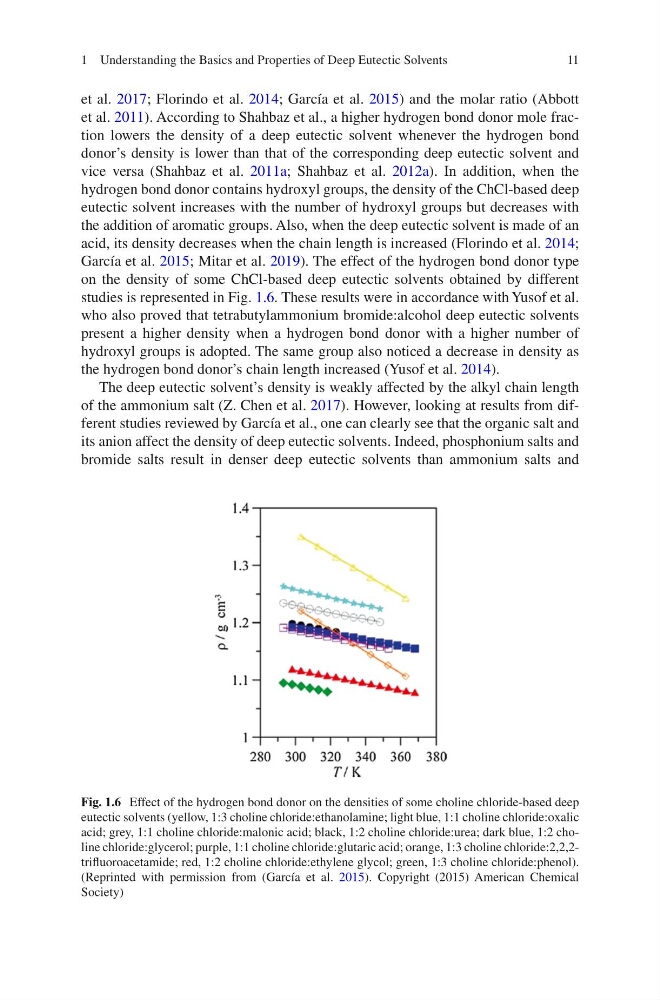
on the density of some ChCl-based deep eutectic solvents obtained by different
studies is represented in Fig. 1.6. These results were in accordance with Yusof et al.
who also proved that tetrabutylammonium bromide:alcohol deep eutectic solvents
present a higher density when a hydrogen bond donor with a higher number of
hydroxyl groups is adopted. The same group also noticed a decrease in density as
the hydrogen bond donor’s chain length increased (Yusof et al. 2014).
The deep eutectic solvent’s density is weakly affected by the alkyl chain length
of the ammonium salt (Z. Chen et al. 2017). However, looking at results from different studies reviewed by García et al., one can clearly see that the organic salt and
its anion affect the density of deep eutectic solvents. Indeed, phosphonium salts and
bromide salts result in denser deep eutectic solvents than ammonium salts and
Fig. 1.6 Effect of the hydrogen bond donor on the densities of some choline chloride-based deep
eutectic solvents (yellow, 1:3 choline chloride:ethanolamine; light blue, 1:1 choline chloride:oxalic
acid; grey, 1:1 choline chloride:malonic acid; black, 1:2 choline chloride:urea; dark blue, 1:2 choline chloride:glycerol; purple, 1:1 choline chloride:glutaric acid; orange, 1:3 choline chloride:2,2,2trifluoroacetamide; red, 1:2 choline chloride:ethylene glycol; green, 1:3 choline chloride:phenol).
(Reprinted with permission from (García et al. 2015). Copyright (2015) American Chemical
Society)
1 Understanding the Basics and Properties of Deep Eutectic Solvents
et al. 2017; Florindo et al. 2014; García et al. 2015) and the molar ratio (Abbott
et al. 2011). According to Shahbaz et al., a higher hydrogen bond donor mole fraction lowers the density of a deep eutectic solvent whenever the hydrogen bond
donor’s density is lower than that of the corresponding deep eutectic solvent and
vice versa (Shahbaz et al. 2011a; Shahbaz et al. 2012a). In addition, when the
hydrogen bond donor contains hydroxyl groups, the density of the ChCl-based deep
eutectic solvent increases with the number of hydroxyl groups but decreases with
the addition of aromatic groups. Also, when the deep eutectic solvent is made of an
acid, its density decreases when the chain length is increased (Florindo et al. 2014;
García et al. 2015; Mitar et al. 2019). The effect of the hydrogen bond donor type
on the density of some ChCl-based deep eutectic solvents obtained by different
studies is represented in Fig. 1.6. These results were in accordance with Yusof et al.
who also proved that tetrabutylammonium bromide:alcohol deep eutectic solvents
present a higher density when a hydrogen bond donor with a higher number of
hydroxyl groups is adopted. The same group also noticed a decrease in density as
the hydrogen bond donor’s chain length increased (Yusof et al. 2014).
The deep eutectic solvent’s density is weakly affected by the alkyl chain length
of the ammonium salt (Z. Chen et al. 2017). However, looking at results from different studies reviewed by García et al., one can clearly see that the organic salt and
its anion affect the density of deep eutectic solvents. Indeed, phosphonium salts and
bromide salts result in denser deep eutectic solvents than ammonium salts and
Fig. 1.6 Effect of the hydrogen bond donor on the densities of some choline chloride-based deep
eutectic solvents (yellow, 1:3 choline chloride:ethanolamine; light blue, 1:1 choline chloride:oxalic
acid; grey, 1:1 choline chloride:malonic acid; black, 1:2 choline chloride:urea; dark blue, 1:2 choline chloride:glycerol; purple, 1:1 choline chloride:glutaric acid; orange, 1:3 choline chloride:2,2,2trifluoroacetamide; red, 1:2 choline chloride:ethylene glycol; green, 1:3 choline chloride:phenol).
(Reprinted with permission from (García et al. 2015). Copyright (2015) American Chemical
Society)
1 Understanding the Basics and Properties of Deep Eutectic Solvents