

9
According to Martins et al., the deep eutectic solvent appellation should only
cover mixtures with a melting point lower than the ideal eutectic temperature; otherwise, deep eutectic solvents would not be called “deep” and could not be differentiated from other mixtures (Martins et al. 2019). In addition, they stated that a deep
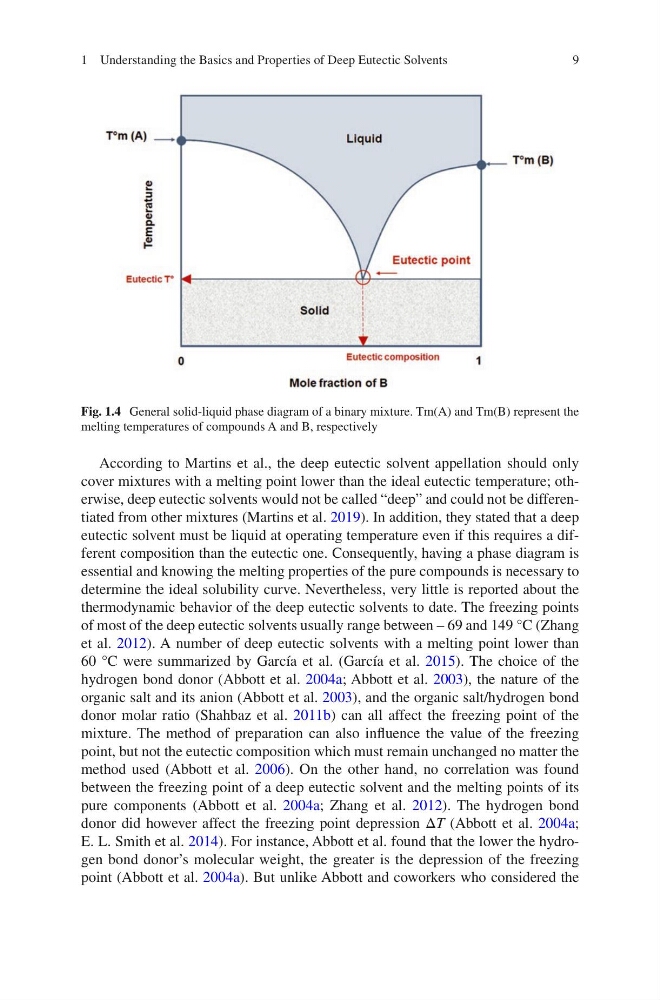
eutectic solvent must be liquid at operating temperature even if this requires a different composition than the eutectic one. Consequently, having a phase diagram is
essential and knowing the melting properties of the pure compounds is necessary to
determine the ideal solubility curve. Nevertheless, very little is reported about the
thermodynamic behavior of the deep eutectic solvents to date. The freezing points
of most of the deep eutectic solvents usually range between – 69 and 149 °C (Zhang
et al. 2012). A number of deep eutectic solvents with a melting point lower than
60 °C were summarized by García et al. (García et al. 2015). The choice of the
hydrogen bond donor (Abbott et al. 2004a; Abbott et al. 2003), the nature of the
organic salt and its anion (Abbott et al. 2003), and the organic salt/hydrogen bond
donor molar ratio (Shahbaz et al. 2011b) can all affect the freezing point of the
mixture. The method of preparation can also influence the value of the freezing
point, but not the eutectic composition which must remain unchanged no matter the
method used (Abbott et al. 2006). On the other hand, no correlation was found
between the freezing point of a deep eutectic solvent and the melting points of its
pure components (Abbott et al. 2004a; Zhang et al. 2012). The hydrogen bond
donor did however affect the freezing point depression ΔT (Abbott et al. 2004a;
E. L. Smith et al. 2014). For instance, Abbott et al. found that the lower the hydrogen bond donor’s molecular weight, the greater is the depression of the freezing
point (Abbott et al. 2004a). But unlike Abbott and coworkers who considered the
Fig. 1.4 General solid-liquid phase diagram of a binary mixture. Tm(A) and Tm(B) represent the
melting temperatures of compounds A and B, respectively
1 Understanding the Basics and Properties of Deep Eutectic Solvents
According to Martins et al., the deep eutectic solvent appellation should only
cover mixtures with a melting point lower than the ideal eutectic temperature; otherwise, deep eutectic solvents would not be called “deep” and could not be differentiated from other mixtures (Martins et al. 2019). In addition, they stated that a deep
eutectic solvent must be liquid at operating temperature even if this requires a different composition than the eutectic one. Consequently, having a phase diagram is
essential and knowing the melting properties of the pure compounds is necessary to
determine the ideal solubility curve. Nevertheless, very little is reported about the
thermodynamic behavior of the deep eutectic solvents to date. The freezing points
of most of the deep eutectic solvents usually range between – 69 and 149 °C (Zhang
et al. 2012). A number of deep eutectic solvents with a melting point lower than
60 °C were summarized by García et al. (García et al. 2015). The choice of the
hydrogen bond donor (Abbott et al. 2004a; Abbott et al. 2003), the nature of the
organic salt and its anion (Abbott et al. 2003), and the organic salt/hydrogen bond
donor molar ratio (Shahbaz et al. 2011b) can all affect the freezing point of the
mixture. The method of preparation can also influence the value of the freezing
point, but not the eutectic composition which must remain unchanged no matter the
method used (Abbott et al. 2006). On the other hand, no correlation was found
between the freezing point of a deep eutectic solvent and the melting points of its
pure components (Abbott et al. 2004a; Zhang et al. 2012). The hydrogen bond
donor did however affect the freezing point depression ΔT (Abbott et al. 2004a;
E. L. Smith et al. 2014). For instance, Abbott et al. found that the lower the hydrogen bond donor’s molecular weight, the greater is the depression of the freezing
point (Abbott et al. 2004a). But unlike Abbott and coworkers who considered the
Fig. 1.4 General solid-liquid phase diagram of a binary mixture. Tm(A) and Tm(B) represent the
melting temperatures of compounds A and B, respectively
1 Understanding the Basics and Properties of Deep Eutectic Solvents