

189
Hollow-Fiber Liquid-Phase Microextraction
Hollow-fiber liquid-phase microextraction constitutes another selective method,
which can be used for the extraction of components from complicated biological
fluids. Interestingly, this technique prevents the diffusion of large molecules from
the donor to the acceptor phase (Khataei et al. 2018). This is due to the use of a
porous polypropylene hollow-fiber membrane. The hollow-fiber liquid-phase
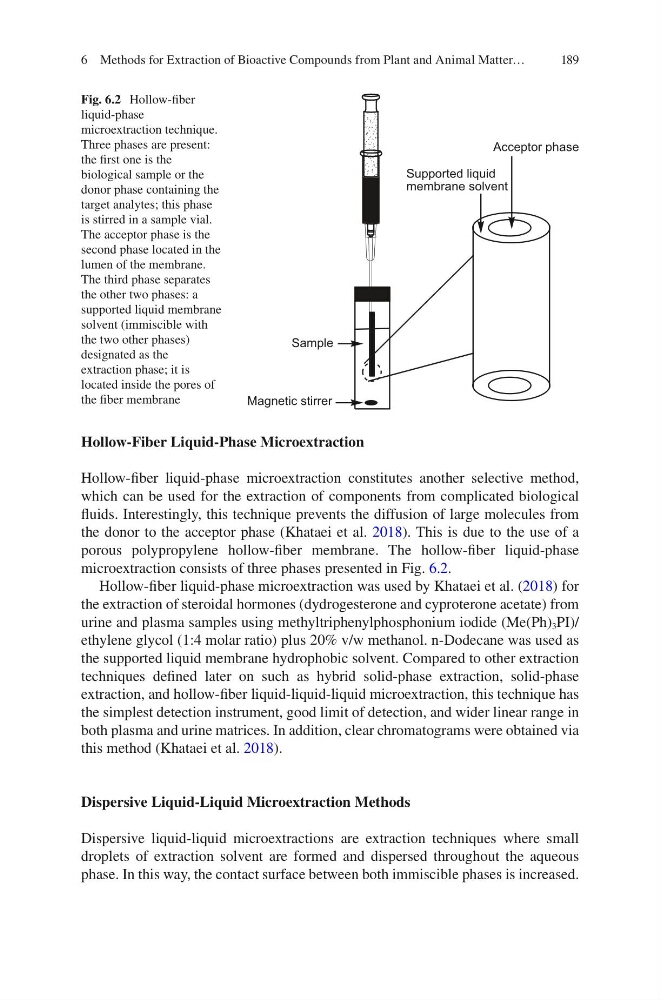
microextraction consists of three phases presented in Fig. 6.2.
Hollow-fiber liquid-phase microextraction was used by Khataei et al. (2018) for
the extraction of steroidal hormones (dydrogesterone and cyproterone acetate) from
urine and plasma samples using methyltriphenylphosphonium iodide (Me(Ph) 3 PI)/
ethylene glycol (1:4 molar ratio) plus 20% v/w methanol. n-Dodecane was used as
the supported liquid membrane hydrophobic solvent. Compared to other extraction
techniques defined later on such as hybrid solid-phase extraction, solid-phase
extraction, and hollow-fiber liquid-liquid-liquid microextraction, this technique has
the simplest detection instrument, good limit of detection, and wider linear range in
both plasma and urine matrices. In addition, clear chromatograms were obtained via
this method (Khataei et al. 2018).
Dispersive Liquid-Liquid Microextraction Methods
Dispersive liquid-liquid microextractions are extraction techniques where small
droplets of extraction solvent are formed and dispersed throughout the aqueous
phase. In this way, the contact surface between both immiscible phases is increased.
Sample
Supported liquid
membrane solvent
Acceptor phase
Magnetic stirrer
Fig. 6.2 Hollow-fiber
liquid-phase
microextraction technique.
Three phases are present:
the first one is the
biological sample or the
donor phase containing the
target analytes; this phase
is stirred in a sample vial.
The acceptor phase is the
second phase located in the
lumen of the membrane.
The third phase separates
the other two phases: a
supported liquid membrane
solvent (immiscible with
the two other phases)
designated as the
extraction phase; it is
located inside the pores of
the fiber membrane
6 Methods for Extraction of Bioactive Compounds from Plant and Animal Matter…
Hollow-Fiber Liquid-Phase Microextraction
Hollow-fiber liquid-phase microextraction constitutes another selective method,
which can be used for the extraction of components from complicated biological
fluids. Interestingly, this technique prevents the diffusion of large molecules from
the donor to the acceptor phase (Khataei et al. 2018). This is due to the use of a
porous polypropylene hollow-fiber membrane. The hollow-fiber liquid-phase
microextraction consists of three phases presented in Fig. 6.2.
Hollow-fiber liquid-phase microextraction was used by Khataei et al. (2018) for
the extraction of steroidal hormones (dydrogesterone and cyproterone acetate) from
urine and plasma samples using methyltriphenylphosphonium iodide (Me(Ph) 3 PI)/
ethylene glycol (1:4 molar ratio) plus 20% v/w methanol. n-Dodecane was used as
the supported liquid membrane hydrophobic solvent. Compared to other extraction
techniques defined later on such as hybrid solid-phase extraction, solid-phase
extraction, and hollow-fiber liquid-liquid-liquid microextraction, this technique has
the simplest detection instrument, good limit of detection, and wider linear range in
both plasma and urine matrices. In addition, clear chromatograms were obtained via
this method (Khataei et al. 2018).
Dispersive Liquid-Liquid Microextraction Methods
Dispersive liquid-liquid microextractions are extraction techniques where small
droplets of extraction solvent are formed and dispersed throughout the aqueous
phase. In this way, the contact surface between both immiscible phases is increased.
Sample
Supported liquid
membrane solvent
Acceptor phase
Magnetic stirrer
Fig. 6.2 Hollow-fiber
liquid-phase
microextraction technique.
Three phases are present:
the first one is the
biological sample or the
donor phase containing the
target analytes; this phase
is stirred in a sample vial.
The acceptor phase is the
second phase located in the
lumen of the membrane.
The third phase separates
the other two phases: a
supported liquid membrane
solvent (immiscible with
the two other phases)
designated as the
extraction phase; it is
located inside the pores of
the fiber membrane
6 Methods for Extraction of Bioactive Compounds from Plant and Animal Matter…