

171
This work follows directly from, and complements, previous exploration of
indate(III) anion extraction using tetraalkylphosphonium carboxylate ionic liquids,
and one aspect of this study was to explore hydrophobic deep eutectic solvents with
lower viscosities than the phosphonium ionic liquids. Although it must be noted that
data available tends to relate to “pure” viscosities rather than those of water- saturated
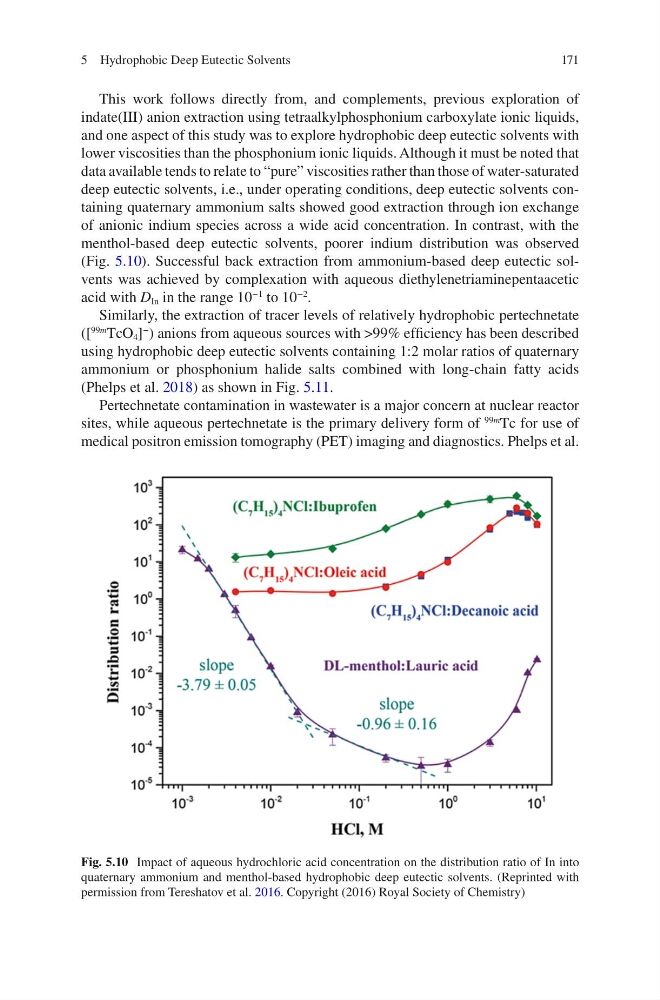
deep eutectic solvents, i.e., under operating conditions, deep eutectic solvents containing quaternary ammonium salts showed good extraction through ion exchange
of anionic indium species across a wide acid concentration. In contrast, with the
menthol-based deep eutectic solvents, poorer indium distribution was observed
(Fig. 5.10). Successful back extraction from ammonium-based deep eutectic solvents was achieved by complexation with aqueous diethylenetriaminepentaacetic
acid with D In in the range 10
−1
to 10
−2
.
Similarly, the extraction of tracer levels of relatively hydrophobic pertechnetate
([
99m
TcO 4 ]
−
) anions from aqueous sources with >99% efficiency has been described
using hydrophobic deep eutectic solvents containing 1:2 molar ratios of quaternary
ammonium or phosphonium halide salts combined with long-chain fatty acids
(Phelps et al. 2018) as shown in Fig. 5.11.
Pertechnetate contamination in wastewater is a major concern at nuclear reactor
sites, while aqueous pertechnetate is the primary delivery form of
99m
Tc for use of
medical positron emission tomography (PET) imaging and diagnostics. Phelps et al.
Fig. 5.10 Impact of aqueous hydrochloric acid concentration on the distribution ratio of In into
quaternary ammonium and menthol-based hydrophobic deep eutectic solvents. (Reprinted with
permission from Tereshatov et al. 2016. Copyright (2016) Royal Society of Chemistry)
5 Hydrophobic Deep Eutectic Solvents
This work follows directly from, and complements, previous exploration of
indate(III) anion extraction using tetraalkylphosphonium carboxylate ionic liquids,
and one aspect of this study was to explore hydrophobic deep eutectic solvents with
lower viscosities than the phosphonium ionic liquids. Although it must be noted that
data available tends to relate to “pure” viscosities rather than those of water- saturated
deep eutectic solvents, i.e., under operating conditions, deep eutectic solvents containing quaternary ammonium salts showed good extraction through ion exchange
of anionic indium species across a wide acid concentration. In contrast, with the
menthol-based deep eutectic solvents, poorer indium distribution was observed
(Fig. 5.10). Successful back extraction from ammonium-based deep eutectic solvents was achieved by complexation with aqueous diethylenetriaminepentaacetic
acid with D In in the range 10
−1
to 10
−2
.
Similarly, the extraction of tracer levels of relatively hydrophobic pertechnetate
([
99m
TcO 4 ]
−
) anions from aqueous sources with >99% efficiency has been described
using hydrophobic deep eutectic solvents containing 1:2 molar ratios of quaternary
ammonium or phosphonium halide salts combined with long-chain fatty acids
(Phelps et al. 2018) as shown in Fig. 5.11.
Pertechnetate contamination in wastewater is a major concern at nuclear reactor
sites, while aqueous pertechnetate is the primary delivery form of
99m
Tc for use of
medical positron emission tomography (PET) imaging and diagnostics. Phelps et al.
Fig. 5.10 Impact of aqueous hydrochloric acid concentration on the distribution ratio of In into
quaternary ammonium and menthol-based hydrophobic deep eutectic solvents. (Reprinted with
permission from Tereshatov et al. 2016. Copyright (2016) Royal Society of Chemistry)
5 Hydrophobic Deep Eutectic Solvents