

170
5.3.2 Extraction of Metals
Extraction of metal species into nonaqueous media usually requires the presence of
either a metal complexing agent or a sacrificial ion exchange component. Both strategies have been used to achieve metal ion partitioning with hydrophobic ionic liquids (Han and Armstrong 2007; Papaiconomou et al. 2008). Although the
performance of ionic liquids with small, hydrophobic, perfluorinated anions (hexafluorophosphate, bistriflimide, etc.) is very good, their hydrolytic instability and/or
very high cost effectively banishes practical uses in most cases. Lower cost ionic
liquids, featuring hydrophobic tetraalkylammonium or tetraalkylphosphonium cations, have been demonstrated to perform well, although practical challenges associated with the high viscosities of these materials still have to be addressed
(Binnemans 2007).
Thus, the objectives in examining metal extraction with hydrophobic deep eutectic solvents are to eliminate the need for fluorous anions and to address some of the
high viscosity characteristics of the typical tetraalkylammonium and phosphonium
ionic liquids.
The first study of metal partitioning with hydrophobic deep eutectic solvents
(Tereshatov et al. 2016) described the extraction of anionic indate(III) species from
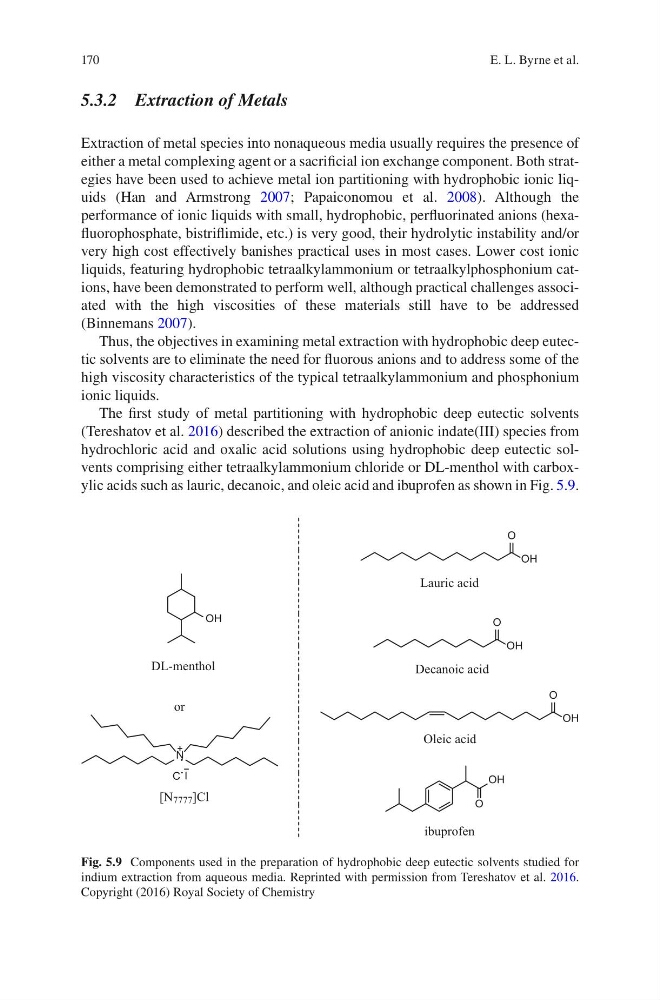
hydrochloric acid and oxalic acid solutions using hydrophobic deep eutectic solvents comprising either tetraalkylammonium chloride or DL-menthol with carboxylic acids such as lauric, decanoic, and oleic acid and ibuprofen as shown in Fig. 5.9.
OH
N
C l
[N 7777 ]Cl
OH
O
OH
O
OH
O
OH
O
or
Lauric acid
Decanoic acid
Oleic acid
ibuprofen
DL-menthol
Fig. 5.9 Components used in the preparation of hydrophobic deep eutectic solvents studied for
indium extraction from aqueous media. Reprinted with permission from Tereshatov et al. 2016.
Copyright (2016) Royal Society of Chemistry
E. L. Byrne et al.
5.3.2 Extraction of Metals
Extraction of metal species into nonaqueous media usually requires the presence of
either a metal complexing agent or a sacrificial ion exchange component. Both strategies have been used to achieve metal ion partitioning with hydrophobic ionic liquids (Han and Armstrong 2007; Papaiconomou et al. 2008). Although the
performance of ionic liquids with small, hydrophobic, perfluorinated anions (hexafluorophosphate, bistriflimide, etc.) is very good, their hydrolytic instability and/or
very high cost effectively banishes practical uses in most cases. Lower cost ionic
liquids, featuring hydrophobic tetraalkylammonium or tetraalkylphosphonium cations, have been demonstrated to perform well, although practical challenges associated with the high viscosities of these materials still have to be addressed
(Binnemans 2007).
Thus, the objectives in examining metal extraction with hydrophobic deep eutectic solvents are to eliminate the need for fluorous anions and to address some of the
high viscosity characteristics of the typical tetraalkylammonium and phosphonium
ionic liquids.
The first study of metal partitioning with hydrophobic deep eutectic solvents
(Tereshatov et al. 2016) described the extraction of anionic indate(III) species from
hydrochloric acid and oxalic acid solutions using hydrophobic deep eutectic solvents comprising either tetraalkylammonium chloride or DL-menthol with carboxylic acids such as lauric, decanoic, and oleic acid and ibuprofen as shown in Fig. 5.9.
OH
N
C l
[N 7777 ]Cl
OH
O
OH
O
OH
O
OH
O
or
Lauric acid
Decanoic acid
Oleic acid
ibuprofen
DL-menthol
Fig. 5.9 Components used in the preparation of hydrophobic deep eutectic solvents studied for
indium extraction from aqueous media. Reprinted with permission from Tereshatov et al. 2016.
Copyright (2016) Royal Society of Chemistry
E. L. Byrne et al.