

169
extraction capability of deep eutectic solvent compared to trioctylphosphine oxide
in a hydrocarbon diluent was attributed to reduced accessibility of trioctylphosphine
oxide due to competitive hydrogen bonding with the N,N-dihexylthiourea component. However, given that urea-carboxylic acid hydrogen bonding is also a key
molecular recognition process, it is possible that other competing factors must come
into play (Jones et al. 2014).
Finally, deep eutectic solvents based on mixed long-chain carboxylic acid
(Florindo et al. 2018a, b) have been examined for removal of bisphenol A, a common water micropollutant, from a water feed. Binary mixtures of dodecanoic acid
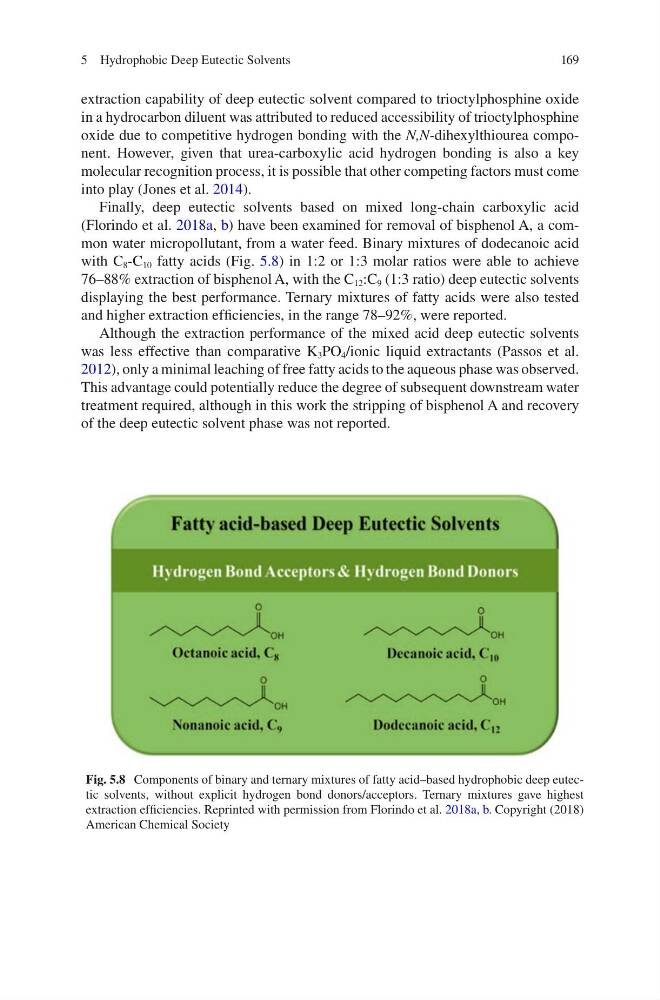
with C 8 -C 10 fatty acids (Fig. 5.8) in 1:2 or 1:3 molar ratios were able to achieve
76–88% extraction of bisphenol A, with the C 12 :C 9 (1:3 ratio) deep eutectic solvents
displaying the best performance. Ternary mixtures of fatty acids were also tested
and higher extraction efficiencies, in the range 78–92%, were reported.
Although the extraction performance of the mixed acid deep eutectic solvents
was less effective than comparative K 3 PO 4 /ionic liquid extractants (Passos et al.
2012), only a minimal leaching of free fatty acids to the aqueous phase was observed.
This advantage could potentially reduce the degree of subsequent downstream water
treatment required, although in this work the stripping of bisphenol A and recovery
of the deep eutectic solvent phase was not reported.
Fig. 5.8 Components of binary and ternary mixtures of fatty acid–based hydrophobic deep eutectic solvents, without explicit hydrogen bond donors/acceptors. Ternary mixtures gave highest
extraction efficiencies. Reprinted with permission from Florindo et al. 2018a, b. Copyright (2018)
American Chemical Society
5 Hydrophobic Deep Eutectic Solvents
extraction capability of deep eutectic solvent compared to trioctylphosphine oxide
in a hydrocarbon diluent was attributed to reduced accessibility of trioctylphosphine
oxide due to competitive hydrogen bonding with the N,N-dihexylthiourea component. However, given that urea-carboxylic acid hydrogen bonding is also a key
molecular recognition process, it is possible that other competing factors must come
into play (Jones et al. 2014).
Finally, deep eutectic solvents based on mixed long-chain carboxylic acid
(Florindo et al. 2018a, b) have been examined for removal of bisphenol A, a common water micropollutant, from a water feed. Binary mixtures of dodecanoic acid
with C 8 -C 10 fatty acids (Fig. 5.8) in 1:2 or 1:3 molar ratios were able to achieve
76–88% extraction of bisphenol A, with the C 12 :C 9 (1:3 ratio) deep eutectic solvents
displaying the best performance. Ternary mixtures of fatty acids were also tested
and higher extraction efficiencies, in the range 78–92%, were reported.
Although the extraction performance of the mixed acid deep eutectic solvents
was less effective than comparative K 3 PO 4 /ionic liquid extractants (Passos et al.
2012), only a minimal leaching of free fatty acids to the aqueous phase was observed.
This advantage could potentially reduce the degree of subsequent downstream water
treatment required, although in this work the stripping of bisphenol A and recovery
of the deep eutectic solvent phase was not reported.
Fig. 5.8 Components of binary and ternary mixtures of fatty acid–based hydrophobic deep eutectic solvents, without explicit hydrogen bond donors/acceptors. Ternary mixtures gave highest
extraction efficiencies. Reprinted with permission from Florindo et al. 2018a, b. Copyright (2018)
American Chemical Society
5 Hydrophobic Deep Eutectic Solvents