

166
alcohols. Molecular dynamics simulations demonstrated that menthol has a much
greater role as an active extractant than the carboxylic component. A flow system
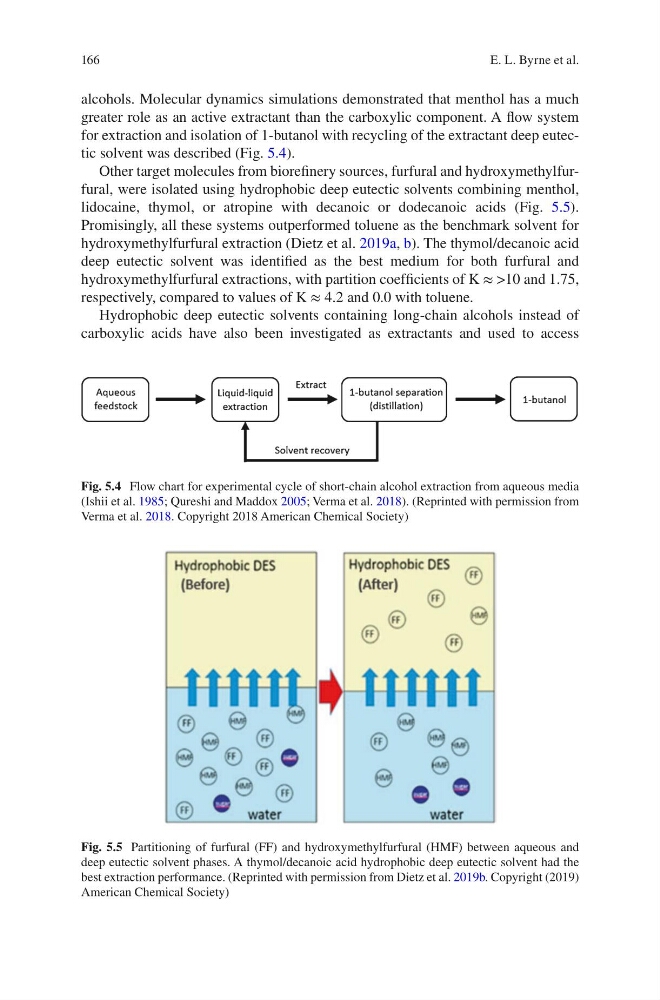
for extraction and isolation of 1-butanol with recycling of the extractant deep eutectic solvent was described (Fig. 5.4).
Other target molecules from biorefinery sources, furfural and hydroxymethylfurfural, were isolated using hydrophobic deep eutectic solvents combining menthol,
lidocaine, thymol, or atropine with decanoic or dodecanoic acids (Fig. 5.5).
Promisingly, all these systems outperformed toluene as the benchmark solvent for
hydroxymethylfurfural extraction (Dietz et al. 2019a, b). The thymol/decanoic acid
deep eutectic solvent was identified as the best medium for both furfural and
hydroxymethylfurfural extractions, with partition coefficients of K ≈ >10 and 1.75,
respectively, compared to values of K ≈ 4.2 and 0.0 with toluene.
Hydrophobic deep eutectic solvents containing long-chain alcohols instead of
carboxylic acids have also been investigated as extractants and used to access
Fig. 5.4 Flow chart for experimental cycle of short-chain alcohol extraction from aqueous media
(Ishii et al. 1985; Qureshi and Maddox 2005; Verma et al. 2018). (Reprinted with permission from
Verma et al. 2018. Copyright 2018 American Chemical Society)
Fig. 5.5 Partitioning of furfural (FF) and hydroxymethylfurfural (HMF) between aqueous and
deep eutectic solvent phases. A thymol/decanoic acid hydrophobic deep eutectic solvent had the
best extraction performance. (Reprinted with permission from Dietz et al. 2019b. Copyright (2019)
American Chemical Society)
E. L. Byrne et al.
alcohols. Molecular dynamics simulations demonstrated that menthol has a much
greater role as an active extractant than the carboxylic component. A flow system
for extraction and isolation of 1-butanol with recycling of the extractant deep eutectic solvent was described (Fig. 5.4).
Other target molecules from biorefinery sources, furfural and hydroxymethylfurfural, were isolated using hydrophobic deep eutectic solvents combining menthol,
lidocaine, thymol, or atropine with decanoic or dodecanoic acids (Fig. 5.5).
Promisingly, all these systems outperformed toluene as the benchmark solvent for
hydroxymethylfurfural extraction (Dietz et al. 2019a, b). The thymol/decanoic acid
deep eutectic solvent was identified as the best medium for both furfural and
hydroxymethylfurfural extractions, with partition coefficients of K ≈ >10 and 1.75,
respectively, compared to values of K ≈ 4.2 and 0.0 with toluene.
Hydrophobic deep eutectic solvents containing long-chain alcohols instead of
carboxylic acids have also been investigated as extractants and used to access
Fig. 5.4 Flow chart for experimental cycle of short-chain alcohol extraction from aqueous media
(Ishii et al. 1985; Qureshi and Maddox 2005; Verma et al. 2018). (Reprinted with permission from
Verma et al. 2018. Copyright 2018 American Chemical Society)
Fig. 5.5 Partitioning of furfural (FF) and hydroxymethylfurfural (HMF) between aqueous and
deep eutectic solvent phases. A thymol/decanoic acid hydrophobic deep eutectic solvent had the
best extraction performance. (Reprinted with permission from Dietz et al. 2019b. Copyright (2019)
American Chemical Society)
E. L. Byrne et al.