

167
bioactive compounds from biomass (Cao et al. 2017a, b, 2018; de Faria et al. 2017)
and to extract pesticides (e.g., neonicotinoids) known to have harmful effect on bee
populations (Florindo et al. 2017). Some encouraging results were reported, such as
the extraction of an antimalarial agent, artemisinin, from sweet wormwood leaves
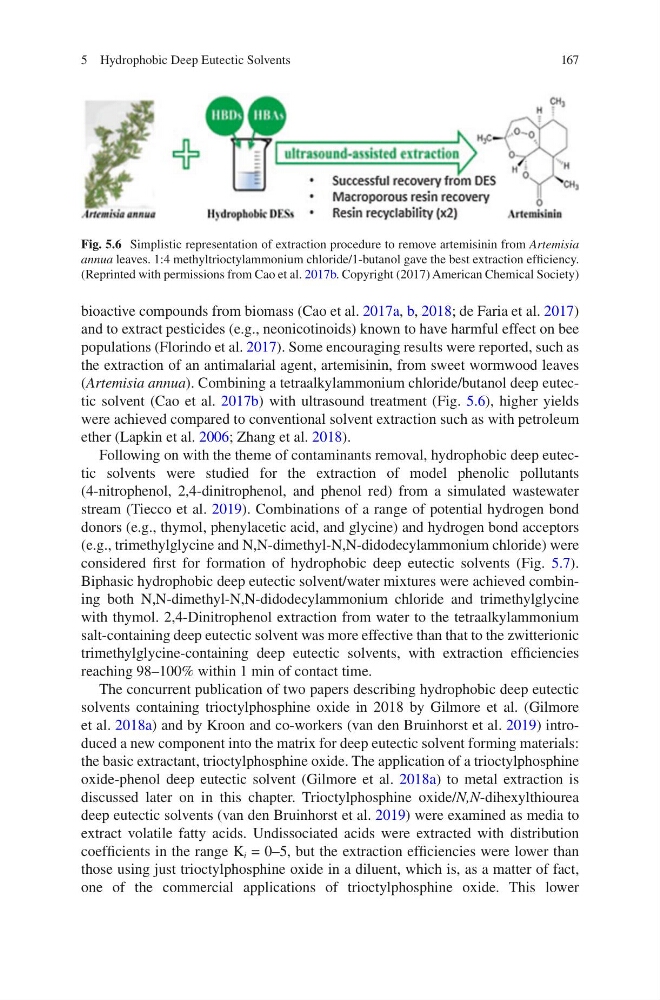
(Artemisia annua). Combining a tetraalkylammonium chloride/butanol deep eutectic solvent (Cao et al. 2017b) with ultrasound treatment (Fig. 5.6), higher yields
were achieved compared to conventional solvent extraction such as with petroleum
ether (Lapkin et al. 2006; Zhang et al. 2018).
Following on with the theme of contaminants removal, hydrophobic deep eutectic solvents were studied for the extraction of model phenolic pollutants
(4- nitrophenol, 2,4-dinitrophenol, and phenol red) from a simulated wastewater
stream (Tiecco et al. 2019). Combinations of a range of potential hydrogen bond
donors (e.g., thymol, phenylacetic acid, and glycine) and hydrogen bond acceptors
(e.g., trimethylglycine and N,N-dimethyl-N,N-didodecylammonium chloride) were
considered first for formation of hydrophobic deep eutectic solvents (Fig. 5.7).
Biphasic hydrophobic deep eutectic solvent/water mixtures were achieved combining both N,N-dimethyl-N,N-didodecylammonium chloride and trimethylglycine
with thymol. 2,4-Dinitrophenol extraction from water to the tetraalkylammonium
salt-containing deep eutectic solvent was more effective than that to the zwitterionic
trimethylglycine-containing deep eutectic solvents, with extraction efficiencies
reaching 98–100% within 1 min of contact time.
The concurrent publication of two papers describing hydrophobic deep eutectic
solvents containing trioctylphosphine oxide in 2018 by Gilmore et al. (Gilmore
et al. 2018a) and by Kroon and co-workers (van den Bruinhorst et al. 2019) introduced a new component into the matrix for deep eutectic solvent forming materials:
the basic extractant, trioctylphosphine oxide. The application of a trioctylphosphine
oxide-phenol deep eutectic solvent (Gilmore et al. 2018a) to metal extraction is
discussed later on in this chapter. Trioctylphosphine oxide/N,N-dihexylthiourea
deep eutectic solvents (van den Bruinhorst et al. 2019) were examined as media to
extract volatile fatty acids. Undissociated acids were extracted with distribution
coefficients in the range K i = 0–5, but the extraction efficiencies were lower than
those using just trioctylphosphine oxide in a diluent, which is, as a matter of fact,
one of the commercial applications of trioctylphosphine oxide. This lower
Fig. 5.6 Simplistic representation of extraction procedure to remove artemisinin from Artemisia
annua leaves. 1:4 methyltrioctylammonium chloride/1-butanol gave the best extraction efficiency.
(Reprinted with permissions from Cao et al. 2017b. Copyright (2017) American Chemical Society)
5 Hydrophobic Deep Eutectic Solvents
bioactive compounds from biomass (Cao et al. 2017a, b, 2018; de Faria et al. 2017)
and to extract pesticides (e.g., neonicotinoids) known to have harmful effect on bee
populations (Florindo et al. 2017). Some encouraging results were reported, such as
the extraction of an antimalarial agent, artemisinin, from sweet wormwood leaves
(Artemisia annua). Combining a tetraalkylammonium chloride/butanol deep eutectic solvent (Cao et al. 2017b) with ultrasound treatment (Fig. 5.6), higher yields
were achieved compared to conventional solvent extraction such as with petroleum
ether (Lapkin et al. 2006; Zhang et al. 2018).
Following on with the theme of contaminants removal, hydrophobic deep eutectic solvents were studied for the extraction of model phenolic pollutants
(4- nitrophenol, 2,4-dinitrophenol, and phenol red) from a simulated wastewater
stream (Tiecco et al. 2019). Combinations of a range of potential hydrogen bond
donors (e.g., thymol, phenylacetic acid, and glycine) and hydrogen bond acceptors
(e.g., trimethylglycine and N,N-dimethyl-N,N-didodecylammonium chloride) were
considered first for formation of hydrophobic deep eutectic solvents (Fig. 5.7).
Biphasic hydrophobic deep eutectic solvent/water mixtures were achieved combining both N,N-dimethyl-N,N-didodecylammonium chloride and trimethylglycine
with thymol. 2,4-Dinitrophenol extraction from water to the tetraalkylammonium
salt-containing deep eutectic solvent was more effective than that to the zwitterionic
trimethylglycine-containing deep eutectic solvents, with extraction efficiencies
reaching 98–100% within 1 min of contact time.
The concurrent publication of two papers describing hydrophobic deep eutectic
solvents containing trioctylphosphine oxide in 2018 by Gilmore et al. (Gilmore
et al. 2018a) and by Kroon and co-workers (van den Bruinhorst et al. 2019) introduced a new component into the matrix for deep eutectic solvent forming materials:
the basic extractant, trioctylphosphine oxide. The application of a trioctylphosphine
oxide-phenol deep eutectic solvent (Gilmore et al. 2018a) to metal extraction is
discussed later on in this chapter. Trioctylphosphine oxide/N,N-dihexylthiourea
deep eutectic solvents (van den Bruinhorst et al. 2019) were examined as media to
extract volatile fatty acids. Undissociated acids were extracted with distribution
coefficients in the range K i = 0–5, but the extraction efficiencies were lower than
those using just trioctylphosphine oxide in a diluent, which is, as a matter of fact,
one of the commercial applications of trioctylphosphine oxide. This lower
Fig. 5.6 Simplistic representation of extraction procedure to remove artemisinin from Artemisia
annua leaves. 1:4 methyltrioctylammonium chloride/1-butanol gave the best extraction efficiency.
(Reprinted with permissions from Cao et al. 2017b. Copyright (2017) American Chemical Society)
5 Hydrophobic Deep Eutectic Solvents