

150
4.4 Conclusions
This chapter reviews the published studies of gas absorption in deep eutectic solvents. The bibliographic research covers publications available up to the 3rd of June
2019 and their references. The publications considered for this review were selected
from a mix and match of the keywords: gas, eutectic, low melting mixture, carbon
dioxide, ethane, ethylene, propane, propene, propylene, acetylene, propyne, methylacetylene, olefin, paraffin, carbon monoxide, oxygen, hydrogen, hydrogen sulfide, ammonia, nitric oxide, nitrogen, sulfur dioxide, N 2 , SO 2 , CO 2 , and solubility.
A huge variety in the behavior of the mixtures was identified from the analysis of
87 different eutectic mixtures with 10 different gases. The gas solubility, expressed
as Henry’s law coefficient, varies up to four orders of magnitude. This is surely the
result of the difference in interactions between the gases and the eutectic mixtures.
Amongst the reviewed works, there are without question some reactive mixtures
where the gas reacts chemically with one or both of the components of the eutectic
mixture; however, it was decided to report the gas absorption identically as in the
original papers, even if this means that the concept of Henry’s law constant is not
applicable. Another reason for the wide extent of the gas absorption values reported
might be the presence of non-accounted impurities present in the eutectic mixture.
It is known that a large number of components used for deep eutectic solvents are
hygroscopic, and that water acts as a third component in the mixtures, changing the
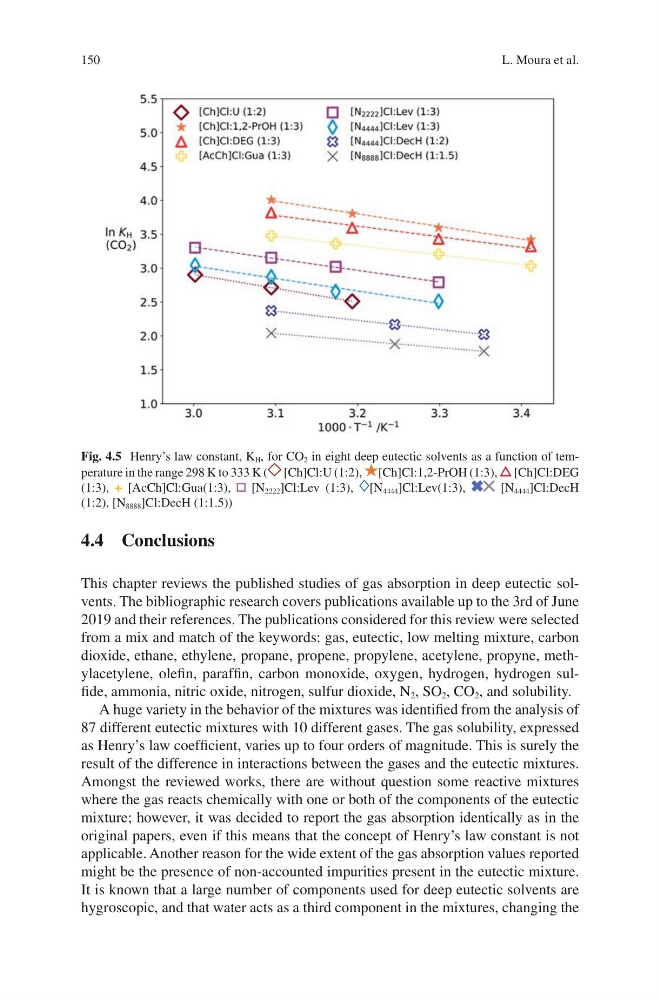
Fig. 4.5 Henry’s law constant, K H , for CO 2 in eight deep eutectic solvents as a function of temperature in the range 298 K to 333 K ( [Ch]Cl:U (1:2), [Ch]Cl:1,2-PrOH (1:3), [Ch]Cl:DEG
(1:3), [AcCh]Cl:Gua(1:3),
[N 2222 ]Cl:Lev (1:3), [N 4444 ]Cl:Lev(1:3),
[N 4444 ]Cl:DecH
(1:2), [N 8888 ]Cl:DecH (1:1.5))
L. Moura et al.
4.4 Conclusions
This chapter reviews the published studies of gas absorption in deep eutectic solvents. The bibliographic research covers publications available up to the 3rd of June
2019 and their references. The publications considered for this review were selected
from a mix and match of the keywords: gas, eutectic, low melting mixture, carbon
dioxide, ethane, ethylene, propane, propene, propylene, acetylene, propyne, methylacetylene, olefin, paraffin, carbon monoxide, oxygen, hydrogen, hydrogen sulfide, ammonia, nitric oxide, nitrogen, sulfur dioxide, N 2 , SO 2 , CO 2 , and solubility.
A huge variety in the behavior of the mixtures was identified from the analysis of
87 different eutectic mixtures with 10 different gases. The gas solubility, expressed
as Henry’s law coefficient, varies up to four orders of magnitude. This is surely the
result of the difference in interactions between the gases and the eutectic mixtures.
Amongst the reviewed works, there are without question some reactive mixtures
where the gas reacts chemically with one or both of the components of the eutectic
mixture; however, it was decided to report the gas absorption identically as in the
original papers, even if this means that the concept of Henry’s law constant is not
applicable. Another reason for the wide extent of the gas absorption values reported
might be the presence of non-accounted impurities present in the eutectic mixture.
It is known that a large number of components used for deep eutectic solvents are
hygroscopic, and that water acts as a third component in the mixtures, changing the
Fig. 4.5 Henry’s law constant, K H , for CO 2 in eight deep eutectic solvents as a function of temperature in the range 298 K to 333 K ( [Ch]Cl:U (1:2), [Ch]Cl:1,2-PrOH (1:3), [Ch]Cl:DEG
(1:3), [AcCh]Cl:Gua(1:3),
[N 2222 ]Cl:Lev (1:3), [N 4444 ]Cl:Lev(1:3),
[N 4444 ]Cl:DecH
(1:2), [N 8888 ]Cl:DecH (1:1.5))
L. Moura et al.