

149
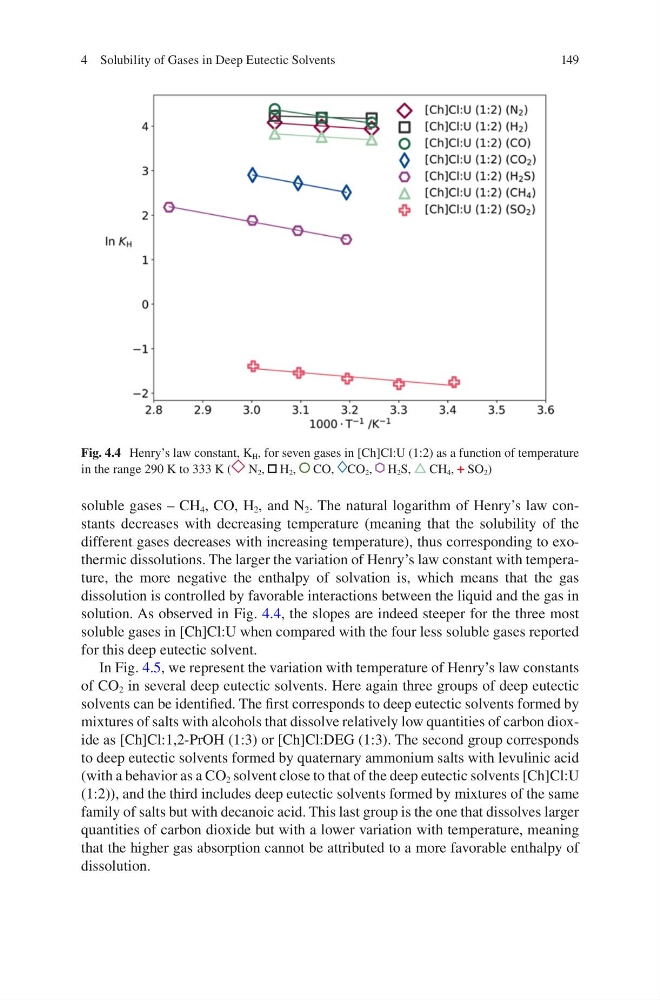
soluble gases – CH 4 , CO, H 2 , and N 2 . The natural logarithm of Henry’s law constants decreases with decreasing temperature (meaning that the solubility of the
different gases decreases with increasing temperature), thus corresponding to exothermic dissolutions. The larger the variation of Henry’s law constant with temperature, the more negative the enthalpy of solvation is, which means that the gas
dissolution is controlled by favorable interactions between the liquid and the gas in
solution. As observed in Fig. 4.4, the slopes are indeed steeper for the three most
soluble gases in [Ch]Cl:U when compared with the four less soluble gases reported
for this deep eutectic solvent.
In Fig. 4.5, we represent the variation with temperature of Henry’s law constants
of CO 2 in several deep eutectic solvents. Here again three groups of deep eutectic
solvents can be identified. The first corresponds to deep eutectic solvents formed by
mixtures of salts with alcohols that dissolve relatively low quantities of carbon dioxide as [Ch]Cl:1,2-PrOH (1:3) or [Ch]Cl:DEG (1:3). The second group corresponds
to deep eutectic solvents formed by quaternary ammonium salts with levulinic acid
(with a behavior as a CO 2 solvent close to that of the deep eutectic solvents [Ch]Cl:U
(1:2)), and the third includes deep eutectic solvents formed by mixtures of the same
family of salts but with decanoic acid. This last group is the one that dissolves larger
quantities of carbon dioxide but with a lower variation with temperature, meaning
that the higher gas absorption cannot be attributed to a more favorable enthalpy of
dissolution.
Fig. 4.4 Henry’s law constant, K H , for seven gases in [Ch]Cl:U (1:2) as a function of temperature
in the range 290 K to 333 K ( N 2 , H 2 , CO, CO 2 , H 2 S, CH 4 , SO 2 )
4 Solubility of Gases in Deep Eutectic Solvents
soluble gases – CH 4 , CO, H 2 , and N 2 . The natural logarithm of Henry’s law constants decreases with decreasing temperature (meaning that the solubility of the
different gases decreases with increasing temperature), thus corresponding to exothermic dissolutions. The larger the variation of Henry’s law constant with temperature, the more negative the enthalpy of solvation is, which means that the gas
dissolution is controlled by favorable interactions between the liquid and the gas in
solution. As observed in Fig. 4.4, the slopes are indeed steeper for the three most
soluble gases in [Ch]Cl:U when compared with the four less soluble gases reported
for this deep eutectic solvent.
In Fig. 4.5, we represent the variation with temperature of Henry’s law constants
of CO 2 in several deep eutectic solvents. Here again three groups of deep eutectic
solvents can be identified. The first corresponds to deep eutectic solvents formed by
mixtures of salts with alcohols that dissolve relatively low quantities of carbon dioxide as [Ch]Cl:1,2-PrOH (1:3) or [Ch]Cl:DEG (1:3). The second group corresponds
to deep eutectic solvents formed by quaternary ammonium salts with levulinic acid
(with a behavior as a CO 2 solvent close to that of the deep eutectic solvents [Ch]Cl:U
(1:2)), and the third includes deep eutectic solvents formed by mixtures of the same
family of salts but with decanoic acid. This last group is the one that dissolves larger
quantities of carbon dioxide but with a lower variation with temperature, meaning
that the higher gas absorption cannot be attributed to a more favorable enthalpy of
dissolution.
Fig. 4.4 Henry’s law constant, K H , for seven gases in [Ch]Cl:U (1:2) as a function of temperature
in the range 290 K to 333 K ( N 2 , H 2 , CO, CO 2 , H 2 S, CH 4 , SO 2 )
4 Solubility of Gases in Deep Eutectic Solvents