

Relativistic Quantum Chemistry and Spectroscopy of Kaonic Atomic Systems …
41
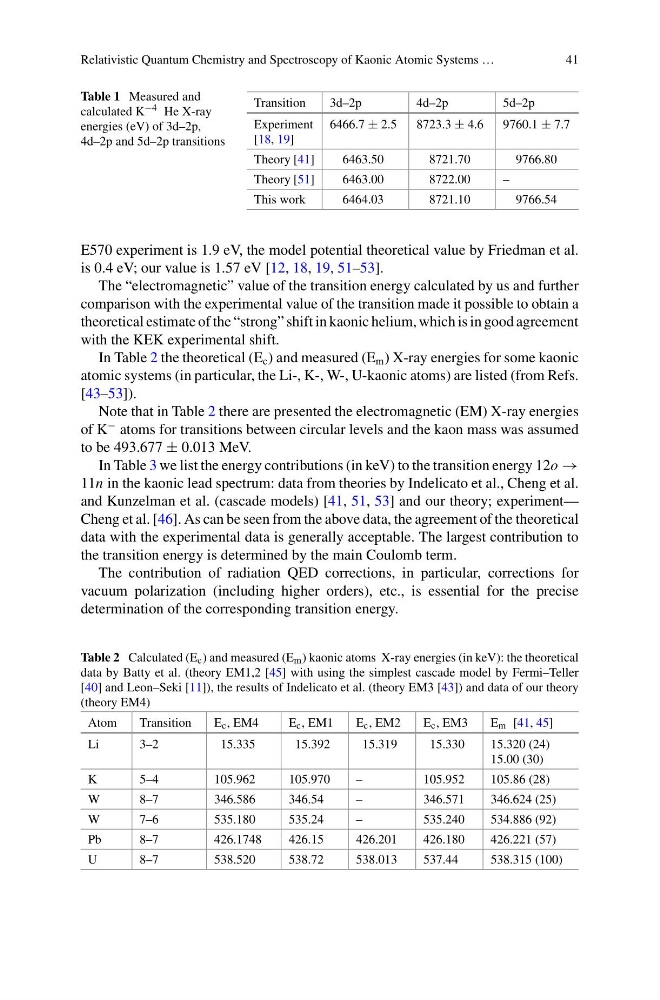
Table 1 Measured and
calculated K −4 He X-ray
energies (eV) of 3d–2p,
4d–2p and 5d–2p transitions
Transition
3d–2p
4d–2p
5d–2p
Experiment
[18, 19]
6466.7 ± 2.5
8723.3 ± 4.6
9760.1 ± 7.7
Theory [41]
6463.50
8721.70
9766.80
Theory [51]
6463.00
8722.00
–
This work
6464.03
8721.10
9766.54
E570 experiment is 1.9 eV, the model potential theoretical value by Friedman et al.
is 0.4 eV; our value is 1.57 eV [12, 18, 19, 51–53].
The “electromagnetic” value of the transition energy calculated by us and further
comparison with the experimental value of the transition made it possible to obtain a
theoretical estimate of the “strong” shift in kaonic helium, which is in good agreement
with the KEK experimental shift.
In Table 2 the theoretical (E c ) and measured (E m ) X-ray energies for some kaonic
atomic systems (in particular, the Li-, K-, W-, U-kaonic atoms) are listed (from Refs.
[43–53]).
Note that in Table 2 there are presented the electromagnetic (EM) X-ray energies
of K
− atoms for transitions between circular levels and the kaon mass was assumed
to be 493.677 ± 0.013 MeV.
In Table 3 we list the energy contributions (in keV) to the transition energy 12o →
11n in the kaonic lead spectrum: data from theories by Indelicato et al., Cheng et al.
and Kunzelman et al. (cascade models) [41, 51, 53] and our theory; experiment—
Cheng et al. [46]. As can be seen from the above data, the agreement of the theoretical
data with the experimental data is generally acceptable. The largest contribution to
the transition energy is determined by the main Coulomb term.
The contribution of radiation QED corrections, in particular, corrections for
vacuum polarization (including higher orders), etc., is essential for the precise
determination of the corresponding transition energy.
Table 2 Calculated (E c ) and measured (E m ) kaonic atoms X-ray energies (in keV): the theoretical
data by Batty et al. (theory EM1,2 [45] with using the simplest cascade model by Fermi–Teller
[40] and Leon–Seki [11]), the results of Indelicato et al. (theory EM3 [43]) and data of our theory
(theory EM4)
Atom
Transition
E c , EM4
E c , EM1
E c , EM2
E c , EM3
E m [41, 45]
Li
3–2
15.335
15.392
15.319
15.330
15.320 (24)
15.00 (30)
K
5–4
105.962
105.970
–
105.952
105.86 (28)
W
8–7
346.586
346.54
–
346.571
346.624 (25)
W
7–6
535.180
535.24
–
535.240
534.886 (92)
Pb
8–7
426.1748
426.15
426.201
426.180
426.221 (57)
U
8–7
538.520
538.72
538.013
537.44
538.315 (100)
41
Table 1 Measured and
calculated K −4 He X-ray
energies (eV) of 3d–2p,
4d–2p and 5d–2p transitions
Transition
3d–2p
4d–2p
5d–2p
Experiment
[18, 19]
6466.7 ± 2.5
8723.3 ± 4.6
9760.1 ± 7.7
Theory [41]
6463.50
8721.70
9766.80
Theory [51]
6463.00
8722.00
–
This work
6464.03
8721.10
9766.54
E570 experiment is 1.9 eV, the model potential theoretical value by Friedman et al.
is 0.4 eV; our value is 1.57 eV [12, 18, 19, 51–53].
The “electromagnetic” value of the transition energy calculated by us and further
comparison with the experimental value of the transition made it possible to obtain a
theoretical estimate of the “strong” shift in kaonic helium, which is in good agreement
with the KEK experimental shift.
In Table 2 the theoretical (E c ) and measured (E m ) X-ray energies for some kaonic
atomic systems (in particular, the Li-, K-, W-, U-kaonic atoms) are listed (from Refs.
[43–53]).
Note that in Table 2 there are presented the electromagnetic (EM) X-ray energies
of K
− atoms for transitions between circular levels and the kaon mass was assumed
to be 493.677 ± 0.013 MeV.
In Table 3 we list the energy contributions (in keV) to the transition energy 12o →
11n in the kaonic lead spectrum: data from theories by Indelicato et al., Cheng et al.
and Kunzelman et al. (cascade models) [41, 51, 53] and our theory; experiment—
Cheng et al. [46]. As can be seen from the above data, the agreement of the theoretical
data with the experimental data is generally acceptable. The largest contribution to
the transition energy is determined by the main Coulomb term.
The contribution of radiation QED corrections, in particular, corrections for
vacuum polarization (including higher orders), etc., is essential for the precise
determination of the corresponding transition energy.
Table 2 Calculated (E c ) and measured (E m ) kaonic atoms X-ray energies (in keV): the theoretical
data by Batty et al. (theory EM1,2 [45] with using the simplest cascade model by Fermi–Teller
[40] and Leon–Seki [11]), the results of Indelicato et al. (theory EM3 [43]) and data of our theory
(theory EM4)
Atom
Transition
E c , EM4
E c , EM1
E c , EM2
E c , EM3
E m [41, 45]
Li
3–2
15.335
15.392
15.319
15.330
15.320 (24)
15.00 (30)
K
5–4
105.962
105.970
–
105.952
105.86 (28)
W
8–7
346.586
346.54
–
346.571
346.624 (25)
W
7–6
535.180
535.24
–
535.240
534.886 (92)
Pb
8–7
426.1748
426.15
426.201
426.180
426.221 (57)
U
8–7
538.520
538.72
538.013
537.44
538.315 (100)