

40
O. Yu. Khetselius et al.
shift, provided by the strong interaction V N , E QED is the correction due to the QED
effects (vacuum-polarization effect), E other —other corrections.
A direct estimate of a shift of the energy levels in a kaonic atom, due to the strong
kaon-nucleus interaction, can be obtained from the relation:
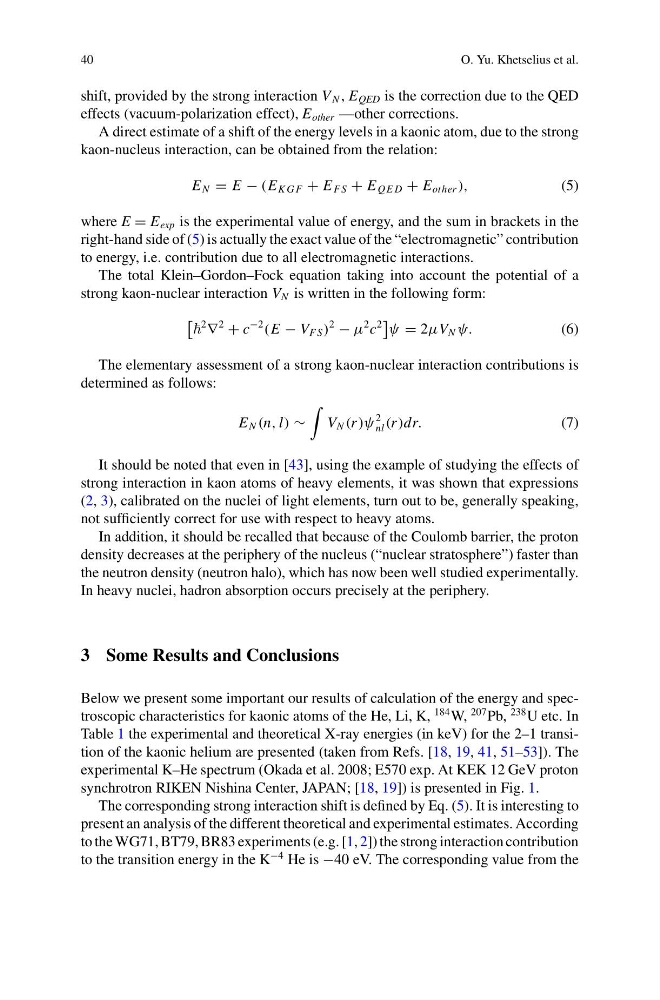
E N = E − (E K G F + E F S + E Q E D + E other ),
(5)
where E = E exp is the experimental value of energy, and the sum in brackets in the
right-hand side of (5) is actually the exact value of the “electromagnetic” contribution
to energy, i.e. contribution due to all electromagnetic interactions.
The total Klein–Gordon–Fock equation taking into account the potential of a
strong kaon-nuclear interaction V N is written in the following form:
2
∇
2
+ c
−2
(E − V F S )
2
− μ
2 c
2
ψ = 2μV N ψ.
(6)
The elementary assessment of a strong kaon-nuclear interaction contributions is
determined as follows:
E N (n, l) ∼
V N (r )ψ
2
nl (r )dr.
(7)
It should be noted that even in [43], using the example of studying the effects of
strong interaction in kaon atoms of heavy elements, it was shown that expressions
(2, 3), calibrated on the nuclei of light elements, turn out to be, generally speaking,
not sufficiently correct for use with respect to heavy atoms.
In addition, it should be recalled that because of the Coulomb barrier, the proton
density decreases at the periphery of the nucleus (“nuclear stratosphere”) faster than
the neutron density (neutron halo), which has now been well studied experimentally.
In heavy nuclei, hadron absorption occurs precisely at the periphery.
3 Some Results and Conclusions
Below we present some important our results of calculation of the energy and spectroscopic characteristics for kaonic atoms of the He, Li, K,
184 W,
207 Pb,
238 U etc. In
Table 1 the experimental and theoretical X-ray energies (in keV) for the 2–1 transition of the kaonic helium are presented (taken from Refs. [18, 19, 41, 51–53]). The
experimental K–He spectrum (Okada et al. 2008; E570 exp. At KEK 12 GeV proton
synchrotron RIKEN Nishina Center, JAPAN; [18, 19]) is presented in Fig. 1.
The corresponding strong interaction shift is defined by Eq. (5). It is interesting to
present an analysis of the different theoretical and experimental estimates. According
to the WG71, BT79, BR83 experiments (e.g. [1, 2]) the strong interaction contribution
to the transition energy in the K
−4 He is −40 eV. The corresponding value from the
O. Yu. Khetselius et al.
shift, provided by the strong interaction V N , E QED is the correction due to the QED
effects (vacuum-polarization effect), E other —other corrections.
A direct estimate of a shift of the energy levels in a kaonic atom, due to the strong
kaon-nucleus interaction, can be obtained from the relation:
E N = E − (E K G F + E F S + E Q E D + E other ),
(5)
where E = E exp is the experimental value of energy, and the sum in brackets in the
right-hand side of (5) is actually the exact value of the “electromagnetic” contribution
to energy, i.e. contribution due to all electromagnetic interactions.
The total Klein–Gordon–Fock equation taking into account the potential of a
strong kaon-nuclear interaction V N is written in the following form:
2
∇
2
+ c
−2
(E − V F S )
2
− μ
2 c
2
ψ = 2μV N ψ.
(6)
The elementary assessment of a strong kaon-nuclear interaction contributions is
determined as follows:
E N (n, l) ∼
V N (r )ψ
2
nl (r )dr.
(7)
It should be noted that even in [43], using the example of studying the effects of
strong interaction in kaon atoms of heavy elements, it was shown that expressions
(2, 3), calibrated on the nuclei of light elements, turn out to be, generally speaking,
not sufficiently correct for use with respect to heavy atoms.
In addition, it should be recalled that because of the Coulomb barrier, the proton
density decreases at the periphery of the nucleus (“nuclear stratosphere”) faster than
the neutron density (neutron halo), which has now been well studied experimentally.
In heavy nuclei, hadron absorption occurs precisely at the periphery.
3 Some Results and Conclusions
Below we present some important our results of calculation of the energy and spectroscopic characteristics for kaonic atoms of the He, Li, K,
184 W,
207 Pb,
238 U etc. In
Table 1 the experimental and theoretical X-ray energies (in keV) for the 2–1 transition of the kaonic helium are presented (taken from Refs. [18, 19, 41, 51–53]). The
experimental K–He spectrum (Okada et al. 2008; E570 exp. At KEK 12 GeV proton
synchrotron RIKEN Nishina Center, JAPAN; [18, 19]) is presented in Fig. 1.
The corresponding strong interaction shift is defined by Eq. (5). It is interesting to
present an analysis of the different theoretical and experimental estimates. According
to the WG71, BT79, BR83 experiments (e.g. [1, 2]) the strong interaction contribution
to the transition energy in the K
−4 He is −40 eV. The corresponding value from the