

Relativistic Quantum Chemistry and Spectroscopy of Kaonic Atomic Systems …
39
2.2 Strong Interactions in Kaonic Atomic System
The most difficult aspect of the problem is an adequate accounting for the strong
kaon-nuclear interaction in the exotic system. Now it is well known that the most
fundamental and consistent microscopic theory of the strong interactions is provided
by the modern quantum chromodynamics. One should be reminded that here speech
is about a gauge theory based on the representation of the confined coloured quarks
and gluons. Naturally one could consider the regimes of relatively low and high
energies (asymptotic freedom). In a case of the low energies so called coupling
constant increases to the order 1 and, therefore, this perturbation methods fail to
describe the interaction of strongly interacting hadrons (including kaons).
Naturally, to describe the strong kaon-nuclear interaction (even at relatively low
energies) microscopically, a different approaches can be developed (look details in
Refs. [1–56]).
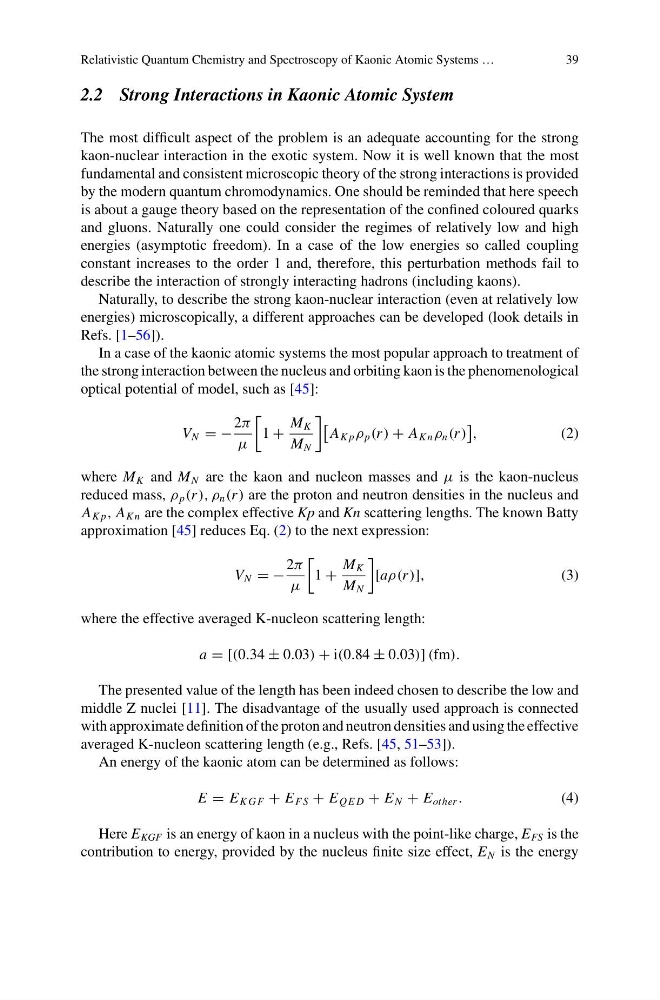
In a case of the kaonic atomic systems the most popular approach to treatment of
the strong interaction between the nucleus and orbiting kaon is the phenomenological
optical potential of model, such as [45]:
V N = −
2π
μ
1 +
M K
M N
A K p ρ p (r ) + A K n ρ n (r )
,
(2)
where M K and M N are the kaon and nucleon masses and μ is the kaon-nucleus
reduced mass, ρ p (r ), ρ n (r ) are the proton and neutron densities in the nucleus and
A K p , A K n are the complex effective Kp and Kn scattering lengths. The known Batty
approximation [45] reduces Eq. (2) to the next expression:
V N = −
2π
μ
1 +
M K
M N
[aρ(r )],
(3)
where the effective averaged K-nucleon scattering length:
a = [(0.34 ± 0.03) + i(0.84 ± 0.03)] (fm).
The presented value of the length has been indeed chosen to describe the low and
middle Z nuclei [11]. The disadvantage of the usually used approach is connected
with approximate definition of the proton and neutron densities and using the effective
averaged K-nucleon scattering length (e.g., Refs. [45, 51–53]).
An energy of the kaonic atom can be determined as follows:
E = E K G F + E F S + E Q E D + E N + E other .
(4)
Here E KGF is an energy of kaon in a nucleus with the point-like charge, E FS is the
contribution to energy, provided by the nucleus finite size effect, E N is the energy
39
2.2 Strong Interactions in Kaonic Atomic System
The most difficult aspect of the problem is an adequate accounting for the strong
kaon-nuclear interaction in the exotic system. Now it is well known that the most
fundamental and consistent microscopic theory of the strong interactions is provided
by the modern quantum chromodynamics. One should be reminded that here speech
is about a gauge theory based on the representation of the confined coloured quarks
and gluons. Naturally one could consider the regimes of relatively low and high
energies (asymptotic freedom). In a case of the low energies so called coupling
constant increases to the order 1 and, therefore, this perturbation methods fail to
describe the interaction of strongly interacting hadrons (including kaons).
Naturally, to describe the strong kaon-nuclear interaction (even at relatively low
energies) microscopically, a different approaches can be developed (look details in
Refs. [1–56]).
In a case of the kaonic atomic systems the most popular approach to treatment of
the strong interaction between the nucleus and orbiting kaon is the phenomenological
optical potential of model, such as [45]:
V N = −
2π
μ
1 +
M K
M N
A K p ρ p (r ) + A K n ρ n (r )
,
(2)
where M K and M N are the kaon and nucleon masses and μ is the kaon-nucleus
reduced mass, ρ p (r ), ρ n (r ) are the proton and neutron densities in the nucleus and
A K p , A K n are the complex effective Kp and Kn scattering lengths. The known Batty
approximation [45] reduces Eq. (2) to the next expression:
V N = −
2π
μ
1 +
M K
M N
[aρ(r )],
(3)
where the effective averaged K-nucleon scattering length:
a = [(0.34 ± 0.03) + i(0.84 ± 0.03)] (fm).
The presented value of the length has been indeed chosen to describe the low and
middle Z nuclei [11]. The disadvantage of the usually used approach is connected
with approximate definition of the proton and neutron densities and using the effective
averaged K-nucleon scattering length (e.g., Refs. [45, 51–53]).
An energy of the kaonic atom can be determined as follows:
E = E K G F + E F S + E Q E D + E N + E other .
(4)
Here E KGF is an energy of kaon in a nucleus with the point-like charge, E FS is the
contribution to energy, provided by the nucleus finite size effect, E N is the energy