

42
O. Yu. Khetselius et al.
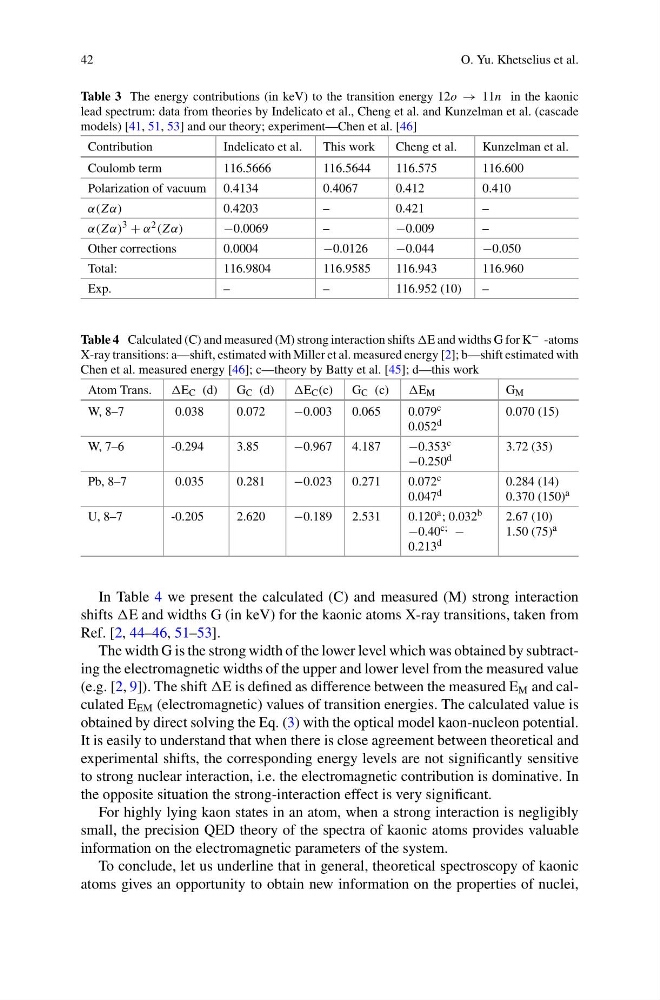
Table 3 The energy contributions (in keV) to the transition energy 12o → 11n in the kaonic
lead spectrum: data from theories by Indelicato et al., Cheng et al. and Kunzelman et al. (cascade
models) [41, 51, 53] and our theory; experiment—Chen et al. [46]
Contribution
Indelicato et al.
This work
Cheng et al.
Kunzelman et al.
Coulomb term
116.5666
116.5644
116.575
116.600
Polarization of vacuum 0.4134
0.4067
0.412
0.410
α(Z α)
0.4203
–
0.421
–
α(Z α)
3 + α 2 (Z α)
−0.0069
–
−0.009
–
Other corrections
0.0004
−0.0126
−0.044
−0.050
Total:
116.9804
116.9585
116.943
116.960
Exp.
–
–
116.952 (10)
–
Table 4 Calculated (C) and measured (M) strong interaction shifts E and widths G for K − -atoms
X-ray transitions: a—shift, estimated with Miller et al. measured energy [2]; b—shift estimated with
Chen et al. measured energy [46]; c—theory by Batty et al. [45]; d—this work
Atom Trans.
E C (d)
G C (d)
E C (c)
G C (c)
E M
G M
W, 8–7
0.038
0.072
−0.003
0.065
0.079 c
0.052 d
0.070 (15)
W, 7–6
-0.294
3.85
−0.967
4.187
−0.353 c
−0.250 d
3.72 (35)
Pb, 8–7
0.035
0.281
−0.023
0.271
0.072 c
0.047 d
0.284 (14)
0.370 (150) a
U, 8–7
-0.205
2.620
−0.189
2.531
0.120 a ; 0.032 b
−0.40 c; −
0.213 d
2.67 (10)
1.50 (75) a
In Table 4 we present the calculated (C) and measured (M) strong interaction
shifts E and widths G (in keV) for the kaonic atoms X-ray transitions, taken from
Ref. [2, 44–46, 51–53].
The width G is the strong width of the lower level which was obtained by subtracting the electromagnetic widths of the upper and lower level from the measured value
(e.g. [2, 9]). The shift E is defined as difference between the measured E M and calculated E EM (electromagnetic) values of transition energies. The calculated value is
obtained by direct solving the Eq. (3) with the optical model kaon-nucleon potential.
It is easily to understand that when there is close agreement between theoretical and
experimental shifts, the corresponding energy levels are not significantly sensitive
to strong nuclear interaction, i.e. the electromagnetic contribution is dominative. In
the opposite situation the strong-interaction effect is very significant.
For highly lying kaon states in an atom, when a strong interaction is negligibly
small, the precision QED theory of the spectra of kaonic atoms provides valuable
information on the electromagnetic parameters of the system.
To conclude, let us underline that in general, theoretical spectroscopy of kaonic
atoms gives an opportunity to obtain new information on the properties of nuclei,
O. Yu. Khetselius et al.
Table 3 The energy contributions (in keV) to the transition energy 12o → 11n in the kaonic
lead spectrum: data from theories by Indelicato et al., Cheng et al. and Kunzelman et al. (cascade
models) [41, 51, 53] and our theory; experiment—Chen et al. [46]
Contribution
Indelicato et al.
This work
Cheng et al.
Kunzelman et al.
Coulomb term
116.5666
116.5644
116.575
116.600
Polarization of vacuum 0.4134
0.4067
0.412
0.410
α(Z α)
0.4203
–
0.421
–
α(Z α)
3 + α 2 (Z α)
−0.0069
–
−0.009
–
Other corrections
0.0004
−0.0126
−0.044
−0.050
Total:
116.9804
116.9585
116.943
116.960
Exp.
–
–
116.952 (10)
–
Table 4 Calculated (C) and measured (M) strong interaction shifts E and widths G for K − -atoms
X-ray transitions: a—shift, estimated with Miller et al. measured energy [2]; b—shift estimated with
Chen et al. measured energy [46]; c—theory by Batty et al. [45]; d—this work
Atom Trans.
E C (d)
G C (d)
E C (c)
G C (c)
E M
G M
W, 8–7
0.038
0.072
−0.003
0.065
0.079 c
0.052 d
0.070 (15)
W, 7–6
-0.294
3.85
−0.967
4.187
−0.353 c
−0.250 d
3.72 (35)
Pb, 8–7
0.035
0.281
−0.023
0.271
0.072 c
0.047 d
0.284 (14)
0.370 (150) a
U, 8–7
-0.205
2.620
−0.189
2.531
0.120 a ; 0.032 b
−0.40 c; −
0.213 d
2.67 (10)
1.50 (75) a
In Table 4 we present the calculated (C) and measured (M) strong interaction
shifts E and widths G (in keV) for the kaonic atoms X-ray transitions, taken from
Ref. [2, 44–46, 51–53].
The width G is the strong width of the lower level which was obtained by subtracting the electromagnetic widths of the upper and lower level from the measured value
(e.g. [2, 9]). The shift E is defined as difference between the measured E M and calculated E EM (electromagnetic) values of transition energies. The calculated value is
obtained by direct solving the Eq. (3) with the optical model kaon-nucleon potential.
It is easily to understand that when there is close agreement between theoretical and
experimental shifts, the corresponding energy levels are not significantly sensitive
to strong nuclear interaction, i.e. the electromagnetic contribution is dominative. In
the opposite situation the strong-interaction effect is very significant.
For highly lying kaon states in an atom, when a strong interaction is negligibly
small, the precision QED theory of the spectra of kaonic atoms provides valuable
information on the electromagnetic parameters of the system.
To conclude, let us underline that in general, theoretical spectroscopy of kaonic
atoms gives an opportunity to obtain new information on the properties of nuclei,