

Abiogenesis and the Second Law of Thermodynamics
429
is important to remember that pioneering quantum mechanics, although it started
as a revelation of quantization in the microscopic province, also tows a continuum.
Obviously, our aim here has been focused on incorporating the latter in which there
are embedded resonances, similar to bound states, permitting a new freedom of
interpretation such as principal time scales, necessary temperature dependences,
thermal- and quantum correlations, microscopic self-organization, Einstein’s laws
of relativity, teleonomic communication and Poisson statistics.
To honour the theme in this article the obvious suggestion would be to formulate
an all-inclusive, universal thermodynamics from the notion of the Universal Device,
U D(n). Since a QBH only exhibits rotational degrees of freedom, it is reasonable to
assume a naïve rotor model and that a simple spectral analysis might be informative.
70
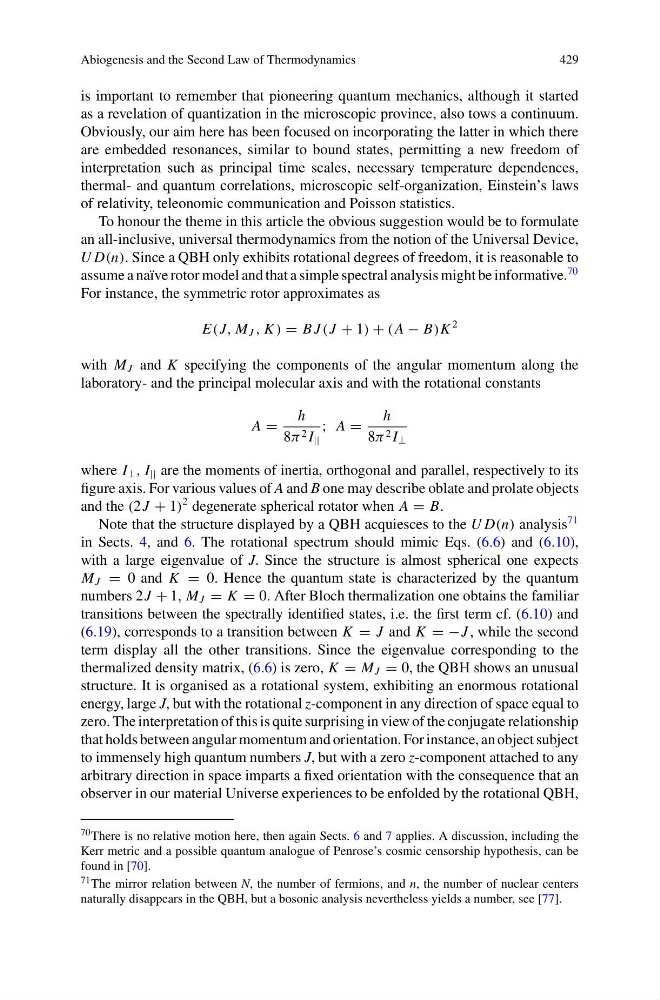
For instance, the symmetric rotor approximates as
E(J, M J , K ) = B J (J + 1) + (A − B)K
2
with M J and K specifying the components of the angular momentum along the
laboratory- and the principal molecular axis and with the rotational constants
A =
h
8π 2 I ||
; A =
h
8π 2 I ⊥
where I ⊥ , I || are the moments of inertia, orthogonal and parallel, respectively to its
figure axis. For various values of A and B one may describe oblate and prolate objects
and the (2J + 1)
2 degenerate spherical rotator when A = B.
Note that the structure displayed by a QBH acquiesces to the U D(n) analysis
71
in Sects. 4, and 6. The rotational spectrum should mimic Eqs. (6.6) and (6.10),
with a large eigenvalue of J. Since the structure is almost spherical one expects
M J = 0 and K = 0. Hence the quantum state is characterized by the quantum
numbers 2J + 1, M J = K = 0. After Bloch thermalization one obtains the familiar
transitions between the spectrally identified states, i.e. the first term cf. (6.10) and
(6.19), corresponds to a transition between K = J and K = −J , while the second
term display all the other transitions. Since the eigenvalue corresponding to the
thermalized density matrix, (6.6) is zero, K = M J = 0, the QBH shows an unusual
structure. It is organised as a rotational system, exhibiting an enormous rotational
energy, large J, but with the rotational z-component in any direction of space equal to
zero. The interpretation of this is quite surprising in view of the conjugate relationship
that holds between angular momentum and orientation. For instance, an object subject
to immensely high quantum numbers J, but with a zero z-component attached to any
arbitrary direction in space imparts a fixed orientation with the consequence that an
observer in our material Universe experiences to be enfolded by the rotational QBH,
70 There is no relative motion here, then again Sects. 6 and 7 applies. A discussion, including the
Kerr metric and a possible quantum analogue of Penrose’s cosmic censorship hypothesis, can be
found in [70].
71 The mirror relation between N, the number of fermions, and n, the number of nuclear centers
naturally disappears in the QBH, but a bosonic analysis nevertheless yields a number, see [77].
429
is important to remember that pioneering quantum mechanics, although it started
as a revelation of quantization in the microscopic province, also tows a continuum.
Obviously, our aim here has been focused on incorporating the latter in which there
are embedded resonances, similar to bound states, permitting a new freedom of
interpretation such as principal time scales, necessary temperature dependences,
thermal- and quantum correlations, microscopic self-organization, Einstein’s laws
of relativity, teleonomic communication and Poisson statistics.
To honour the theme in this article the obvious suggestion would be to formulate
an all-inclusive, universal thermodynamics from the notion of the Universal Device,
U D(n). Since a QBH only exhibits rotational degrees of freedom, it is reasonable to
assume a naïve rotor model and that a simple spectral analysis might be informative.
70
For instance, the symmetric rotor approximates as
E(J, M J , K ) = B J (J + 1) + (A − B)K
2
with M J and K specifying the components of the angular momentum along the
laboratory- and the principal molecular axis and with the rotational constants
A =
h
8π 2 I ||
; A =
h
8π 2 I ⊥
where I ⊥ , I || are the moments of inertia, orthogonal and parallel, respectively to its
figure axis. For various values of A and B one may describe oblate and prolate objects
and the (2J + 1)
2 degenerate spherical rotator when A = B.
Note that the structure displayed by a QBH acquiesces to the U D(n) analysis
71
in Sects. 4, and 6. The rotational spectrum should mimic Eqs. (6.6) and (6.10),
with a large eigenvalue of J. Since the structure is almost spherical one expects
M J = 0 and K = 0. Hence the quantum state is characterized by the quantum
numbers 2J + 1, M J = K = 0. After Bloch thermalization one obtains the familiar
transitions between the spectrally identified states, i.e. the first term cf. (6.10) and
(6.19), corresponds to a transition between K = J and K = −J , while the second
term display all the other transitions. Since the eigenvalue corresponding to the
thermalized density matrix, (6.6) is zero, K = M J = 0, the QBH shows an unusual
structure. It is organised as a rotational system, exhibiting an enormous rotational
energy, large J, but with the rotational z-component in any direction of space equal to
zero. The interpretation of this is quite surprising in view of the conjugate relationship
that holds between angular momentum and orientation. For instance, an object subject
to immensely high quantum numbers J, but with a zero z-component attached to any
arbitrary direction in space imparts a fixed orientation with the consequence that an
observer in our material Universe experiences to be enfolded by the rotational QBH,
70 There is no relative motion here, then again Sects. 6 and 7 applies. A discussion, including the
Kerr metric and a possible quantum analogue of Penrose’s cosmic censorship hypothesis, can be
found in [70].
71 The mirror relation between N, the number of fermions, and n, the number of nuclear centers
naturally disappears in the QBH, but a bosonic analysis nevertheless yields a number, see [77].