

428
E. J. Brändas
and straightforwardly the so-called Schwarzschild
67 line element, leaving out the
term r
2 d
2 , and m 0 = 0,
−c
2 ds
2
= −c
2 dτ
2
(1 − 2κ(r )) + dr
2
(1 − 2κ(r ))
−1
(8.16)
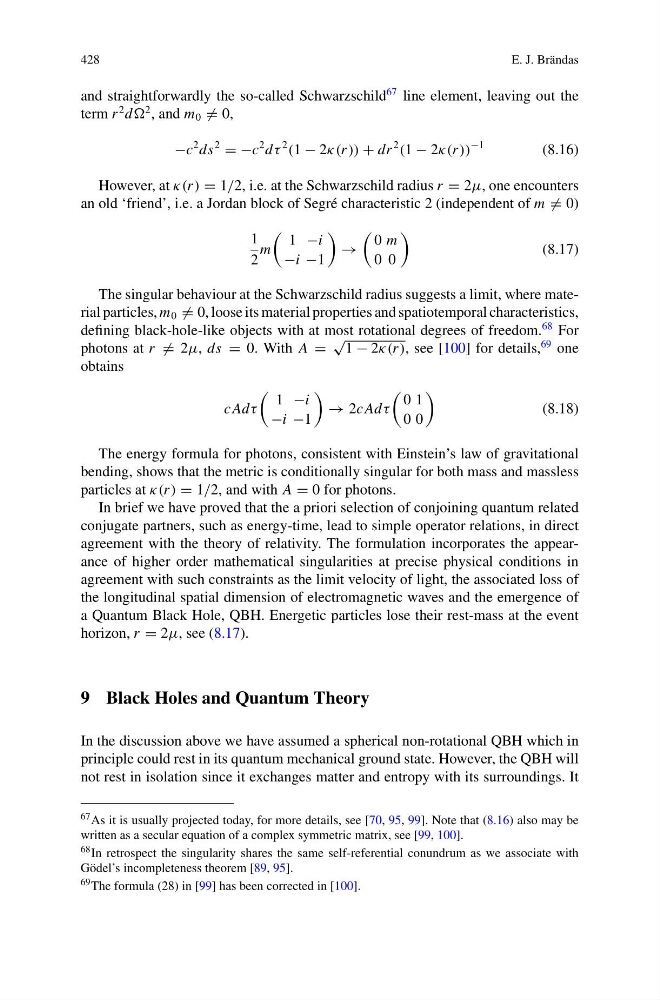
However, at κ(r ) = 1/2, i.e. at the Schwarzschild radius r = 2μ, one encounters
an old ‘friend’, i.e. a Jordan block of Segré characteristic 2 (independent of m = 0)
1
2
m
1 −i
−i −1
→
0 m
0 0
(8.17)
The singular behaviour at the Schwarzschild radius suggests a limit, where material particles, m 0 = 0, loose its material properties and spatiotemporal characteristics,
defining black-hole-like objects with at most rotational degrees of freedom.
68 For
photons at r = 2μ, ds = 0. With A =
√
1 − 2κ(r ), see [100] for details,
69 one
obtains
c Adτ
1 −i
−i −1
→ 2c Adτ
0 1
0 0
(8.18)
The energy formula for photons, consistent with Einstein’s law of gravitational
bending, shows that the metric is conditionally singular for both mass and massless
particles at κ(r ) = 1/2, and with A = 0 for photons.
In brief we have proved that the a priori selection of conjoining quantum related
conjugate partners, such as energy-time, lead to simple operator relations, in direct
agreement with the theory of relativity. The formulation incorporates the appearance of higher order mathematical singularities at precise physical conditions in
agreement with such constraints as the limit velocity of light, the associated loss of
the longitudinal spatial dimension of electromagnetic waves and the emergence of
a Quantum Black Hole, QBH. Energetic particles lose their rest-mass at the event
horizon, r = 2μ, see (8.17).
9 Black Holes and Quantum Theory
In the discussion above we have assumed a spherical non-rotational QBH which in
principle could rest in its quantum mechanical ground state. However, the QBH will
not rest in isolation since it exchanges matter and entropy with its surroundings. It
67 As it is usually projected today, for more details, see [70, 95, 99]. Note that (8.16) also may be
written as a secular equation of a complex symmetric matrix, see [99, 100].
68 In retrospect the singularity shares the same self-referential conundrum as we associate with
Gödel’s incompleteness theorem [89, 95].
69 The formula (28) in [99] has been corrected in [100].
E. J. Brändas
and straightforwardly the so-called Schwarzschild
67 line element, leaving out the
term r
2 d
2 , and m 0 = 0,
−c
2 ds
2
= −c
2 dτ
2
(1 − 2κ(r )) + dr
2
(1 − 2κ(r ))
−1
(8.16)
However, at κ(r ) = 1/2, i.e. at the Schwarzschild radius r = 2μ, one encounters
an old ‘friend’, i.e. a Jordan block of Segré characteristic 2 (independent of m = 0)
1
2
m
1 −i
−i −1
→
0 m
0 0
(8.17)
The singular behaviour at the Schwarzschild radius suggests a limit, where material particles, m 0 = 0, loose its material properties and spatiotemporal characteristics,
defining black-hole-like objects with at most rotational degrees of freedom.
68 For
photons at r = 2μ, ds = 0. With A =
√
1 − 2κ(r ), see [100] for details,
69 one
obtains
c Adτ
1 −i
−i −1
→ 2c Adτ
0 1
0 0
(8.18)
The energy formula for photons, consistent with Einstein’s law of gravitational
bending, shows that the metric is conditionally singular for both mass and massless
particles at κ(r ) = 1/2, and with A = 0 for photons.
In brief we have proved that the a priori selection of conjoining quantum related
conjugate partners, such as energy-time, lead to simple operator relations, in direct
agreement with the theory of relativity. The formulation incorporates the appearance of higher order mathematical singularities at precise physical conditions in
agreement with such constraints as the limit velocity of light, the associated loss of
the longitudinal spatial dimension of electromagnetic waves and the emergence of
a Quantum Black Hole, QBH. Energetic particles lose their rest-mass at the event
horizon, r = 2μ, see (8.17).
9 Black Holes and Quantum Theory
In the discussion above we have assumed a spherical non-rotational QBH which in
principle could rest in its quantum mechanical ground state. However, the QBH will
not rest in isolation since it exchanges matter and entropy with its surroundings. It
67 As it is usually projected today, for more details, see [70, 95, 99]. Note that (8.16) also may be
written as a secular equation of a complex symmetric matrix, see [99, 100].
68 In retrospect the singularity shares the same self-referential conundrum as we associate with
Gödel’s incompleteness theorem [89, 95].
69 The formula (28) in [99] has been corrected in [100].