

Abiogenesis and the Second Law of Thermodynamics
427
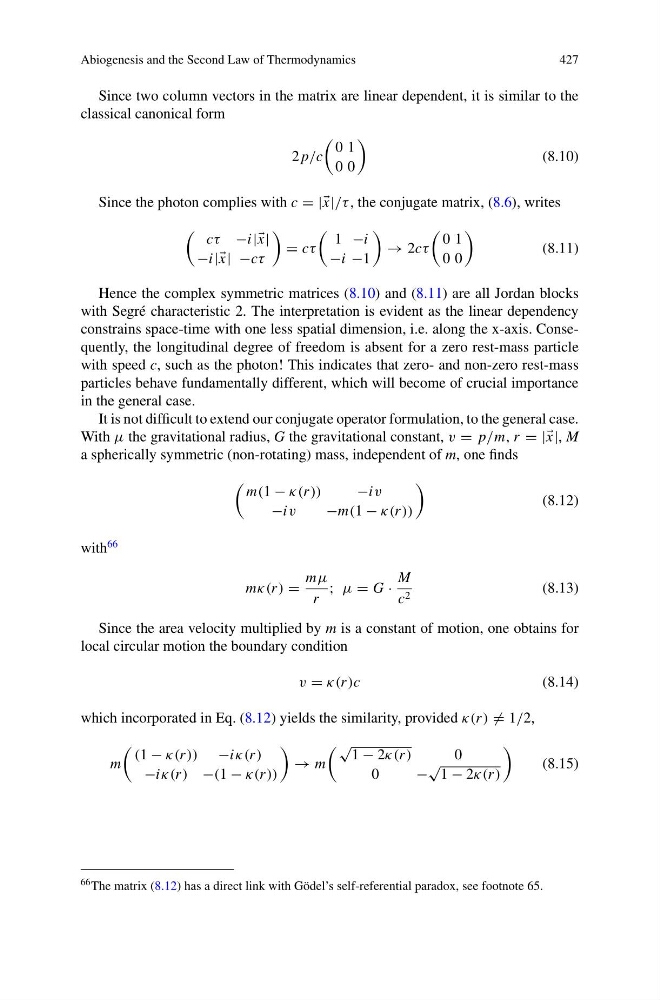
Since two column vectors in the matrix are linear dependent, it is similar to the
classical canonical form
2 p/c
0 1
0 0
(8.10)
Since the photon complies with c = | x|/τ , the conjugate matrix, (8.6), writes
cτ −i| x|
−i| x| −cτ
= cτ
1 −i
−i −1
→ 2cτ
0 1
0 0
(8.11)
Hence the complex symmetric matrices (8.10) and (8.11) are all Jordan blocks
with Segré characteristic 2. The interpretation is evident as the linear dependency
constrains space-time with one less spatial dimension, i.e. along the x-axis. Consequently, the longitudinal degree of freedom is absent for a zero rest-mass particle
with speed c, such as the photon! This indicates that zero- and non-zero rest-mass
particles behave fundamentally different, which will become of crucial importance
in the general case.
It is not difficult to extend our conjugate operator formulation, to the general case.
With μ the gravitational radius, G the gravitational constant, v = p/m, r = | x|, M
a spherically symmetric (non-rotating) mass, independent of m, one finds
m(1 − κ(r ))
−iv
−iv
−m(1 − κ(r ))
(8.12)
with
66
mκ(r ) =
mμ
r
; μ = G ·
M
c 2
(8.13)
Since the area velocity multiplied by m is a constant of motion, one obtains for
local circular motion the boundary condition
v = κ(r )c
(8.14)
which incorporated in Eq. (8.12) yields the similarity, provided κ(r ) = 1/2,
m
(1 − κ(r )) −iκ(r )
−iκ(r ) −(1 − κ(r ))
→ m
√
1 − 2κ(r )
0
0
−
√
1 − 2κ(r )
(8.15)
66 The matrix (8.12) has a direct link with Gödel’s self-referential paradox, see footnote 65.
427
Since two column vectors in the matrix are linear dependent, it is similar to the
classical canonical form
2 p/c
0 1
0 0
(8.10)
Since the photon complies with c = | x|/τ , the conjugate matrix, (8.6), writes
cτ −i| x|
−i| x| −cτ
= cτ
1 −i
−i −1
→ 2cτ
0 1
0 0
(8.11)
Hence the complex symmetric matrices (8.10) and (8.11) are all Jordan blocks
with Segré characteristic 2. The interpretation is evident as the linear dependency
constrains space-time with one less spatial dimension, i.e. along the x-axis. Consequently, the longitudinal degree of freedom is absent for a zero rest-mass particle
with speed c, such as the photon! This indicates that zero- and non-zero rest-mass
particles behave fundamentally different, which will become of crucial importance
in the general case.
It is not difficult to extend our conjugate operator formulation, to the general case.
With μ the gravitational radius, G the gravitational constant, v = p/m, r = | x|, M
a spherically symmetric (non-rotating) mass, independent of m, one finds
m(1 − κ(r ))
−iv
−iv
−m(1 − κ(r ))
(8.12)
with
66
mκ(r ) =
mμ
r
; μ = G ·
M
c 2
(8.13)
Since the area velocity multiplied by m is a constant of motion, one obtains for
local circular motion the boundary condition
v = κ(r )c
(8.14)
which incorporated in Eq. (8.12) yields the similarity, provided κ(r ) = 1/2,
m
(1 − κ(r )) −iκ(r )
−iκ(r ) −(1 − κ(r ))
→ m
√
1 − 2κ(r )
0
0
−
√
1 − 2κ(r )
(8.15)
66 The matrix (8.12) has a direct link with Gödel’s self-referential paradox, see footnote 65.