

426
E. J. Brändas
operator is defined when the energy and time intervals are (–∞, +∞),
E op = i
∂
∂t
; ;
p op = −i
∇
x
(8.3)
and
τ = t op = −i
∂
∂ E
; ;
x op = i
∇
p
(8.4)
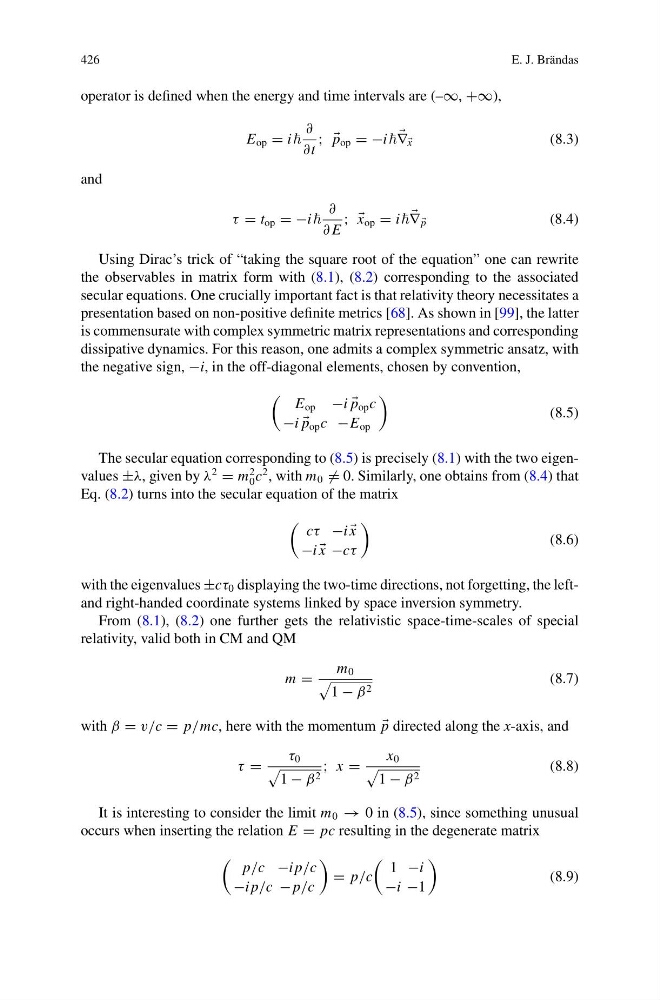
Using Dirac’s trick of “taking the square root of the equation” one can rewrite
the observables in matrix form with (8.1), (8.2) corresponding to the associated
secular equations. One crucially important fact is that relativity theory necessitates a
presentation based on non-positive definite metrics [68]. As shown in [99], the latter
is commensurate with complex symmetric matrix representations and corresponding
dissipative dynamics. For this reason, one admits a complex symmetric ansatz, with
the negative sign, −i, in the off-diagonal elements, chosen by convention,
E op −i
p op c
−i
p op c −E op
(8.5)
The secular equation corresponding to (8.5) is precisely (8.1) with the two eigenvalues ±λ, given by λ
2
= m
2
0 c
2 , with m 0 = 0. Similarly, one obtains from (8.4) that
Eq. (8.2) turns into the secular equation of the matrix
cτ −i
x
−i
x −cτ
(8.6)
with the eigenvalues ±cτ 0 displaying the two-time directions, not forgetting, the leftand right-handed coordinate systems linked by space inversion symmetry.
From (8.1), (8.2) one further gets the relativistic space-time-scales of special
relativity, valid both in CM and QM
m =
m 0
1 − β 2
(8.7)
with β = v/c = p/mc, here with the momentum
p directed along the x-axis, and
τ =
τ 0
1 − β 2
; x =
x 0
1 − β 2
(8.8)
It is interesting to consider the limit m 0 → 0 in (8.5), since something unusual
occurs when inserting the relation E = pc resulting in the degenerate matrix
p/c −i p/c
−i p/c − p/c
= p/c
1 −i
−i −1
(8.9)
E. J. Brändas
operator is defined when the energy and time intervals are (–∞, +∞),
E op = i
∂
∂t
; ;
p op = −i
∇
x
(8.3)
and
τ = t op = −i
∂
∂ E
; ;
x op = i
∇
p
(8.4)
Using Dirac’s trick of “taking the square root of the equation” one can rewrite
the observables in matrix form with (8.1), (8.2) corresponding to the associated
secular equations. One crucially important fact is that relativity theory necessitates a
presentation based on non-positive definite metrics [68]. As shown in [99], the latter
is commensurate with complex symmetric matrix representations and corresponding
dissipative dynamics. For this reason, one admits a complex symmetric ansatz, with
the negative sign, −i, in the off-diagonal elements, chosen by convention,
E op −i
p op c
−i
p op c −E op
(8.5)
The secular equation corresponding to (8.5) is precisely (8.1) with the two eigenvalues ±λ, given by λ
2
= m
2
0 c
2 , with m 0 = 0. Similarly, one obtains from (8.4) that
Eq. (8.2) turns into the secular equation of the matrix
cτ −i
x
−i
x −cτ
(8.6)
with the eigenvalues ±cτ 0 displaying the two-time directions, not forgetting, the leftand right-handed coordinate systems linked by space inversion symmetry.
From (8.1), (8.2) one further gets the relativistic space-time-scales of special
relativity, valid both in CM and QM
m =
m 0
1 − β 2
(8.7)
with β = v/c = p/mc, here with the momentum
p directed along the x-axis, and
τ =
τ 0
1 − β 2
; x =
x 0
1 − β 2
(8.8)
It is interesting to consider the limit m 0 → 0 in (8.5), since something unusual
occurs when inserting the relation E = pc resulting in the degenerate matrix
p/c −i p/c
−i p/c − p/c
= p/c
1 −i
−i −1
(8.9)