

418
E. J. Brändas
0, as n → ∞, exhibits a dominating eigenvector of
(2) yielding the condensate
wavefunction, i.e. reflects the population of the same pair state analogous to BoseEinstein condensation [79, 80]. But Coleman [81] concedes: However, Yang’s paper
went much farther and showed that it is when
(2) has a “large” eigenvalue that a
fermion system manifests long-range order such as presented in superconductivity.
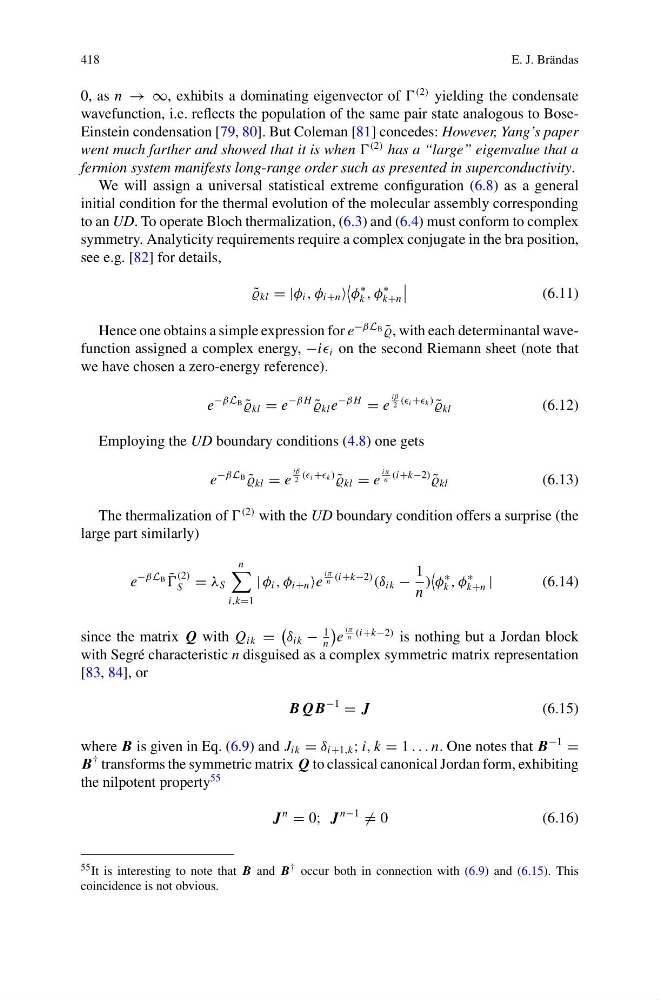
We will assign a universal statistical extreme configuration (6.8) as a general
initial condition for the thermal evolution of the molecular assembly corresponding
to an UD. To operate Bloch thermalization, (6.3) and (6.4) must conform to complex
symmetry. Analyticity requirements require a complex conjugate in the bra position,
see e.g. [82] for details,
˜
kl = |φ i , φ i+n
φ
∗
k , φ
∗
k+n
(6.11)
Hence one obtains a simple expression for e
−βL B ˜
, with each determinantal wavefunction assigned a complex energy, −i i on the second Riemann sheet (note that
we have chosen a zero-energy reference).
e
−βL B ˜
kl = e
−β H
˜
kl e
−β H
= e
iβ
2 (i + k )
˜
kl
(6.12)
Employing the UD boundary conditions (4.8) one gets
e
−βL B ˜
kl = e
iβ
2 (i + k )
˜
kl = e
iπ
n (i+k−2)
˜
kl
(6.13)
The thermalization of
(2) with the UD boundary condition offers a surprise (the
large part similarly)
e
−βL B ˜
(2)
S = λ S
n
i,k=1
| φ i , φ i+n e
iπ
n (i+k−2)
(δ ik −
1
n
)
φ
∗
k , φ
∗
k+n |
(6.14)
since the matrix Q with Q ik =
δ ik −
1
n
e
iπ
n (i+k−2) is nothing but a Jordan block
with Segré characteristic n disguised as a complex symmetric matrix representation
[83, 84], or
B Q B
−1
= J
(6.15)
where B is given in Eq. (6.9) and J ik = δ i+1,k ; i, k = 1 . . . n. One notes that B
−1
=
B
† transforms the symmetric matrix Q to classical canonical Jordan form, exhibiting
the nilpotent property
55
J
n
= 0; J
n−1
= 0
(6.16)
55 It is interesting to note that B and B † occur both in connection with (6.9) and (6.15). This
coincidence is not obvious.
E. J. Brändas
0, as n → ∞, exhibits a dominating eigenvector of
(2) yielding the condensate
wavefunction, i.e. reflects the population of the same pair state analogous to BoseEinstein condensation [79, 80]. But Coleman [81] concedes: However, Yang’s paper
went much farther and showed that it is when
(2) has a “large” eigenvalue that a
fermion system manifests long-range order such as presented in superconductivity.
We will assign a universal statistical extreme configuration (6.8) as a general
initial condition for the thermal evolution of the molecular assembly corresponding
to an UD. To operate Bloch thermalization, (6.3) and (6.4) must conform to complex
symmetry. Analyticity requirements require a complex conjugate in the bra position,
see e.g. [82] for details,
˜
kl = |φ i , φ i+n
φ
∗
k , φ
∗
k+n
(6.11)
Hence one obtains a simple expression for e
−βL B ˜
, with each determinantal wavefunction assigned a complex energy, −i i on the second Riemann sheet (note that
we have chosen a zero-energy reference).
e
−βL B ˜
kl = e
−β H
˜
kl e
−β H
= e
iβ
2 (i + k )
˜
kl
(6.12)
Employing the UD boundary conditions (4.8) one gets
e
−βL B ˜
kl = e
iβ
2 (i + k )
˜
kl = e
iπ
n (i+k−2)
˜
kl
(6.13)
The thermalization of
(2) with the UD boundary condition offers a surprise (the
large part similarly)
e
−βL B ˜
(2)
S = λ S
n
i,k=1
| φ i , φ i+n e
iπ
n (i+k−2)
(δ ik −
1
n
)
φ
∗
k , φ
∗
k+n |
(6.14)
since the matrix Q with Q ik =
δ ik −
1
n
e
iπ
n (i+k−2) is nothing but a Jordan block
with Segré characteristic n disguised as a complex symmetric matrix representation
[83, 84], or
B Q B
−1
= J
(6.15)
where B is given in Eq. (6.9) and J ik = δ i+1,k ; i, k = 1 . . . n. One notes that B
−1
=
B
† transforms the symmetric matrix Q to classical canonical Jordan form, exhibiting
the nilpotent property
55
J
n
= 0; J
n−1
= 0
(6.16)
55 It is interesting to note that B and B † occur both in connection with (6.9) and (6.15). This
coincidence is not obvious.