

Abiogenesis and the Second Law of Thermodynamics
417
the system to be subject to Schrödinger’s equation with a wavefunction that can
be represented as an anti-symmetrized product [44] of N /2 geminals g 1 , i.e. =
g 1 ∧ · · · ∧ g 1 = g
N /2
1
with
50
g 1 =
1
√
n
n
i=1
| φ i , φ i+n
(6.7)
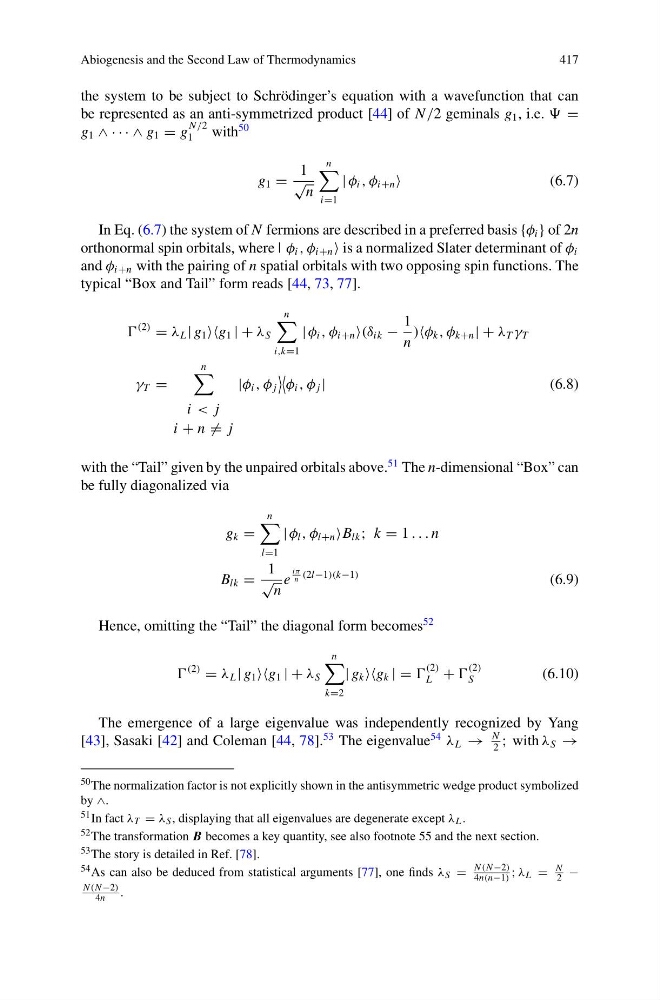
In Eq. (6.7) the system of N fermions are described in a preferred basis {φ i } of 2n
orthonormal spin orbitals, where | φ i , φ i+n is a normalized Slater determinant of φ i
and φ i+n with the pairing of n spatial orbitals with two opposing spin functions. The
typical “Box and Tail” form reads [44, 73, 77].
(2)
= λ L | g 1 g 1 | + λ S
n
i,k=1
| φ i , φ i+n (δ ik −
1
n
)φ k , φ k+n | + λ T γ T
γ T =
n
i < j
i + n = j
|φ i , φ j
φ i , φ j |
(6.8)
with the “Tail” given by the unpaired orbitals above.
51 The n-dimensional “Box” can
be fully diagonalized via
g k =
n
l=1
| φ l , φ l+n B lk ; k = 1 . . . n
B lk =
1
√
n
e
iπ
n (2l−1)(k−1)
(6.9)
Hence, omitting the “Tail” the diagonal form becomes
52
(2)
= λ L | g 1 g 1 | + λ S
n
k=2
| g k g k | =
(2)
L +
(2)
S
(6.10)
The emergence of a large eigenvalue was independently recognized by Yang
[43], Sasaki [42] and Coleman [44, 78].
53 The eigenvalue
54
λ L →
N
2
; with λ S →
50 The normalization factor is not explicitly shown in the antisymmetric wedge product symbolized
by ∧.
51 In fact λ T = λ S , displaying that all eigenvalues are degenerate except λ L .
52 The transformation B becomes a key quantity, see also footnote 55 and the next section.
53 The story is detailed in Ref. [78].
54 As can also be deduced from statistical arguments [77], one finds λ S =
N (N −2)
4n(n−1) ; λ L =
N
2 −
N (N −2)
4n
.
417
the system to be subject to Schrödinger’s equation with a wavefunction that can
be represented as an anti-symmetrized product [44] of N /2 geminals g 1 , i.e. =
g 1 ∧ · · · ∧ g 1 = g
N /2
1
with
50
g 1 =
1
√
n
n
i=1
| φ i , φ i+n
(6.7)
In Eq. (6.7) the system of N fermions are described in a preferred basis {φ i } of 2n
orthonormal spin orbitals, where | φ i , φ i+n is a normalized Slater determinant of φ i
and φ i+n with the pairing of n spatial orbitals with two opposing spin functions. The
typical “Box and Tail” form reads [44, 73, 77].
(2)
= λ L | g 1 g 1 | + λ S
n
i,k=1
| φ i , φ i+n (δ ik −
1
n
)φ k , φ k+n | + λ T γ T
γ T =
n
i < j
i + n = j
|φ i , φ j
φ i , φ j |
(6.8)
with the “Tail” given by the unpaired orbitals above.
51 The n-dimensional “Box” can
be fully diagonalized via
g k =
n
l=1
| φ l , φ l+n B lk ; k = 1 . . . n
B lk =
1
√
n
e
iπ
n (2l−1)(k−1)
(6.9)
Hence, omitting the “Tail” the diagonal form becomes
52
(2)
= λ L | g 1 g 1 | + λ S
n
k=2
| g k g k | =
(2)
L +
(2)
S
(6.10)
The emergence of a large eigenvalue was independently recognized by Yang
[43], Sasaki [42] and Coleman [44, 78].
53 The eigenvalue
54
λ L →
N
2
; with λ S →
50 The normalization factor is not explicitly shown in the antisymmetric wedge product symbolized
by ∧.
51 In fact λ T = λ S , displaying that all eigenvalues are degenerate except λ L .
52 The transformation B becomes a key quantity, see also footnote 55 and the next section.
53 The story is detailed in Ref. [78].
54 As can also be deduced from statistical arguments [77], one finds λ S =
N (N −2)
4n(n−1) ; λ L =
N
2 −
N (N −2)
4n
.