

Abiogenesis and the Second Law of Thermodynamics
419
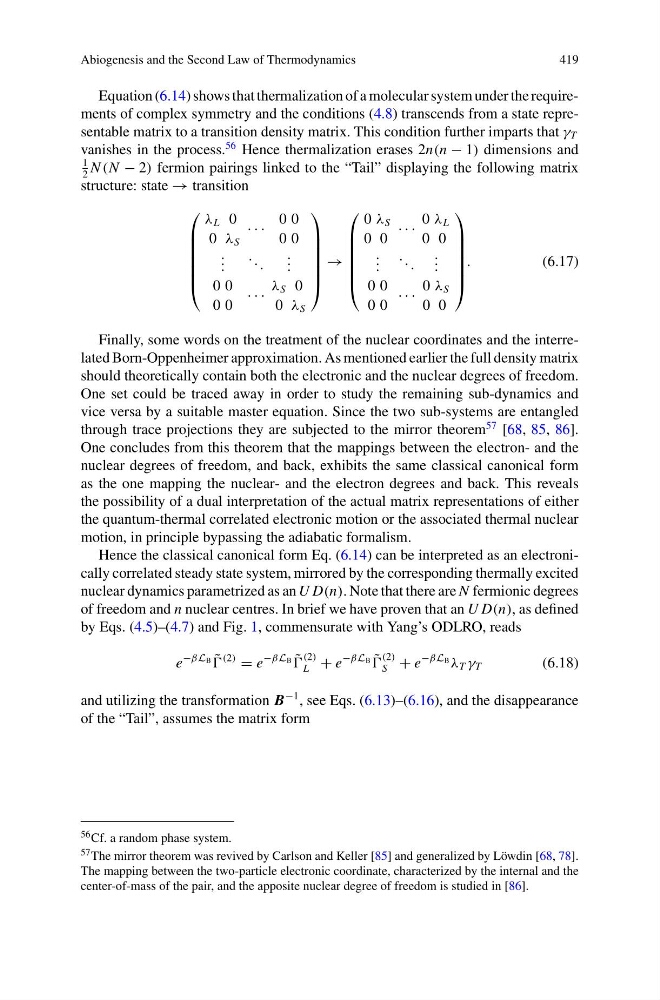
Equation (6.14) shows that thermalization of a molecular system under the requirements of complex symmetry and the conditions (4.8) transcends from a state representable matrix to a transition density matrix. This condition further imparts that γ T
vanishes in the process.
56 Hence thermalization erases 2n(n − 1) dimensions and
1
2
N (N − 2) fermion pairings linked to the “Tail” displaying the following matrix
structure: state → transition
⎛
⎜
⎜
⎜
⎜
⎜
⎝
λ L 0
0 λ S
· · ·
0 0
0 0
. . .
. . .
. . .
0 0
0 0
· · ·
λ S 0
0 λ S
⎞
⎟
⎟
⎟
⎟
⎟
⎠
→
⎛
⎜
⎜
⎜
⎜
⎜
⎝
0 λ S
0 0
· · ·
0 λ L
0 0
. . .
. . .
. . .
0 0
0 0
· · ·
0 λ S
0 0
⎞
⎟
⎟
⎟
⎟
⎟
⎠
.
(6.17)
Finally, some words on the treatment of the nuclear coordinates and the interrelated Born-Oppenheimer approximation. As mentioned earlier the full density matrix
should theoretically contain both the electronic and the nuclear degrees of freedom.
One set could be traced away in order to study the remaining sub-dynamics and
vice versa by a suitable master equation. Since the two sub-systems are entangled
through trace projections they are subjected to the mirror theorem
57 [68, 85, 86].
One concludes from this theorem that the mappings between the electron- and the
nuclear degrees of freedom, and back, exhibits the same classical canonical form
as the one mapping the nuclear- and the electron degrees and back. This reveals
the possibility of a dual interpretation of the actual matrix representations of either
the quantum-thermal correlated electronic motion or the associated thermal nuclear
motion, in principle bypassing the adiabatic formalism.
Hence the classical canonical form Eq. (6.14) can be interpreted as an electronically correlated steady state system, mirrored by the corresponding thermally excited
nuclear dynamics parametrized as an U D(n). Note that there are N fermionic degrees
of freedom and n nuclear centres. In brief we have proven that an U D(n), as defined
by Eqs. (4.5)–(4.7) and Fig. 1, commensurate with Yang’s ODLRO, reads
e
−βL B ˜
(2)
= e
−βL B ˜
(2)
L + e
−βL B ˜
(2)
S + e
−βL B λ T γ T
(6.18)
and utilizing the transformation B
−1 , see Eqs. (6.13)–(6.16), and the disappearance
of the “Tail”, assumes the matrix form
56 Cf. a random phase system.
57 The mirror theorem was revived by Carlson and Keller [85] and generalized by Löwdin [68, 78].
The mapping between the two-particle electronic coordinate, characterized by the internal and the
center-of-mass of the pair, and the apposite nuclear degree of freedom is studied in [86].
419
Equation (6.14) shows that thermalization of a molecular system under the requirements of complex symmetry and the conditions (4.8) transcends from a state representable matrix to a transition density matrix. This condition further imparts that γ T
vanishes in the process.
56 Hence thermalization erases 2n(n − 1) dimensions and
1
2
N (N − 2) fermion pairings linked to the “Tail” displaying the following matrix
structure: state → transition
⎛
⎜
⎜
⎜
⎜
⎜
⎝
λ L 0
0 λ S
· · ·
0 0
0 0
. . .
. . .
. . .
0 0
0 0
· · ·
λ S 0
0 λ S
⎞
⎟
⎟
⎟
⎟
⎟
⎠
→
⎛
⎜
⎜
⎜
⎜
⎜
⎝
0 λ S
0 0
· · ·
0 λ L
0 0
. . .
. . .
. . .
0 0
0 0
· · ·
0 λ S
0 0
⎞
⎟
⎟
⎟
⎟
⎟
⎠
.
(6.17)
Finally, some words on the treatment of the nuclear coordinates and the interrelated Born-Oppenheimer approximation. As mentioned earlier the full density matrix
should theoretically contain both the electronic and the nuclear degrees of freedom.
One set could be traced away in order to study the remaining sub-dynamics and
vice versa by a suitable master equation. Since the two sub-systems are entangled
through trace projections they are subjected to the mirror theorem
57 [68, 85, 86].
One concludes from this theorem that the mappings between the electron- and the
nuclear degrees of freedom, and back, exhibits the same classical canonical form
as the one mapping the nuclear- and the electron degrees and back. This reveals
the possibility of a dual interpretation of the actual matrix representations of either
the quantum-thermal correlated electronic motion or the associated thermal nuclear
motion, in principle bypassing the adiabatic formalism.
Hence the classical canonical form Eq. (6.14) can be interpreted as an electronically correlated steady state system, mirrored by the corresponding thermally excited
nuclear dynamics parametrized as an U D(n). Note that there are N fermionic degrees
of freedom and n nuclear centres. In brief we have proven that an U D(n), as defined
by Eqs. (4.5)–(4.7) and Fig. 1, commensurate with Yang’s ODLRO, reads
e
−βL B ˜
(2)
= e
−βL B ˜
(2)
L + e
−βL B ˜
(2)
S + e
−βL B λ T γ T
(6.18)
and utilizing the transformation B
−1 , see Eqs. (6.13)–(6.16), and the disappearance
of the “Tail”, assumes the matrix form
56 Cf. a random phase system.
57 The mirror theorem was revived by Carlson and Keller [85] and generalized by Löwdin [68, 78].
The mapping between the two-particle electronic coordinate, characterized by the internal and the
center-of-mass of the pair, and the apposite nuclear degree of freedom is studied in [86].