

412
E. J. Brändas
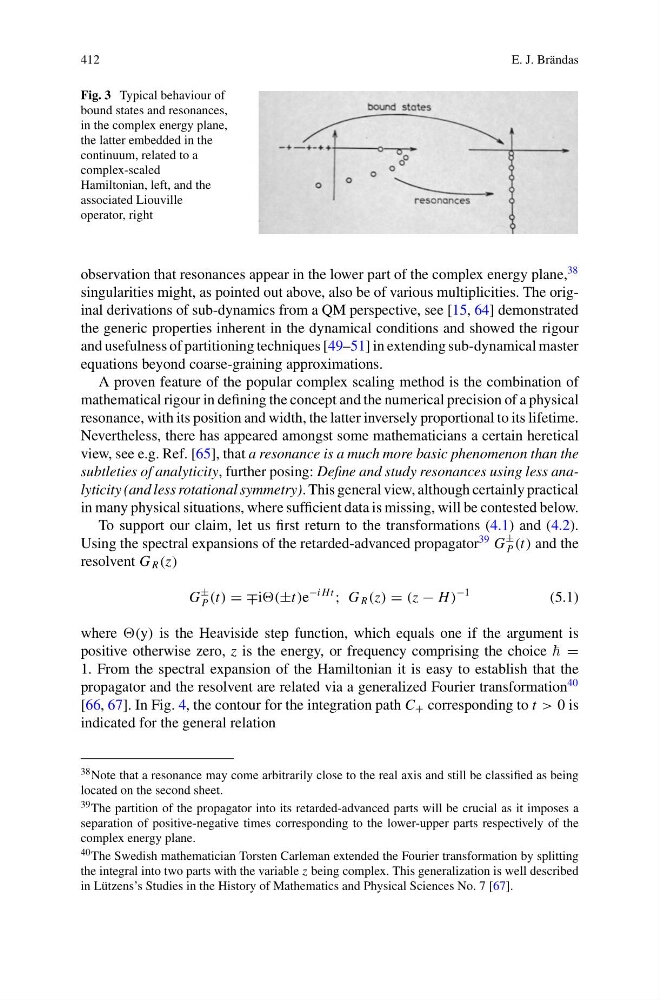
Fig. 3 Typical behaviour of
bound states and resonances,
in the complex energy plane,
the latter embedded in the
continuum, related to a
complex-scaled
Hamiltonian, left, and the
associated Liouville
operator, right
observation that resonances appear in the lower part of the complex energy plane,
38
singularities might, as pointed out above, also be of various multiplicities. The original derivations of sub-dynamics from a QM perspective, see [15, 64] demonstrated
the generic properties inherent in the dynamical conditions and showed the rigour
and usefulness of partitioning techniques [49–51] in extending sub-dynamical master
equations beyond coarse-graining approximations.
A proven feature of the popular complex scaling method is the combination of
mathematical rigour in defining the concept and the numerical precision of a physical
resonance, with its position and width, the latter inversely proportional to its lifetime.
Nevertheless, there has appeared amongst some mathematicians a certain heretical
view, see e.g. Ref. [65], that a resonance is a much more basic phenomenon than the
subtleties of analyticity, further posing: Define and study resonances using less analyticity (and less rotational symmetry). This general view, although certainly practical
in many physical situations, where sufficient data is missing, will be contested below.
To support our claim, let us first return to the transformations (4.1) and (4.2).
Using the spectral expansions of the retarded-advanced propagator
39 G
±
P (t) and the
resolvent G R (z)
G
±
P (t) = ∓i(±t)e
−i Ht
; G R (z) = (z − H )
−1
(5.1)
where (y) is the Heaviside step function, which equals one if the argument is
positive otherwise zero, z is the energy, or frequency comprising the choice =
1. From the spectral expansion of the Hamiltonian it is easy to establish that the
propagator and the resolvent are related via a generalized Fourier transformation
40
[66, 67]. In Fig. 4, the contour for the integration path C + corresponding to t > 0 is
indicated for the general relation
38 Note that a resonance may come arbitrarily close to the real axis and still be classified as being
located on the second sheet.
39 The partition of the propagator into its retarded-advanced parts will be crucial as it imposes a
separation of positive-negative times corresponding to the lower-upper parts respectively of the
complex energy plane.
40 The Swedish mathematician Torsten Carleman extended the Fourier transformation by splitting
the integral into two parts with the variable z being complex. This generalization is well described
in Lützens’s Studies in the History of Mathematics and Physical Sciences No. 7 [67].
E. J. Brändas
Fig. 3 Typical behaviour of
bound states and resonances,
in the complex energy plane,
the latter embedded in the
continuum, related to a
complex-scaled
Hamiltonian, left, and the
associated Liouville
operator, right
observation that resonances appear in the lower part of the complex energy plane,
38
singularities might, as pointed out above, also be of various multiplicities. The original derivations of sub-dynamics from a QM perspective, see [15, 64] demonstrated
the generic properties inherent in the dynamical conditions and showed the rigour
and usefulness of partitioning techniques [49–51] in extending sub-dynamical master
equations beyond coarse-graining approximations.
A proven feature of the popular complex scaling method is the combination of
mathematical rigour in defining the concept and the numerical precision of a physical
resonance, with its position and width, the latter inversely proportional to its lifetime.
Nevertheless, there has appeared amongst some mathematicians a certain heretical
view, see e.g. Ref. [65], that a resonance is a much more basic phenomenon than the
subtleties of analyticity, further posing: Define and study resonances using less analyticity (and less rotational symmetry). This general view, although certainly practical
in many physical situations, where sufficient data is missing, will be contested below.
To support our claim, let us first return to the transformations (4.1) and (4.2).
Using the spectral expansions of the retarded-advanced propagator
39 G
±
P (t) and the
resolvent G R (z)
G
±
P (t) = ∓i(±t)e
−i Ht
; G R (z) = (z − H )
−1
(5.1)
where (y) is the Heaviside step function, which equals one if the argument is
positive otherwise zero, z is the energy, or frequency comprising the choice =
1. From the spectral expansion of the Hamiltonian it is easy to establish that the
propagator and the resolvent are related via a generalized Fourier transformation
40
[66, 67]. In Fig. 4, the contour for the integration path C + corresponding to t > 0 is
indicated for the general relation
38 Note that a resonance may come arbitrarily close to the real axis and still be classified as being
located on the second sheet.
39 The partition of the propagator into its retarded-advanced parts will be crucial as it imposes a
separation of positive-negative times corresponding to the lower-upper parts respectively of the
complex energy plane.
40 The Swedish mathematician Torsten Carleman extended the Fourier transformation by splitting
the integral into two parts with the variable z being complex. This generalization is well described
in Lützens’s Studies in the History of Mathematics and Physical Sciences No. 7 [67].