

Abiogenesis and the Second Law of Thermodynamics
411
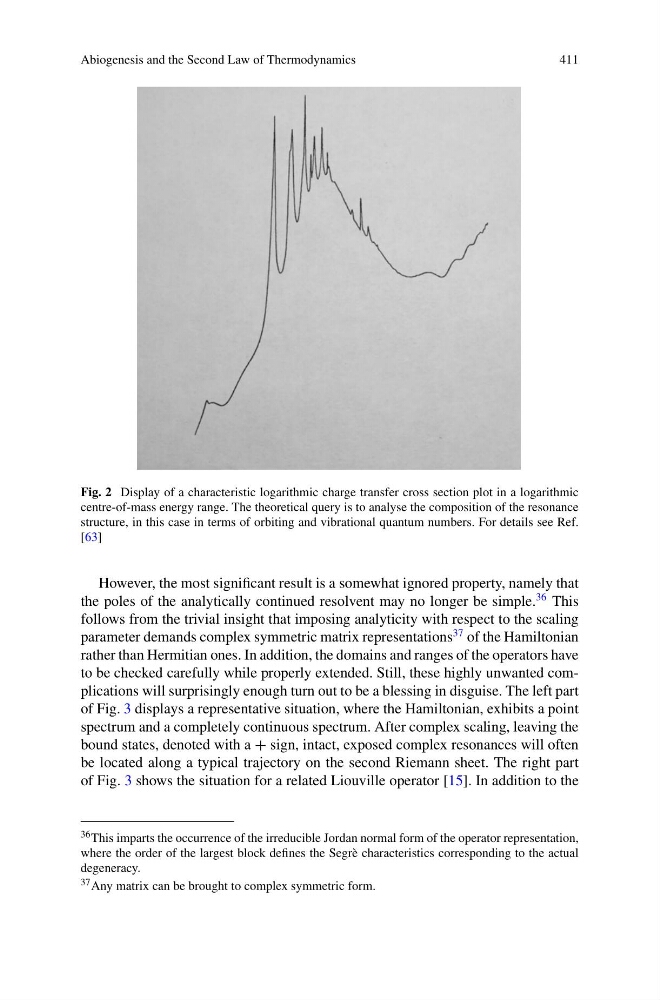
Fig. 2 Display of a characteristic logarithmic charge transfer cross section plot in a logarithmic
centre-of-mass energy range. The theoretical query is to analyse the composition of the resonance
structure, in this case in terms of orbiting and vibrational quantum numbers. For details see Ref.
[63]
However, the most significant result is a somewhat ignored property, namely that
the poles of the analytically continued resolvent may no longer be simple.
36 This
follows from the trivial insight that imposing analyticity with respect to the scaling
parameter demands complex symmetric matrix representations
37 of the Hamiltonian
rather than Hermitian ones. In addition, the domains and ranges of the operators have
to be checked carefully while properly extended. Still, these highly unwanted complications will surprisingly enough turn out to be a blessing in disguise. The left part
of Fig. 3 displays a representative situation, where the Hamiltonian, exhibits a point
spectrum and a completely continuous spectrum. After complex scaling, leaving the
bound states, denoted with a + sign, intact, exposed complex resonances will often
be located along a typical trajectory on the second Riemann sheet. The right part
of Fig. 3 shows the situation for a related Liouville operator [15]. In addition to the
36 This imparts the occurrence of the irreducible Jordan normal form of the operator representation,
where the order of the largest block defines the Segrè characteristics corresponding to the actual
degeneracy.
37 Any matrix can be brought to complex symmetric form.
411
Fig. 2 Display of a characteristic logarithmic charge transfer cross section plot in a logarithmic
centre-of-mass energy range. The theoretical query is to analyse the composition of the resonance
structure, in this case in terms of orbiting and vibrational quantum numbers. For details see Ref.
[63]
However, the most significant result is a somewhat ignored property, namely that
the poles of the analytically continued resolvent may no longer be simple.
36 This
follows from the trivial insight that imposing analyticity with respect to the scaling
parameter demands complex symmetric matrix representations
37 of the Hamiltonian
rather than Hermitian ones. In addition, the domains and ranges of the operators have
to be checked carefully while properly extended. Still, these highly unwanted complications will surprisingly enough turn out to be a blessing in disguise. The left part
of Fig. 3 displays a representative situation, where the Hamiltonian, exhibits a point
spectrum and a completely continuous spectrum. After complex scaling, leaving the
bound states, denoted with a + sign, intact, exposed complex resonances will often
be located along a typical trajectory on the second Riemann sheet. The right part
of Fig. 3 shows the situation for a related Liouville operator [15]. In addition to the
36 This imparts the occurrence of the irreducible Jordan normal form of the operator representation,
where the order of the largest block defines the Segrè characteristics corresponding to the actual
degeneracy.
37 Any matrix can be brought to complex symmetric form.