

Abiogenesis and the Second Law of Thermodynamics
413
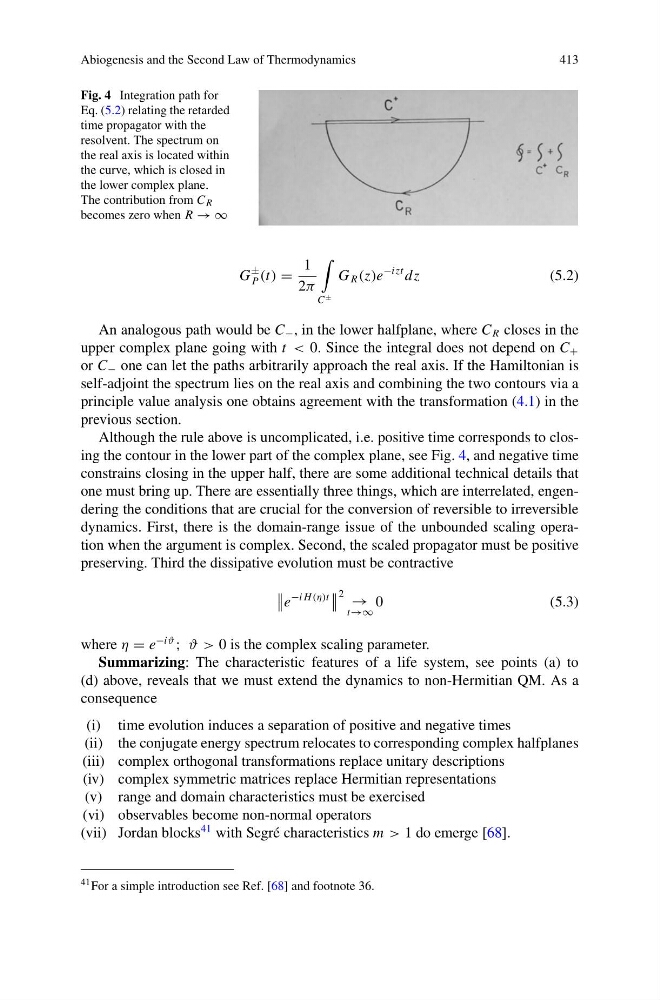
Fig. 4 Integration path for
Eq. (5.2) relating the retarded
time propagator with the
resolvent. The spectrum on
the real axis is located within
the curve, which is closed in
the lower complex plane.
The contribution from C R
becomes zero when R → ∞
G
±
P (t) =
1
2π
C ±
G R (z)e
−izt dz
(5.2)
An analogous path would be C − , in the lower halfplane, where C R closes in the
upper complex plane going with t < 0. Since the integral does not depend on C +
or C − one can let the paths arbitrarily approach the real axis. If the Hamiltonian is
self-adjoint the spectrum lies on the real axis and combining the two contours via a
principle value analysis one obtains agreement with the transformation (4.1) in the
previous section.
Although the rule above is uncomplicated, i.e. positive time corresponds to closing the contour in the lower part of the complex plane, see Fig. 4, and negative time
constrains closing in the upper half, there are some additional technical details that
one must bring up. There are essentially three things, which are interrelated, engendering the conditions that are crucial for the conversion of reversible to irreversible
dynamics. First, there is the domain-range issue of the unbounded scaling operation when the argument is complex. Second, the scaled propagator must be positive
preserving. Third the dissipative evolution must be contractive
e
−i H(η)t
2 →
t→∞
0
(5.3)
where η = e
−iϑ
; ϑ > 0 is the complex scaling parameter.
Summarizing: The characteristic features of a life system, see points (a) to
(d) above, reveals that we must extend the dynamics to non-Hermitian QM. As a
consequence
(i) time evolution induces a separation of positive and negative times
(ii) the conjugate energy spectrum relocates to corresponding complex halfplanes
(iii) complex orthogonal transformations replace unitary descriptions
(iv) complex symmetric matrices replace Hermitian representations
(v) range and domain characteristics must be exercised
(vi) observables become non-normal operators
(vii) Jordan blocks
41 with Segré characteristics m > 1 do emerge [68].
41 For a simple introduction see Ref. [68] and footnote 36.
413
Fig. 4 Integration path for
Eq. (5.2) relating the retarded
time propagator with the
resolvent. The spectrum on
the real axis is located within
the curve, which is closed in
the lower complex plane.
The contribution from C R
becomes zero when R → ∞
G
±
P (t) =
1
2π
C ±
G R (z)e
−izt dz
(5.2)
An analogous path would be C − , in the lower halfplane, where C R closes in the
upper complex plane going with t < 0. Since the integral does not depend on C +
or C − one can let the paths arbitrarily approach the real axis. If the Hamiltonian is
self-adjoint the spectrum lies on the real axis and combining the two contours via a
principle value analysis one obtains agreement with the transformation (4.1) in the
previous section.
Although the rule above is uncomplicated, i.e. positive time corresponds to closing the contour in the lower part of the complex plane, see Fig. 4, and negative time
constrains closing in the upper half, there are some additional technical details that
one must bring up. There are essentially three things, which are interrelated, engendering the conditions that are crucial for the conversion of reversible to irreversible
dynamics. First, there is the domain-range issue of the unbounded scaling operation when the argument is complex. Second, the scaled propagator must be positive
preserving. Third the dissipative evolution must be contractive
e
−i H(η)t
2 →
t→∞
0
(5.3)
where η = e
−iϑ
; ϑ > 0 is the complex scaling parameter.
Summarizing: The characteristic features of a life system, see points (a) to
(d) above, reveals that we must extend the dynamics to non-Hermitian QM. As a
consequence
(i) time evolution induces a separation of positive and negative times
(ii) the conjugate energy spectrum relocates to corresponding complex halfplanes
(iii) complex orthogonal transformations replace unitary descriptions
(iv) complex symmetric matrices replace Hermitian representations
(v) range and domain characteristics must be exercised
(vi) observables become non-normal operators
(vii) Jordan blocks
41 with Segré characteristics m > 1 do emerge [68].
41 For a simple introduction see Ref. [68] and footnote 36.