

Abiogenesis and the Second Law of Thermodynamics
407
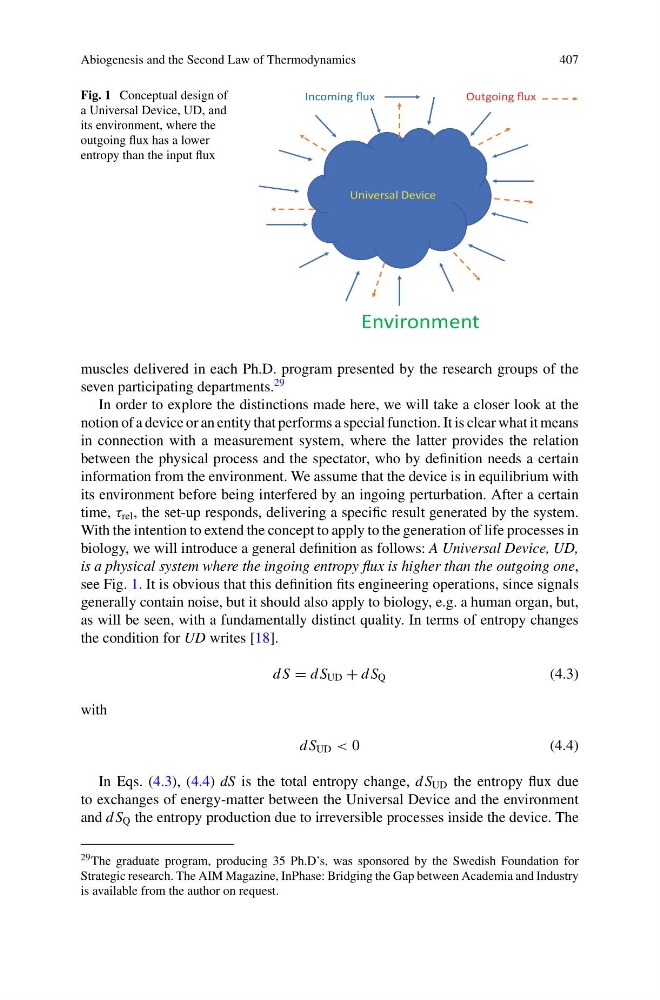
Fig. 1 Conceptual design of
a Universal Device, UD, and
its environment, where the
outgoing flux has a lower
entropy than the input flux
Incoming flux
Outgoing flux
Environment
Universal Device
muscles delivered in each Ph.D. program presented by the research groups of the
seven participating departments.
29
In order to explore the distinctions made here, we will take a closer look at the
notion of a device or an entity that performs a special function. It is clear what it means
in connection with a measurement system, where the latter provides the relation
between the physical process and the spectator, who by definition needs a certain
information from the environment. We assume that the device is in equilibrium with
its environment before being interfered by an ingoing perturbation. After a certain
time, τ rel , the set-up responds, delivering a specific result generated by the system.
With the intention to extend the concept to apply to the generation of life processes in
biology, we will introduce a general definition as follows: A Universal Device, UD,
is a physical system where the ingoing entropy flux is higher than the outgoing one,
see Fig. 1. It is obvious that this definition fits engineering operations, since signals
generally contain noise, but it should also apply to biology, e.g. a human organ, but,
as will be seen, with a fundamentally distinct quality. In terms of entropy changes
the condition for UD writes [18].
d S = d S UD + d S Q
(4.3)
with
d S UD < 0
( 4 . 4 )
In Eqs. (4.3), (4.4) dS is the total entropy change, d S UD the entropy flux due
to exchanges of energy-matter between the Universal Device and the environment
and d S Q the entropy production due to irreversible processes inside the device. The
29 The graduate program, producing 35 Ph.D’s, was sponsored by the Swedish Foundation for
Strategic research. The AIM Magazine, InPhase: Bridging the Gap between Academia and Industry
is available from the author on request.
407
Fig. 1 Conceptual design of
a Universal Device, UD, and
its environment, where the
outgoing flux has a lower
entropy than the input flux
Incoming flux
Outgoing flux
Environment
Universal Device
muscles delivered in each Ph.D. program presented by the research groups of the
seven participating departments.
29
In order to explore the distinctions made here, we will take a closer look at the
notion of a device or an entity that performs a special function. It is clear what it means
in connection with a measurement system, where the latter provides the relation
between the physical process and the spectator, who by definition needs a certain
information from the environment. We assume that the device is in equilibrium with
its environment before being interfered by an ingoing perturbation. After a certain
time, τ rel , the set-up responds, delivering a specific result generated by the system.
With the intention to extend the concept to apply to the generation of life processes in
biology, we will introduce a general definition as follows: A Universal Device, UD,
is a physical system where the ingoing entropy flux is higher than the outgoing one,
see Fig. 1. It is obvious that this definition fits engineering operations, since signals
generally contain noise, but it should also apply to biology, e.g. a human organ, but,
as will be seen, with a fundamentally distinct quality. In terms of entropy changes
the condition for UD writes [18].
d S = d S UD + d S Q
(4.3)
with
d S UD < 0
( 4 . 4 )
In Eqs. (4.3), (4.4) dS is the total entropy change, d S UD the entropy flux due
to exchanges of energy-matter between the Universal Device and the environment
and d S Q the entropy production due to irreversible processes inside the device. The
29 The graduate program, producing 35 Ph.D’s, was sponsored by the Swedish Foundation for
Strategic research. The AIM Magazine, InPhase: Bridging the Gap between Academia and Industry
is available from the author on request.