

406
E. J. Brändas
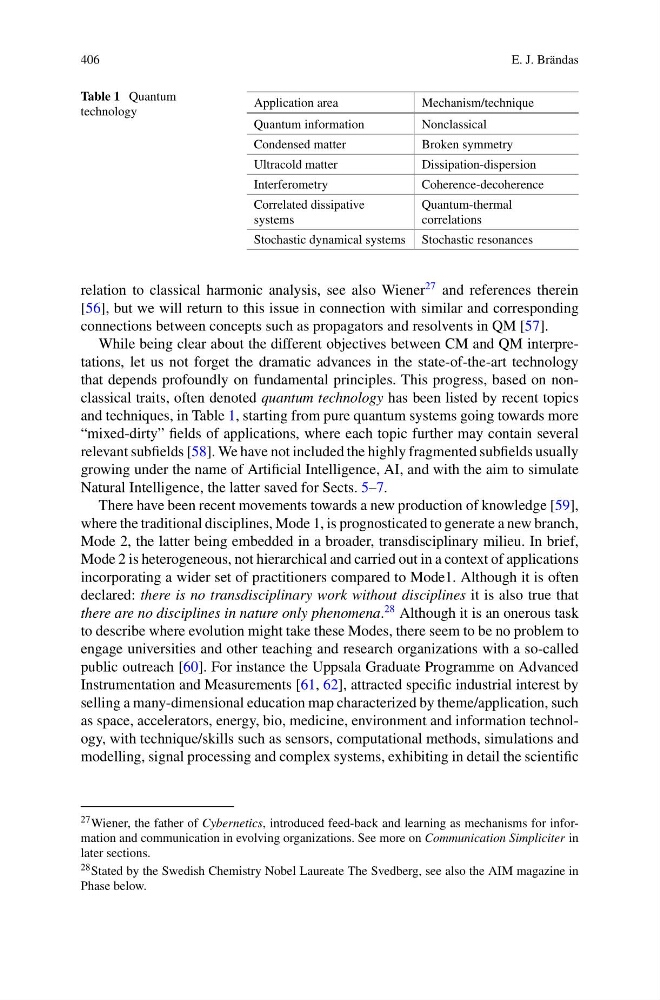
Table 1 Quantum
technology
Application area
Mechanism/technique
Quantum information
Nonclassical
Condensed matter
Broken symmetry
Ultracold matter
Dissipation-dispersion
Interferometry
Coherence-decoherence
Correlated dissipative
systems
Quantum-thermal
correlations
Stochastic dynamical systems Stochastic resonances
relation to classical harmonic analysis, see also Wiener
27 and references therein
[56], but we will return to this issue in connection with similar and corresponding
connections between concepts such as propagators and resolvents in QM [57].
While being clear about the different objectives between CM and QM interpretations, let us not forget the dramatic advances in the state-of-the-art technology
that depends profoundly on fundamental principles. This progress, based on nonclassical traits, often denoted quantum technology has been listed by recent topics
and techniques, in Table 1, starting from pure quantum systems going towards more
“mixed-dirty” fields of applications, where each topic further may contain several
relevant subfields [58]. We have not included the highly fragmented subfields usually
growing under the name of Artificial Intelligence, AI, and with the aim to simulate
Natural Intelligence, the latter saved for Sects. 5–7.
There have been recent movements towards a new production of knowledge [59],
where the traditional disciplines, Mode 1, is prognosticated to generate a new branch,
Mode 2, the latter being embedded in a broader, transdisciplinary milieu. In brief,
Mode 2 is heterogeneous, not hierarchical and carried out in a context of applications
incorporating a wider set of practitioners compared to Mode1. Although it is often
declared: there is no transdisciplinary work without disciplines it is also true that
there are no disciplines in nature only phenomena.
28 Although it is an onerous task
to describe where evolution might take these Modes, there seem to be no problem to
engage universities and other teaching and research organizations with a so-called
public outreach [60]. For instance the Uppsala Graduate Programme on Advanced
Instrumentation and Measurements [61, 62], attracted specific industrial interest by
selling a many-dimensional education map characterized by theme/application, such
as space, accelerators, energy, bio, medicine, environment and information technology, with technique/skills such as sensors, computational methods, simulations and
modelling, signal processing and complex systems, exhibiting in detail the scientific
27 Wiener, the father of Cybernetics, introduced feed-back and learning as mechanisms for information and communication in evolving organizations. See more on Communication Simpliciter in
later sections.
28 Stated by the Swedish Chemistry Nobel Laureate The Svedberg, see also the AIM magazine in
Phase below.
E. J. Brändas
Table 1 Quantum
technology
Application area
Mechanism/technique
Quantum information
Nonclassical
Condensed matter
Broken symmetry
Ultracold matter
Dissipation-dispersion
Interferometry
Coherence-decoherence
Correlated dissipative
systems
Quantum-thermal
correlations
Stochastic dynamical systems Stochastic resonances
relation to classical harmonic analysis, see also Wiener
27 and references therein
[56], but we will return to this issue in connection with similar and corresponding
connections between concepts such as propagators and resolvents in QM [57].
While being clear about the different objectives between CM and QM interpretations, let us not forget the dramatic advances in the state-of-the-art technology
that depends profoundly on fundamental principles. This progress, based on nonclassical traits, often denoted quantum technology has been listed by recent topics
and techniques, in Table 1, starting from pure quantum systems going towards more
“mixed-dirty” fields of applications, where each topic further may contain several
relevant subfields [58]. We have not included the highly fragmented subfields usually
growing under the name of Artificial Intelligence, AI, and with the aim to simulate
Natural Intelligence, the latter saved for Sects. 5–7.
There have been recent movements towards a new production of knowledge [59],
where the traditional disciplines, Mode 1, is prognosticated to generate a new branch,
Mode 2, the latter being embedded in a broader, transdisciplinary milieu. In brief,
Mode 2 is heterogeneous, not hierarchical and carried out in a context of applications
incorporating a wider set of practitioners compared to Mode1. Although it is often
declared: there is no transdisciplinary work without disciplines it is also true that
there are no disciplines in nature only phenomena.
28 Although it is an onerous task
to describe where evolution might take these Modes, there seem to be no problem to
engage universities and other teaching and research organizations with a so-called
public outreach [60]. For instance the Uppsala Graduate Programme on Advanced
Instrumentation and Measurements [61, 62], attracted specific industrial interest by
selling a many-dimensional education map characterized by theme/application, such
as space, accelerators, energy, bio, medicine, environment and information technology, with technique/skills such as sensors, computational methods, simulations and
modelling, signal processing and complex systems, exhibiting in detail the scientific
27 Wiener, the father of Cybernetics, introduced feed-back and learning as mechanisms for information and communication in evolving organizations. See more on Communication Simpliciter in
later sections.
28 Stated by the Swedish Chemistry Nobel Laureate The Svedberg, see also the AIM magazine in
Phase below.