

Abiogenesis and the Second Law of Thermodynamics
405
4 Technology and Quantum Theory
It is worthwhile to remember that signal processing and quantum mechanics, despite
different habits and routines, share a similar mathematical apparatus [53, 54]. In
particular image science concerns various systems, methods, procedures, devices
and techniques to analyse the physical effects that influence the structure of images.
Important advances in the interdisciplinary domain of quantum mechanical signaland spectral analysis have been developed and exploited in medical practice by
Belki´ c [54] utilizing spectral estimators as Padé approximants and the Lanczos
algorithm. Other interdisciplinary applications concern filtering and postprocessing, such as convolution with prolates for optimizing the information contained in
the autocorrelation function and its Fourier transform [55].
Even if the mathematical methods are in many respects identical, there is nevertheless a fundamental distinction to be made. First of all, to practise research,
we are searching for knowledge by accumulating facts by systematic observation,
deliberate experiments and rational theory. In every branch of technology and science, measurement tools link a physical operational process with an observer. The
distinction between the apparatus and the environment, including the observer is
clear-cut. In quantum mechanics there is the notorious measurement problem due to
the fundamental absence of a well-defined fixed observer-system demarcation. While
engineering disciplines, using both CM and QM operations, concern procedures that
treat, handle and mediate devices and sensors, quantum science models the universe
in that each elemental systems are subject to QM. The former constructs tools that
in principle reflect processing data at an arbitrary precision and accuracy, while the
interpretation of QM sets a limit by the Heisenberg uncertainty relations. Granted
that the Fourier transformation between conjugate variables, i.e. between the time
correlation function C(t) and the corresponding Fourier transform in the frequency
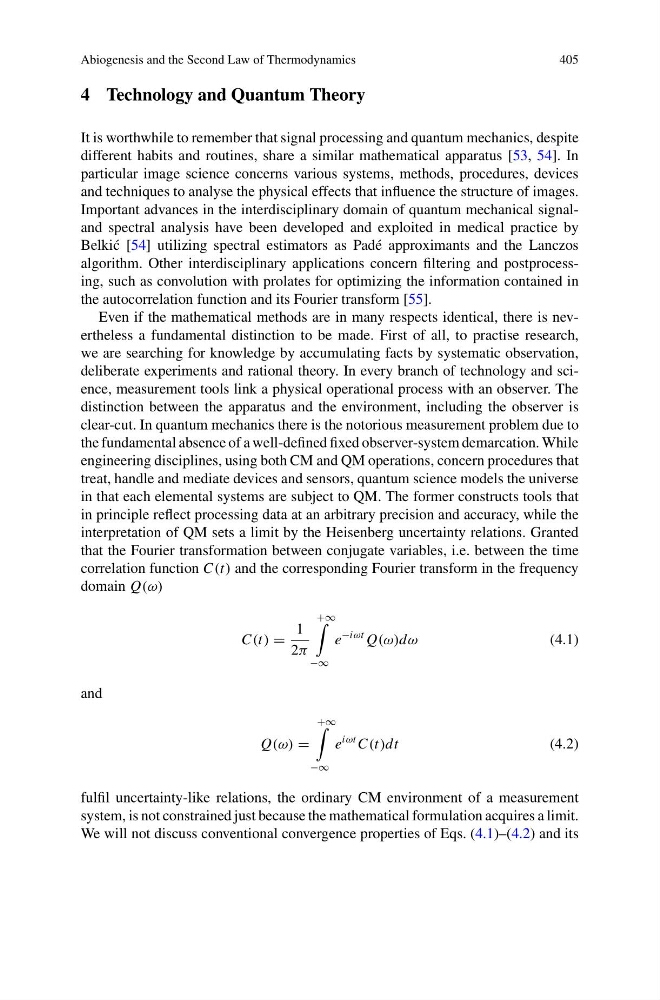
domain Q(ω)
C(t) =
1
2π
+∞
−∞
e
−iωt Q(ω)dω
(4.1)
and
Q(ω) =
+∞
−∞
e
iωt C(t)dt
(4.2)
fulfil uncertainty-like relations, the ordinary CM environment of a measurement
system, is not constrained just because the mathematical formulation acquires a limit.
We will not discuss conventional convergence properties of Eqs. (4.1)–(4.2) and its
405
4 Technology and Quantum Theory
It is worthwhile to remember that signal processing and quantum mechanics, despite
different habits and routines, share a similar mathematical apparatus [53, 54]. In
particular image science concerns various systems, methods, procedures, devices
and techniques to analyse the physical effects that influence the structure of images.
Important advances in the interdisciplinary domain of quantum mechanical signaland spectral analysis have been developed and exploited in medical practice by
Belki´ c [54] utilizing spectral estimators as Padé approximants and the Lanczos
algorithm. Other interdisciplinary applications concern filtering and postprocessing, such as convolution with prolates for optimizing the information contained in
the autocorrelation function and its Fourier transform [55].
Even if the mathematical methods are in many respects identical, there is nevertheless a fundamental distinction to be made. First of all, to practise research,
we are searching for knowledge by accumulating facts by systematic observation,
deliberate experiments and rational theory. In every branch of technology and science, measurement tools link a physical operational process with an observer. The
distinction between the apparatus and the environment, including the observer is
clear-cut. In quantum mechanics there is the notorious measurement problem due to
the fundamental absence of a well-defined fixed observer-system demarcation. While
engineering disciplines, using both CM and QM operations, concern procedures that
treat, handle and mediate devices and sensors, quantum science models the universe
in that each elemental systems are subject to QM. The former constructs tools that
in principle reflect processing data at an arbitrary precision and accuracy, while the
interpretation of QM sets a limit by the Heisenberg uncertainty relations. Granted
that the Fourier transformation between conjugate variables, i.e. between the time
correlation function C(t) and the corresponding Fourier transform in the frequency
domain Q(ω)
C(t) =
1
2π
+∞
−∞
e
−iωt Q(ω)dω
(4.1)
and
Q(ω) =
+∞
−∞
e
iωt C(t)dt
(4.2)
fulfil uncertainty-like relations, the ordinary CM environment of a measurement
system, is not constrained just because the mathematical formulation acquires a limit.
We will not discuss conventional convergence properties of Eqs. (4.1)–(4.2) and its