

402
E. J. Brändas
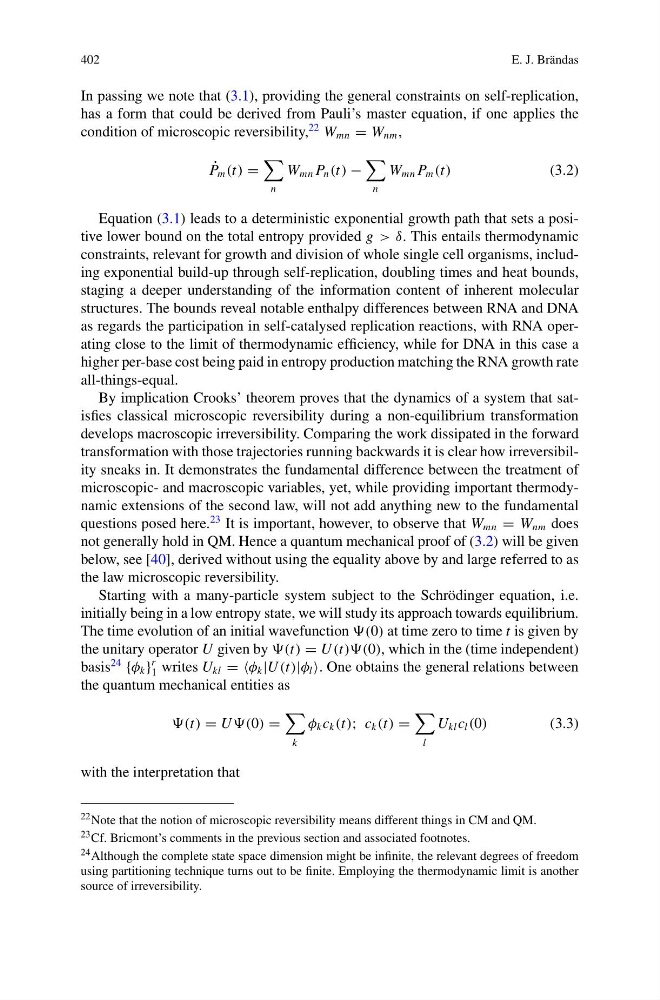
In passing we note that (3.1), providing the general constraints on self-replication,
has a form that could be derived from Pauli’s master equation, if one applies the
condition of microscopic reversibility,
22 W mn = W nm ,
˙
P m (t) =
n
W mn P n (t) −
n
W mn P m (t)
(3.2)
Equation (3.1) leads to a deterministic exponential growth path that sets a positive lower bound on the total entropy provided g > δ. This entails thermodynamic
constraints, relevant for growth and division of whole single cell organisms, including exponential build-up through self-replication, doubling times and heat bounds,
staging a deeper understanding of the information content of inherent molecular
structures. The bounds reveal notable enthalpy differences between RNA and DNA
as regards the participation in self-catalysed replication reactions, with RNA operating close to the limit of thermodynamic efficiency, while for DNA in this case a
higher per-base cost being paid in entropy production matching the RNA growth rate
all-things-equal.
By implication Crooks’ theorem proves that the dynamics of a system that satisfies classical microscopic reversibility during a non-equilibrium transformation
develops macroscopic irreversibility. Comparing the work dissipated in the forward
transformation with those trajectories running backwards it is clear how irreversibility sneaks in. It demonstrates the fundamental difference between the treatment of
microscopic- and macroscopic variables, yet, while providing important thermodynamic extensions of the second law, will not add anything new to the fundamental
questions posed here.
23 It is important, however, to observe that W mn = W nm does
not generally hold in QM. Hence a quantum mechanical proof of (3.2) will be given
below, see [40], derived without using the equality above by and large referred to as
the law microscopic reversibility.
Starting with a many-particle system subject to the Schrödinger equation, i.e.
initially being in a low entropy state, we will study its approach towards equilibrium.
The time evolution of an initial wavefunction (0) at time zero to time t is given by
the unitary operator U given by (t) = U (t)(0), which in the (time independent)
basis
24
{φ k }
r
1 writes U kl = φ k |U (t)|φ l . One obtains the general relations between
the quantum mechanical entities as
(t) = U (0) =
k
φ k c k (t); c k (t) =
l
U kl c l (0)
(3.3)
with the interpretation that
22 Note that the notion of microscopic reversibility means different things in CM and QM.
23 Cf. Bricmont’s comments in the previous section and associated footnotes.
24 Although the complete state space dimension might be infinite, the relevant degrees of freedom
using partitioning technique turns out to be finite. Employing the thermodynamic limit is another
source of irreversibility.
E. J. Brändas
In passing we note that (3.1), providing the general constraints on self-replication,
has a form that could be derived from Pauli’s master equation, if one applies the
condition of microscopic reversibility,
22 W mn = W nm ,
˙
P m (t) =
n
W mn P n (t) −
n
W mn P m (t)
(3.2)
Equation (3.1) leads to a deterministic exponential growth path that sets a positive lower bound on the total entropy provided g > δ. This entails thermodynamic
constraints, relevant for growth and division of whole single cell organisms, including exponential build-up through self-replication, doubling times and heat bounds,
staging a deeper understanding of the information content of inherent molecular
structures. The bounds reveal notable enthalpy differences between RNA and DNA
as regards the participation in self-catalysed replication reactions, with RNA operating close to the limit of thermodynamic efficiency, while for DNA in this case a
higher per-base cost being paid in entropy production matching the RNA growth rate
all-things-equal.
By implication Crooks’ theorem proves that the dynamics of a system that satisfies classical microscopic reversibility during a non-equilibrium transformation
develops macroscopic irreversibility. Comparing the work dissipated in the forward
transformation with those trajectories running backwards it is clear how irreversibility sneaks in. It demonstrates the fundamental difference between the treatment of
microscopic- and macroscopic variables, yet, while providing important thermodynamic extensions of the second law, will not add anything new to the fundamental
questions posed here.
23 It is important, however, to observe that W mn = W nm does
not generally hold in QM. Hence a quantum mechanical proof of (3.2) will be given
below, see [40], derived without using the equality above by and large referred to as
the law microscopic reversibility.
Starting with a many-particle system subject to the Schrödinger equation, i.e.
initially being in a low entropy state, we will study its approach towards equilibrium.
The time evolution of an initial wavefunction (0) at time zero to time t is given by
the unitary operator U given by (t) = U (t)(0), which in the (time independent)
basis
24
{φ k }
r
1 writes U kl = φ k |U (t)|φ l . One obtains the general relations between
the quantum mechanical entities as
(t) = U (0) =
k
φ k c k (t); c k (t) =
l
U kl c l (0)
(3.3)
with the interpretation that
22 Note that the notion of microscopic reversibility means different things in CM and QM.
23 Cf. Bricmont’s comments in the previous section and associated footnotes.
24 Although the complete state space dimension might be infinite, the relevant degrees of freedom
using partitioning technique turns out to be finite. Employing the thermodynamic limit is another
source of irreversibility.