

Abiogenesis and the Second Law of Thermodynamics
401
Order [43], ODLRO, identified by a sudden appearance of a large eigenvalue in the
fermionic second-order reduced density matrix, providing the mathematical conditions for Coleman’s concept of so-called extreme states [44]. We leave these issues
briefly, but will return further below.
Viewing from the unfolding Plenary Debate: Quantum Effects in Biology: Trivial
or Not? [25], the general understanding transpired as collaborations between experimental and theoretical physics,
19 cosmology, electrical- electronic- and biomedical
engineering, with inputs from structural biology, medicine and psychology. Since
the panellists were partitioned for the purpose of a lively debate, wittily with those in
favour of quantum effects in biology to be the no-team, it foreshadowed an entertaining and outspoken encounter, however not always reflecting the true opinions of the
contributors, yet with some of the main actors sincerely contesting the pros and cons.
It was agreed that the crux of the matter was the word trivial mostly interpreted here
to mean quantum mechanics is the default position, see Davies [25], while nontrivial
was indicated as something that would convince biologists that they need to learn
quantum mechanics, Wiseman [25]. Except for pioneering experimental and theoretical advances related to quantum entanglement, see e.g. Zeilinger [45],
20 many
technological advances in material science, chemistry and genetics, being the source
of dramatic progress in human understanding and the manufacturing of medicines
and pharmaceuticals, were actually missing in the debate, which therefore ran the
risk of being trivialized by the panellists. Hence, one of the conclusions emerged that,
if life nontrivially should emerge from the quantum mechanical material world complex, intermediate chemistry would not be necessary.
21 This view will be challenged
in this work.
To reconnect with the fundamental work of Eigen, Prigogine and others, let us first
take a short look at some recent advances in non-equilibrium statistical mechanics. An
interesting concept, known as Crooks’ fluctuation theorem [46] relating free energy
differences and irreversible work along an ensemble joining the states, also known
as the Jarzynski equality [47], has recently been applied to self-replicating nuclear
acids and bacterial cell division by England [48]. The derivation shows macroscopic
irreversibility from microscopic reversibility relating the populations of microscopic
trajectories in the forward direction with the time reversed ones. The ensuing master
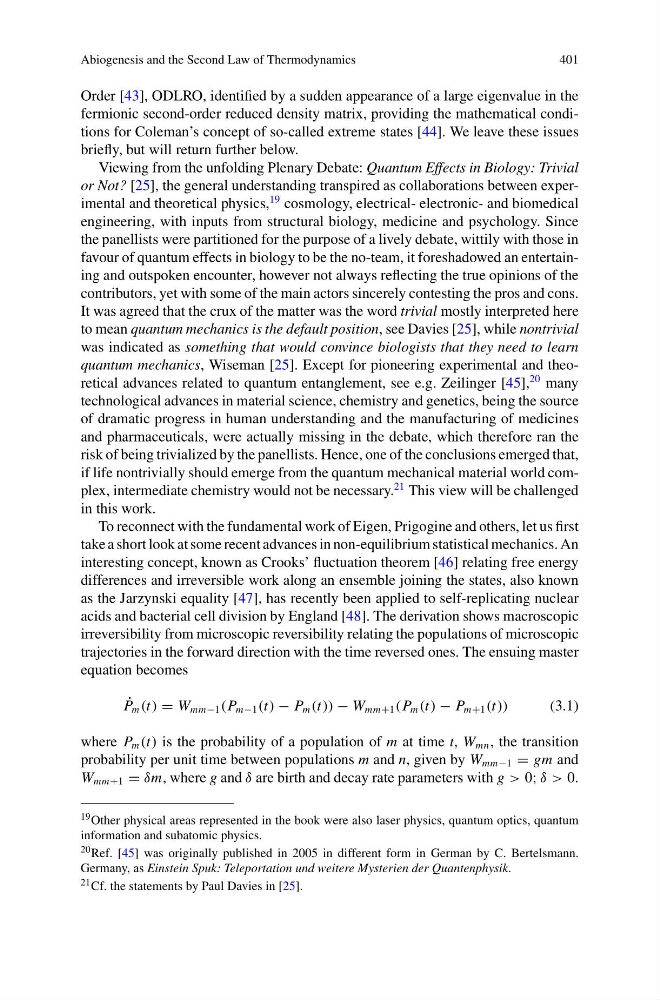
equation becomes
˙
P m (t) = W mm−1 (P m−1 (t) − P m (t)) − W mm+1 (P m (t) − P m+1 (t))
(3.1)
where P m (t) is the probability of a population of m at time t, W mn , the transition
probability per unit time between populations m and n, given by W mm−1 = gm and
W mm+1 = δm, where g and δ are birth and decay rate parameters with g > 0; δ > 0.
19 Other physical areas represented in the book were also laser physics, quantum optics, quantum
information and subatomic physics.
20 Ref. [45] was originally published in 2005 in different form in German by C. Bertelsmann.
Germany, as Einstein Spuk: Teleportation und weitere Mysterien der Quantenphysik.
21 Cf. the statements by Paul Davies in [25].
401
Order [43], ODLRO, identified by a sudden appearance of a large eigenvalue in the
fermionic second-order reduced density matrix, providing the mathematical conditions for Coleman’s concept of so-called extreme states [44]. We leave these issues
briefly, but will return further below.
Viewing from the unfolding Plenary Debate: Quantum Effects in Biology: Trivial
or Not? [25], the general understanding transpired as collaborations between experimental and theoretical physics,
19 cosmology, electrical- electronic- and biomedical
engineering, with inputs from structural biology, medicine and psychology. Since
the panellists were partitioned for the purpose of a lively debate, wittily with those in
favour of quantum effects in biology to be the no-team, it foreshadowed an entertaining and outspoken encounter, however not always reflecting the true opinions of the
contributors, yet with some of the main actors sincerely contesting the pros and cons.
It was agreed that the crux of the matter was the word trivial mostly interpreted here
to mean quantum mechanics is the default position, see Davies [25], while nontrivial
was indicated as something that would convince biologists that they need to learn
quantum mechanics, Wiseman [25]. Except for pioneering experimental and theoretical advances related to quantum entanglement, see e.g. Zeilinger [45],
20 many
technological advances in material science, chemistry and genetics, being the source
of dramatic progress in human understanding and the manufacturing of medicines
and pharmaceuticals, were actually missing in the debate, which therefore ran the
risk of being trivialized by the panellists. Hence, one of the conclusions emerged that,
if life nontrivially should emerge from the quantum mechanical material world complex, intermediate chemistry would not be necessary.
21 This view will be challenged
in this work.
To reconnect with the fundamental work of Eigen, Prigogine and others, let us first
take a short look at some recent advances in non-equilibrium statistical mechanics. An
interesting concept, known as Crooks’ fluctuation theorem [46] relating free energy
differences and irreversible work along an ensemble joining the states, also known
as the Jarzynski equality [47], has recently been applied to self-replicating nuclear
acids and bacterial cell division by England [48]. The derivation shows macroscopic
irreversibility from microscopic reversibility relating the populations of microscopic
trajectories in the forward direction with the time reversed ones. The ensuing master
equation becomes
˙
P m (t) = W mm−1 (P m−1 (t) − P m (t)) − W mm+1 (P m (t) − P m+1 (t))
(3.1)
where P m (t) is the probability of a population of m at time t, W mn , the transition
probability per unit time between populations m and n, given by W mm−1 = gm and
W mm+1 = δm, where g and δ are birth and decay rate parameters with g > 0; δ > 0.
19 Other physical areas represented in the book were also laser physics, quantum optics, quantum
information and subatomic physics.
20 Ref. [45] was originally published in 2005 in different form in German by C. Bertelsmann.
Germany, as Einstein Spuk: Teleportation und weitere Mysterien der Quantenphysik.
21 Cf. the statements by Paul Davies in [25].