

Abiogenesis and the Second Law of Thermodynamics
403
P k (t) = |c k (t)|
2
(3.4)
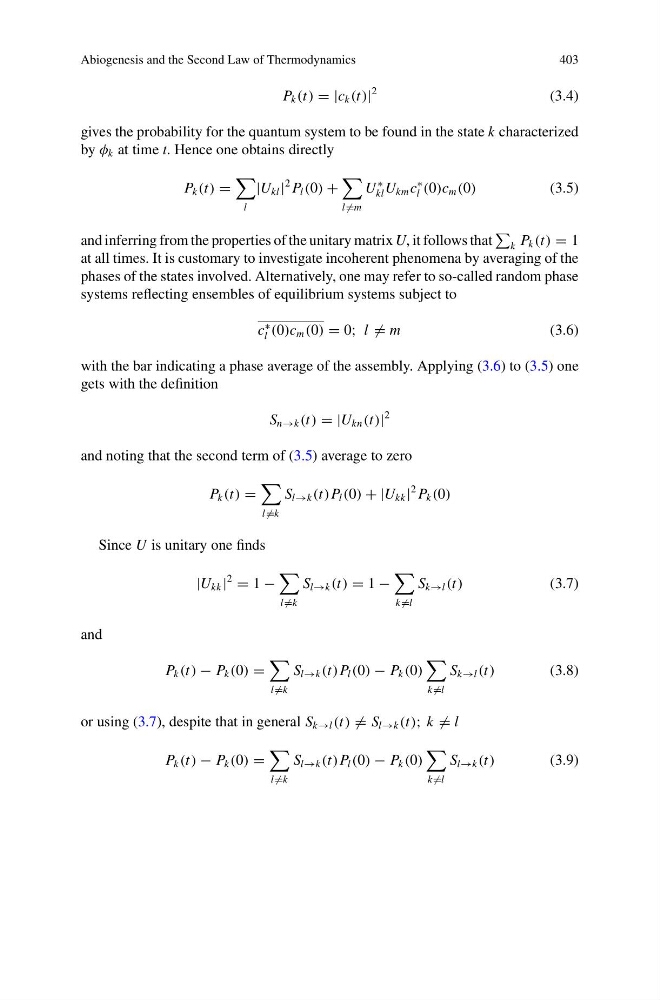
gives the probability for the quantum system to be found in the state k characterized
by φ k at time t. Hence one obtains directly
P k (t) =
l
|U kl |
2 P l (0) +
l =m
U
∗
kl U km c
∗
l (0)c m (0)
(3.5)
and inferring from the properties of the unitary matrix U, it follows that
k P k (t) = 1
at all times. It is customary to investigate incoherent phenomena by averaging of the
phases of the states involved. Alternatively, one may refer to so-called random phase
systems reflecting ensembles of equilibrium systems subject to
c
∗
l (0)c m (0) = 0; l = m
(3.6)
with the bar indicating a phase average of the assembly. Applying (3.6) to (3.5) one
gets with the definition
S n→k (t) = |U kn (t)|
2
and noting that the second term of (3.5) average to zero
P k (t) =
l =k
S l→k (t)P l (0) + |U kk |
2 P k (0)
Since U is unitary one finds
|U kk |
2
= 1 −
l =k
S l→k (t) = 1 −
k =l
S k→l (t)
(3.7)
and
P k (t) − P k (0) =
l =k
S l→k (t)P l (0) − P k (0)
k =l
S k→l (t)
(3.8)
or using (3.7), despite that in general S k→l (t) = S l→k (t); k = l
P k (t) − P k (0) =
l =k
S l→k (t)P l (0) − P k (0)
k =l
S l→k (t)
(3.9)
403
P k (t) = |c k (t)|
2
(3.4)
gives the probability for the quantum system to be found in the state k characterized
by φ k at time t. Hence one obtains directly
P k (t) =
l
|U kl |
2 P l (0) +
l =m
U
∗
kl U km c
∗
l (0)c m (0)
(3.5)
and inferring from the properties of the unitary matrix U, it follows that
k P k (t) = 1
at all times. It is customary to investigate incoherent phenomena by averaging of the
phases of the states involved. Alternatively, one may refer to so-called random phase
systems reflecting ensembles of equilibrium systems subject to
c
∗
l (0)c m (0) = 0; l = m
(3.6)
with the bar indicating a phase average of the assembly. Applying (3.6) to (3.5) one
gets with the definition
S n→k (t) = |U kn (t)|
2
and noting that the second term of (3.5) average to zero
P k (t) =
l =k
S l→k (t)P l (0) + |U kk |
2 P k (0)
Since U is unitary one finds
|U kk |
2
= 1 −
l =k
S l→k (t) = 1 −
k =l
S k→l (t)
(3.7)
and
P k (t) − P k (0) =
l =k
S l→k (t)P l (0) − P k (0)
k =l
S k→l (t)
(3.8)
or using (3.7), despite that in general S k→l (t) = S l→k (t); k = l
P k (t) − P k (0) =
l =k
S l→k (t)P l (0) − P k (0)
k =l
S l→k (t)
(3.9)