

Megascopic Quantum Phenomena
363
physics, based on Bohr’s correspondence principle. Therefore contemporary quantum physics has never succeeded to explain the Meissner effect, and if not the Meissner effect, it also concerns superconductivity. Any attempt to find their microscopic
solutions inevitably implicates the breakdown of Bohr’s correspondence principle,
see Sect. 9. Thus the BCS theory and all theories, based on the microscopic dynamics of the superconducting carriers, whatever these carries may be, whether unpaired
or Cooper paired electrons, polarons, bipolarons etc., are still inadequate. Only a
holistic megascopic quantum theory is able to overthrow the traditional corpuscular
philosophy, and to explain the Meissner effect and superconductivity.
Most physicists agree, that superfluidity should have an analogous explanation
as compared to superconductivity. However if superconductivity has no microscopic
explanation, superfluidity does not, too. Superfluidity shares with superconductivity
the macroscopic wave function (14.1). In a similar way, cf. Eq. (14.2), follows from
(14.1) in the case of superconductors, that we can write
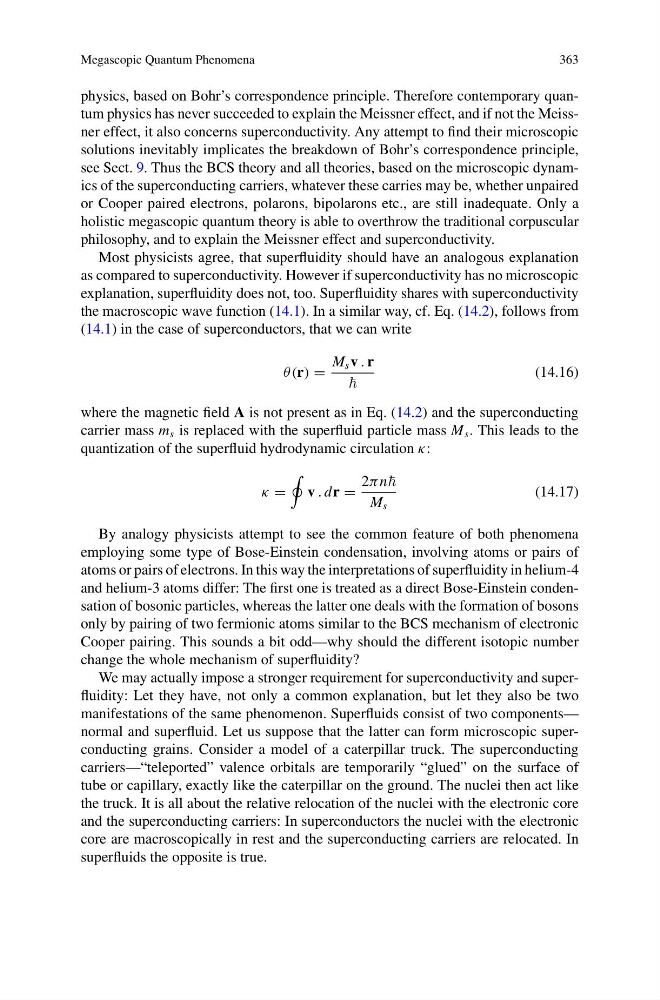
θ (r) =
M s v . r
(14.16)
where the magnetic field A is not present as in Eq. (14.2) and the superconducting
carrier mass m s is replaced with the superfluid particle mass M s . This leads to the
quantization of the superfluid hydrodynamic circulation κ:
κ =
v . dr =
2π n
M s
(14.17)
By analogy physicists attempt to see the common feature of both phenomena
employing some type of Bose-Einstein condensation, involving atoms or pairs of
atoms or pairs of electrons. In this way the interpretations of superfluidity in helium-4
and helium-3 atoms differ: The first one is treated as a direct Bose-Einstein condensation of bosonic particles, whereas the latter one deals with the formation of bosons
only by pairing of two fermionic atoms similar to the BCS mechanism of electronic
Cooper pairing. This sounds a bit odd—why should the different isotopic number
change the whole mechanism of superfluidity?
We may actually impose a stronger requirement for superconductivity and superfluidity: Let they have, not only a common explanation, but let they also be two
manifestations of the same phenomenon. Superfluids consist of two components—
normal and superfluid. Let us suppose that the latter can form microscopic superconducting grains. Consider a model of a caterpillar truck. The superconducting
carriers—“teleported” valence orbitals are temporarily “glued” on the surface of
tube or capillary, exactly like the caterpillar on the ground. The nuclei then act like
the truck. It is all about the relative relocation of the nuclei with the electronic core
and the superconducting carriers: In superconductors the nuclei with the electronic
core are macroscopically in rest and the superconducting carriers are relocated. In
superfluids the opposite is true.
363
physics, based on Bohr’s correspondence principle. Therefore contemporary quantum physics has never succeeded to explain the Meissner effect, and if not the Meissner effect, it also concerns superconductivity. Any attempt to find their microscopic
solutions inevitably implicates the breakdown of Bohr’s correspondence principle,
see Sect. 9. Thus the BCS theory and all theories, based on the microscopic dynamics of the superconducting carriers, whatever these carries may be, whether unpaired
or Cooper paired electrons, polarons, bipolarons etc., are still inadequate. Only a
holistic megascopic quantum theory is able to overthrow the traditional corpuscular
philosophy, and to explain the Meissner effect and superconductivity.
Most physicists agree, that superfluidity should have an analogous explanation
as compared to superconductivity. However if superconductivity has no microscopic
explanation, superfluidity does not, too. Superfluidity shares with superconductivity
the macroscopic wave function (14.1). In a similar way, cf. Eq. (14.2), follows from
(14.1) in the case of superconductors, that we can write
θ (r) =
M s v . r
(14.16)
where the magnetic field A is not present as in Eq. (14.2) and the superconducting
carrier mass m s is replaced with the superfluid particle mass M s . This leads to the
quantization of the superfluid hydrodynamic circulation κ:
κ =
v . dr =
2π n
M s
(14.17)
By analogy physicists attempt to see the common feature of both phenomena
employing some type of Bose-Einstein condensation, involving atoms or pairs of
atoms or pairs of electrons. In this way the interpretations of superfluidity in helium-4
and helium-3 atoms differ: The first one is treated as a direct Bose-Einstein condensation of bosonic particles, whereas the latter one deals with the formation of bosons
only by pairing of two fermionic atoms similar to the BCS mechanism of electronic
Cooper pairing. This sounds a bit odd—why should the different isotopic number
change the whole mechanism of superfluidity?
We may actually impose a stronger requirement for superconductivity and superfluidity: Let they have, not only a common explanation, but let they also be two
manifestations of the same phenomenon. Superfluids consist of two components—
normal and superfluid. Let us suppose that the latter can form microscopic superconducting grains. Consider a model of a caterpillar truck. The superconducting
carriers—“teleported” valence orbitals are temporarily “glued” on the surface of
tube or capillary, exactly like the caterpillar on the ground. The nuclei then act like
the truck. It is all about the relative relocation of the nuclei with the electronic core
and the superconducting carriers: In superconductors the nuclei with the electronic
core are macroscopically in rest and the superconducting carriers are relocated. In
superfluids the opposite is true.