

362
M. Svrˇ cek
megascopic interpretation, unlike the BCS theory which associates this phase with
the motion of carriers in Bloch’s k space, the phase is associated with the macroscopic
l space, orthogonal to the Bloch k space:
θ (r) = l . r; l =
m s μa
τ
; m s = 2m e
(14.12)
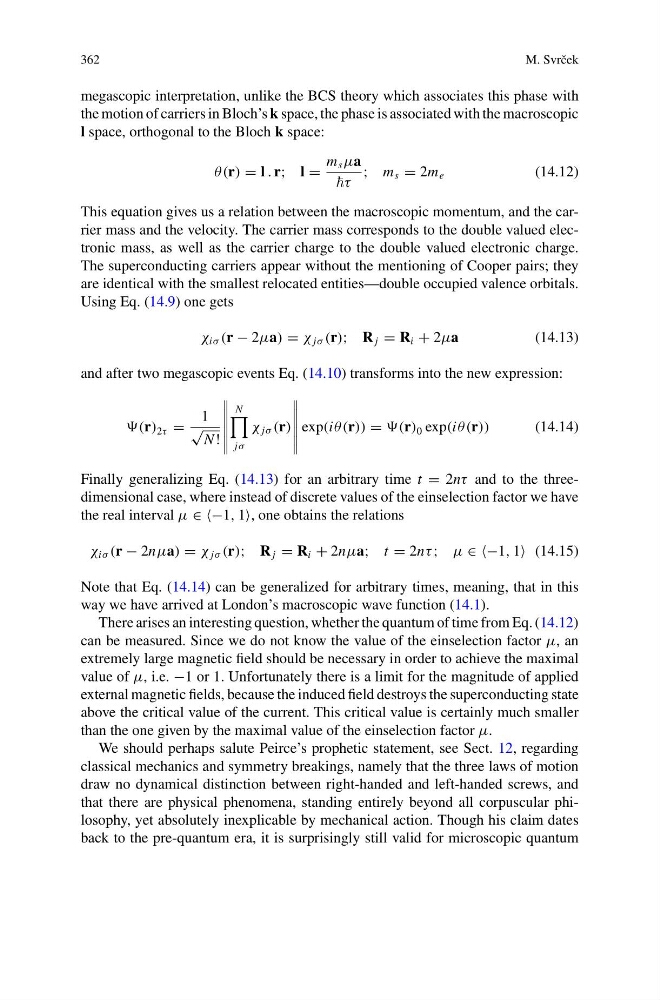
This equation gives us a relation between the macroscopic momentum, and the carrier mass and the velocity. The carrier mass corresponds to the double valued electronic mass, as well as the carrier charge to the double valued electronic charge.
The superconducting carriers appear without the mentioning of Cooper pairs; they
are identical with the smallest relocated entities—double occupied valence orbitals.
Using Eq. (14.9) one gets
χ iσ (r − 2μa) = χ jσ (r); R j = R i + 2μa
(14.13)
and after two megascopic events Eq. (14.10) transforms into the new expression:
(r) 2τ =
1
√
N !
N
jσ
χ jσ (r)
exp(iθ (r)) = (r) 0 exp(iθ (r))
(14.14)
Finally generalizing Eq. (14.13) for an arbitrary time t = 2nτ and to the threedimensional case, where instead of discrete values of the einselection factor we have
the real interval μ ∈ −1, 1, one obtains the relations
χ iσ (r − 2nμa) = χ jσ (r); R j = R i + 2nμa; t = 2nτ ; μ ∈ −1, 1 (14.15)
Note that Eq. (14.14) can be generalized for arbitrary times, meaning, that in this
way we have arrived at London’s macroscopic wave function (14.1).
There arises an interesting question, whether the quantum of time from Eq. (14.12)
can be measured. Since we do not know the value of the einselection factor μ, an
extremely large magnetic field should be necessary in order to achieve the maximal
value of μ, i.e. −1 or 1. Unfortunately there is a limit for the magnitude of applied
external magnetic fields, because the induced field destroys the superconducting state
above the critical value of the current. This critical value is certainly much smaller
than the one given by the maximal value of the einselection factor μ.
We should perhaps salute Peirce’s prophetic statement, see Sect. 12, regarding
classical mechanics and symmetry breakings, namely that the three laws of motion
draw no dynamical distinction between right-handed and left-handed screws, and
that there are physical phenomena, standing entirely beyond all corpuscular philosophy, yet absolutely inexplicable by mechanical action. Though his claim dates
back to the pre-quantum era, it is surprisingly still valid for microscopic quantum
M. Svrˇ cek
megascopic interpretation, unlike the BCS theory which associates this phase with
the motion of carriers in Bloch’s k space, the phase is associated with the macroscopic
l space, orthogonal to the Bloch k space:
θ (r) = l . r; l =
m s μa
τ
; m s = 2m e
(14.12)
This equation gives us a relation between the macroscopic momentum, and the carrier mass and the velocity. The carrier mass corresponds to the double valued electronic mass, as well as the carrier charge to the double valued electronic charge.
The superconducting carriers appear without the mentioning of Cooper pairs; they
are identical with the smallest relocated entities—double occupied valence orbitals.
Using Eq. (14.9) one gets
χ iσ (r − 2μa) = χ jσ (r); R j = R i + 2μa
(14.13)
and after two megascopic events Eq. (14.10) transforms into the new expression:
(r) 2τ =
1
√
N !
N
jσ
χ jσ (r)
exp(iθ (r)) = (r) 0 exp(iθ (r))
(14.14)
Finally generalizing Eq. (14.13) for an arbitrary time t = 2nτ and to the threedimensional case, where instead of discrete values of the einselection factor we have
the real interval μ ∈ −1, 1, one obtains the relations
χ iσ (r − 2nμa) = χ jσ (r); R j = R i + 2nμa; t = 2nτ ; μ ∈ −1, 1 (14.15)
Note that Eq. (14.14) can be generalized for arbitrary times, meaning, that in this
way we have arrived at London’s macroscopic wave function (14.1).
There arises an interesting question, whether the quantum of time from Eq. (14.12)
can be measured. Since we do not know the value of the einselection factor μ, an
extremely large magnetic field should be necessary in order to achieve the maximal
value of μ, i.e. −1 or 1. Unfortunately there is a limit for the magnitude of applied
external magnetic fields, because the induced field destroys the superconducting state
above the critical value of the current. This critical value is certainly much smaller
than the one given by the maximal value of the einselection factor μ.
We should perhaps salute Peirce’s prophetic statement, see Sect. 12, regarding
classical mechanics and symmetry breakings, namely that the three laws of motion
draw no dynamical distinction between right-handed and left-handed screws, and
that there are physical phenomena, standing entirely beyond all corpuscular philosophy, yet absolutely inexplicable by mechanical action. Though his claim dates
back to the pre-quantum era, it is surprisingly still valid for microscopic quantum