

Megascopic Quantum Phenomena
333
The first part (11.39) is of a pure one-fermion origin and has a non-diagonal form.
The second part is a vacuum value of type 0|B r B s |0 and/or 0| B r B s |0 of the mixed
fermion-boson terms, where the bosonic part is of the quadratic form of coordinate
and/or momentum operators.
We can now demonstrate the simplest applications of these general equations
where the field COM covariant theory reduces to the classical mechanical COM
separation limit, i.e. ω = ˜
ω and only the Goldstone bosons descending from the
Galilean broken symmetries—vibrations/phonons—are taken into consideration. We
will present the limits of the four examples leading up to Pople’s equations, Fröhlich’s ground state energy correction and the effective two-electron Hamiltonian, and
the Lee-Low-Pines polarons. These four cases were particularly mentioned as they
immediately follow from the pure electron-vibrational theory [103]. We start with
the four cases and continue with three more related to the Born-Huang ansatz.
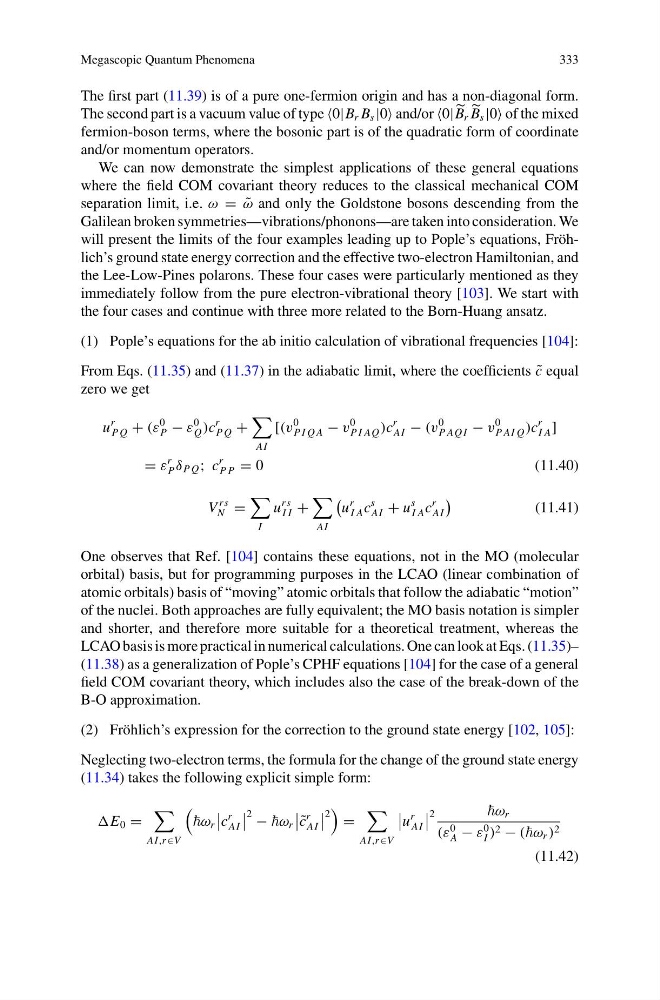
(1) Pople’s equations for the ab initio calculation of vibrational frequencies [104]:
From Eqs. (11.35) and (11.37) in the adiabatic limit, where the coefficients ˜
c equal
zero we get
u
r
P Q + (ε
0
P − ε
0
Q )c
r
P Q +
AI
[(v
0
P I Q A − v
0
P I AQ )c
r
AI − (v
0
P AQI − v
0
P AI Q )c
r
I A ]
= ε
r
P δ P Q ; c
r
P P = 0
(11.40)
V
rs
N =
I
u
rs
I I +
AI
u
r
I A c
s
AI + u
s
I A c
r
AI
(11.41)
One observes that Ref. [104] contains these equations, not in the MO (molecular
orbital) basis, but for programming purposes in the LCAO (linear combination of
atomic orbitals) basis of “moving” atomic orbitals that follow the adiabatic “motion”
of the nuclei. Both approaches are fully equivalent; the MO basis notation is simpler
and shorter, and therefore more suitable for a theoretical treatment, whereas the
LCAO basis is more practical in numerical calculations. One can look at Eqs. (11.35)–
(11.38) as a generalization of Pople’s CPHF equations [104] for the case of a general
field COM covariant theory, which includes also the case of the break-down of the
B-O approximation.
(2) Fröhlich’s expression for the correction to the ground state energy [102, 105]:
Neglecting two-electron terms, the formula for the change of the ground state energy
(11.34) takes the following explicit simple form:
E 0 =
AI,r ∈V
ω r
c
r
AI
2 − ω r
˜
c
r
AI
2
=
AI,r ∈V
u
r
AI
2
ω r
(ε
0
A − ε
0
I ) 2 − (ω r ) 2
(11.42)
333
The first part (11.39) is of a pure one-fermion origin and has a non-diagonal form.
The second part is a vacuum value of type 0|B r B s |0 and/or 0| B r B s |0 of the mixed
fermion-boson terms, where the bosonic part is of the quadratic form of coordinate
and/or momentum operators.
We can now demonstrate the simplest applications of these general equations
where the field COM covariant theory reduces to the classical mechanical COM
separation limit, i.e. ω = ˜
ω and only the Goldstone bosons descending from the
Galilean broken symmetries—vibrations/phonons—are taken into consideration. We
will present the limits of the four examples leading up to Pople’s equations, Fröhlich’s ground state energy correction and the effective two-electron Hamiltonian, and
the Lee-Low-Pines polarons. These four cases were particularly mentioned as they
immediately follow from the pure electron-vibrational theory [103]. We start with
the four cases and continue with three more related to the Born-Huang ansatz.
(1) Pople’s equations for the ab initio calculation of vibrational frequencies [104]:
From Eqs. (11.35) and (11.37) in the adiabatic limit, where the coefficients ˜
c equal
zero we get
u
r
P Q + (ε
0
P − ε
0
Q )c
r
P Q +
AI
[(v
0
P I Q A − v
0
P I AQ )c
r
AI − (v
0
P AQI − v
0
P AI Q )c
r
I A ]
= ε
r
P δ P Q ; c
r
P P = 0
(11.40)
V
rs
N =
I
u
rs
I I +
AI
u
r
I A c
s
AI + u
s
I A c
r
AI
(11.41)
One observes that Ref. [104] contains these equations, not in the MO (molecular
orbital) basis, but for programming purposes in the LCAO (linear combination of
atomic orbitals) basis of “moving” atomic orbitals that follow the adiabatic “motion”
of the nuclei. Both approaches are fully equivalent; the MO basis notation is simpler
and shorter, and therefore more suitable for a theoretical treatment, whereas the
LCAO basis is more practical in numerical calculations. One can look at Eqs. (11.35)–
(11.38) as a generalization of Pople’s CPHF equations [104] for the case of a general
field COM covariant theory, which includes also the case of the break-down of the
B-O approximation.
(2) Fröhlich’s expression for the correction to the ground state energy [102, 105]:
Neglecting two-electron terms, the formula for the change of the ground state energy
(11.34) takes the following explicit simple form:
E 0 =
AI,r ∈V
ω r
c
r
AI
2 − ω r
˜
c
r
AI
2
=
AI,r ∈V
u
r
AI
2
ω r
(ε
0
A − ε
0
I ) 2 − (ω r ) 2
(11.42)