

332
M. Svrˇ cek
3N degrees of freedom without the mechanical COM separation. We will denote the
quality of this unitary transformation as the field COM covariance.
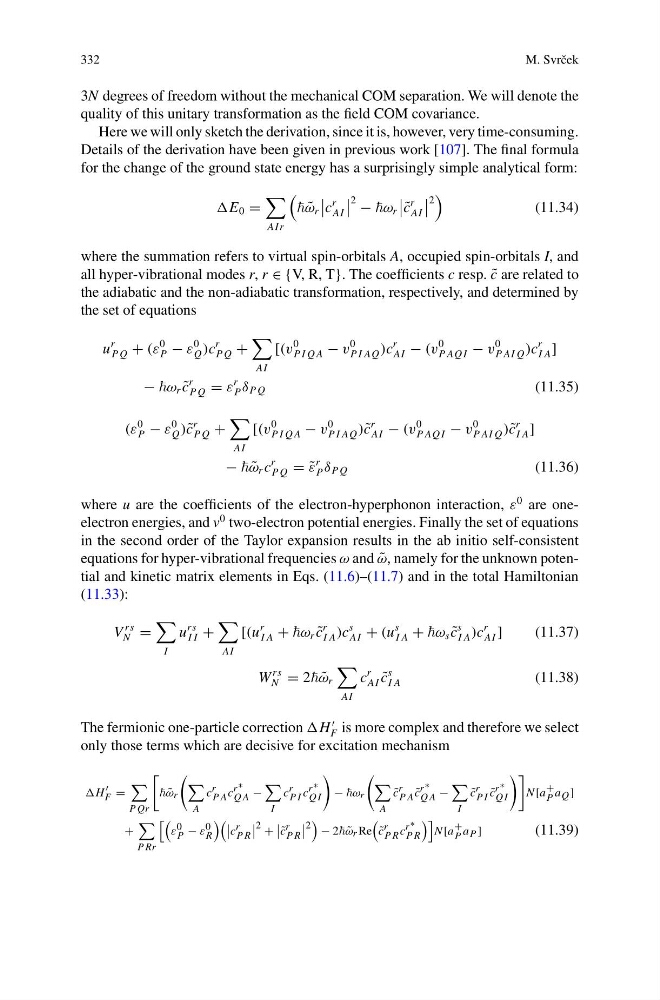
Here we will only sketch the derivation, since it is, however, very time-consuming.
Details of the derivation have been given in previous work [107]. The final formula
for the change of the ground state energy has a surprisingly simple analytical form:
E 0 =
AIr
˜
ω r
c
r
AI
2 − ω r
˜
c
r
AI
2
(11.34)
where the summation refers to virtual spin-orbitals A, occupied spin-orbitals I, and
all hyper-vibrational modes r, r ∈ {V, R, T}. The coefficients c resp. ˜
c are related to
the adiabatic and the non-adiabatic transformation, respectively, and determined by
the set of equations
u
r
P Q + (ε
0
P − ε
0
Q )c
r
P Q +
AI
[(v
0
P I Q A − v
0
P I AQ )c
r
AI − (v
0
P AQI − v
0
P AI Q )c
r
I A ]
− ω r ˜
c
r
P Q = ε
r
P δ P Q
(11.35)
(ε
0
P − ε
0
Q ) ˜
c
r
P Q +
AI
[(v
0
P I Q A − v
0
P I AQ ) ˜
c
r
AI − (v
0
P AQI − v
0
P AI Q ) ˜
c
r
I A ]
− ˜
ω r c
r
P Q = ˜
ε
r
P δ P Q
(11.36)
where u are the coefficients of the electron-hyperphonon interaction, ε
0 are oneelectron energies, and v
0 two-electron potential energies. Finally the set of equations
in the second order of the Taylor expansion results in the ab initio self-consistent
equations for hyper-vibrational frequencies ω and ˜
ω, namely for the unknown potential and kinetic matrix elements in Eqs. (11.6)–(11.7) and in the total Hamiltonian
(11.33):
V
rs
N =
I
u
rs
I I +
AI
[(u
r
I A + ω r ˜
c
r
I A )c
s
AI + (u
s
I A + ω s ˜
c
s
I A )c
r
AI ]
(11.37)
W
rs
N = 2 ˜
ω r
AI
c
r
AI ˜
c
s
I A
(11.38)
The fermionic one-particle correction H
F is more complex and therefore we select
only those terms which are decisive for excitation mechanism
H
F =
P Qr
˜
ω r
A
c r
P A c r ∗
Q A −
I
c r
P I c r ∗
Q I
− ω r
A
˜
c r
P A ˜
c r ∗
Q A −
I
˜
c r
P I ˜
c r ∗
Q I
N [a
+
P a Q ]
+
P Rr
ε 0
P − ε 0
R
c r
P R
2 +
˜
c r
P R
2
− 2 ˜
ω r Re
˜
c r
P R c r ∗
P R
N [a
+
P a P ]
(11.39)
M. Svrˇ cek
3N degrees of freedom without the mechanical COM separation. We will denote the
quality of this unitary transformation as the field COM covariance.
Here we will only sketch the derivation, since it is, however, very time-consuming.
Details of the derivation have been given in previous work [107]. The final formula
for the change of the ground state energy has a surprisingly simple analytical form:
E 0 =
AIr
˜
ω r
c
r
AI
2 − ω r
˜
c
r
AI
2
(11.34)
where the summation refers to virtual spin-orbitals A, occupied spin-orbitals I, and
all hyper-vibrational modes r, r ∈ {V, R, T}. The coefficients c resp. ˜
c are related to
the adiabatic and the non-adiabatic transformation, respectively, and determined by
the set of equations
u
r
P Q + (ε
0
P − ε
0
Q )c
r
P Q +
AI
[(v
0
P I Q A − v
0
P I AQ )c
r
AI − (v
0
P AQI − v
0
P AI Q )c
r
I A ]
− ω r ˜
c
r
P Q = ε
r
P δ P Q
(11.35)
(ε
0
P − ε
0
Q ) ˜
c
r
P Q +
AI
[(v
0
P I Q A − v
0
P I AQ ) ˜
c
r
AI − (v
0
P AQI − v
0
P AI Q ) ˜
c
r
I A ]
− ˜
ω r c
r
P Q = ˜
ε
r
P δ P Q
(11.36)
where u are the coefficients of the electron-hyperphonon interaction, ε
0 are oneelectron energies, and v
0 two-electron potential energies. Finally the set of equations
in the second order of the Taylor expansion results in the ab initio self-consistent
equations for hyper-vibrational frequencies ω and ˜
ω, namely for the unknown potential and kinetic matrix elements in Eqs. (11.6)–(11.7) and in the total Hamiltonian
(11.33):
V
rs
N =
I
u
rs
I I +
AI
[(u
r
I A + ω r ˜
c
r
I A )c
s
AI + (u
s
I A + ω s ˜
c
s
I A )c
r
AI ]
(11.37)
W
rs
N = 2 ˜
ω r
AI
c
r
AI ˜
c
s
I A
(11.38)
The fermionic one-particle correction H
F is more complex and therefore we select
only those terms which are decisive for excitation mechanism
H
F =
P Qr
˜
ω r
A
c r
P A c r ∗
Q A −
I
c r
P I c r ∗
Q I
− ω r
A
˜
c r
P A ˜
c r ∗
Q A −
I
˜
c r
P I ˜
c r ∗
Q I
N [a
+
P a Q ]
+
P Rr
ε 0
P − ε 0
R
c r
P R
2 +
˜
c r
P R
2
− 2 ˜
ω r Re
˜
c r
P R c r ∗
P R
N [a
+
P a P ]
(11.39)