

334
M. Svrˇ cek
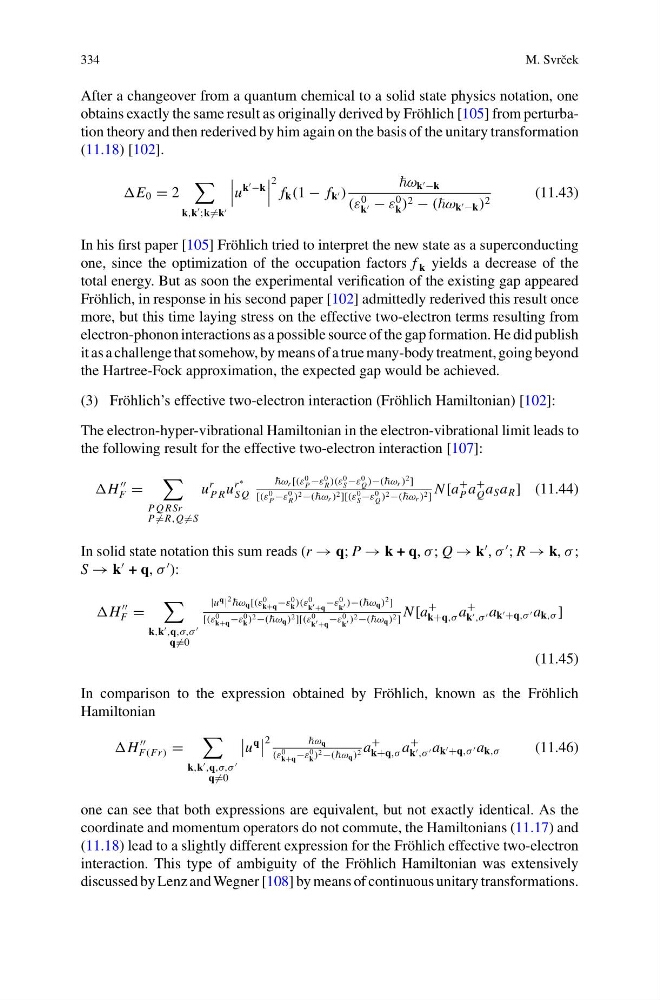
After a changeover from a quantum chemical to a solid state physics notation, one
obtains exactly the same result as originally derived by Fröhlich [105] from perturbation theory and then rederived by him again on the basis of the unitary transformation
(11.18) [102].
E 0 = 2
k,k
;k =k
u
k
−k
2
f k (1 − f k )
ω k −k
(ε
0
k − ε
0
k ) 2 − (ω k −k ) 2
(11.43)
In his first paper [105] Fröhlich tried to interpret the new state as a superconducting
one, since the optimization of the occupation factors f k yields a decrease of the
total energy. But as soon the experimental verification of the existing gap appeared
Fröhlich, in response in his second paper [102] admittedly rederived this result once
more, but this time laying stress on the effective two-electron terms resulting from
electron-phonon interactions as a possible source of the gap formation. He did publish
it as a challenge that somehow, by means of a true many-body treatment, going beyond
the Hartree-Fock approximation, the expected gap would be achieved.
(3) Fröhlich’s effective two-electron interaction (Fröhlich Hamiltonian) [102]:
The electron-hyper-vibrational Hamiltonian in the electron-vibrational limit leads to
the following result for the effective two-electron interaction [107]:
H
F =
P Q RSr
P =R,Q =S
u
r
P R u
r
∗
SQ
ω r [(ε
0
P −ε
0
R )(ε
0
S −ε
0
Q )−(ω r )
2 ]
[(ε
0
P −ε
0
R ) 2 −(ω r ) 2 ][(ε
0
S −ε
0
Q ) 2 −(ω r ) 2 ]
N [a
+
P a
+
Q a S a R ] (11.44)
In solid state notation this sum reads (r → q; P → k + q, σ ; Q → k
, σ
; R → k, σ ;
S → k
+ q, σ
):
H
F =
k,k
,q,σ,σ
q =0
|u q |
2 ω q [(ε
0
k+q −ε
0
k )(ε
0
k +q
−ε
0
k )−(ω q )
2 ]
[(ε
0
k+q −ε
0
k ) 2 −(ω q ) 2 ][(ε
0
k +q
−ε
0
k ) 2 −(ω q ) 2 ]
N [a
+
k+q,σ a
+
k ,σ a k +q,σ a k,σ ]
(11.45)
In comparison to the expression obtained by Fröhlich, known as the Fröhlich
Hamiltonian
H
F(Fr) =
k,k
,q,σ,σ
q =0
u
q
2
ω q
(ε
0
k+q −ε
0
k ) 2 −(ω q ) 2 a
+
k+q,σ a
+
k ,σ a k +q,σ a k,σ
(11.46)
one can see that both expressions are equivalent, but not exactly identical. As the
coordinate and momentum operators do not commute, the Hamiltonians (11.17) and
(11.18) lead to a slightly different expression for the Fröhlich effective two-electron
interaction. This type of ambiguity of the Fröhlich Hamiltonian was extensively
discussed by Lenz and Wegner [108] by means of continuous unitary transformations.
M. Svrˇ cek
After a changeover from a quantum chemical to a solid state physics notation, one
obtains exactly the same result as originally derived by Fröhlich [105] from perturbation theory and then rederived by him again on the basis of the unitary transformation
(11.18) [102].
E 0 = 2
k,k
;k =k
u
k
−k
2
f k (1 − f k )
ω k −k
(ε
0
k − ε
0
k ) 2 − (ω k −k ) 2
(11.43)
In his first paper [105] Fröhlich tried to interpret the new state as a superconducting
one, since the optimization of the occupation factors f k yields a decrease of the
total energy. But as soon the experimental verification of the existing gap appeared
Fröhlich, in response in his second paper [102] admittedly rederived this result once
more, but this time laying stress on the effective two-electron terms resulting from
electron-phonon interactions as a possible source of the gap formation. He did publish
it as a challenge that somehow, by means of a true many-body treatment, going beyond
the Hartree-Fock approximation, the expected gap would be achieved.
(3) Fröhlich’s effective two-electron interaction (Fröhlich Hamiltonian) [102]:
The electron-hyper-vibrational Hamiltonian in the electron-vibrational limit leads to
the following result for the effective two-electron interaction [107]:
H
F =
P Q RSr
P =R,Q =S
u
r
P R u
r
∗
SQ
ω r [(ε
0
P −ε
0
R )(ε
0
S −ε
0
Q )−(ω r )
2 ]
[(ε
0
P −ε
0
R ) 2 −(ω r ) 2 ][(ε
0
S −ε
0
Q ) 2 −(ω r ) 2 ]
N [a
+
P a
+
Q a S a R ] (11.44)
In solid state notation this sum reads (r → q; P → k + q, σ ; Q → k
, σ
; R → k, σ ;
S → k
+ q, σ
):
H
F =
k,k
,q,σ,σ
q =0
|u q |
2 ω q [(ε
0
k+q −ε
0
k )(ε
0
k +q
−ε
0
k )−(ω q )
2 ]
[(ε
0
k+q −ε
0
k ) 2 −(ω q ) 2 ][(ε
0
k +q
−ε
0
k ) 2 −(ω q ) 2 ]
N [a
+
k+q,σ a
+
k ,σ a k +q,σ a k,σ ]
(11.45)
In comparison to the expression obtained by Fröhlich, known as the Fröhlich
Hamiltonian
H
F(Fr) =
k,k
,q,σ,σ
q =0
u
q
2
ω q
(ε
0
k+q −ε
0
k ) 2 −(ω q ) 2 a
+
k+q,σ a
+
k ,σ a k +q,σ a k,σ
(11.46)
one can see that both expressions are equivalent, but not exactly identical. As the
coordinate and momentum operators do not commute, the Hamiltonians (11.17) and
(11.18) lead to a slightly different expression for the Fröhlich effective two-electron
interaction. This type of ambiguity of the Fröhlich Hamiltonian was extensively
discussed by Lenz and Wegner [108] by means of continuous unitary transformations.