

Megascopic Quantum Phenomena
327
E pot = E
(2)
N N (B) + V
(2)
N (B)
(11.6)
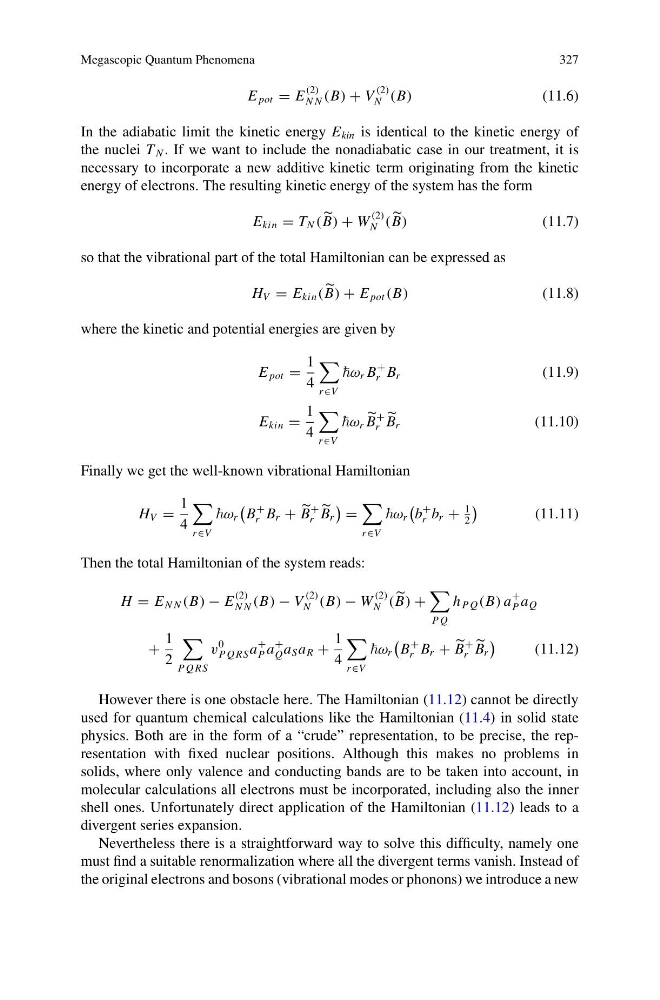
In the adiabatic limit the kinetic energy E kin is identical to the kinetic energy of
the nuclei T N . If we want to include the nonadiabatic case in our treatment, it is
necessary to incorporate a new additive kinetic term originating from the kinetic
energy of electrons. The resulting kinetic energy of the system has the form
E kin = T N ( B) + W
(2)
N ( B)
(11.7)
so that the vibrational part of the total Hamiltonian can be expressed as
H V = E kin ( B) + E pot (B)
(11.8)
where the kinetic and potential energies are given by
E pot =
1
4
r ∈V
ω r B
+
r B r
(11.9)
E kin =
1
4
r ∈V
ω r B
+
r
B r
(11.10)
Finally we get the well-known vibrational Hamiltonian
H V =
1
4
r ∈V
ω r
B
+
r B r + B
+
r
B r
=
r ∈V
ω r
b
+
r b r +
1
2
(11.11)
Then the total Hamiltonian of the system reads:
H = E N N (B) − E
(2)
N N (B) − V
(2)
N (B) − W
(2)
N ( B) +
P Q
h P Q (B) a
+
P a Q
+
1
2
P Q RS
v
0
P Q RS a
+
P a
+
Q a S a R +
1
4
r ∈V
ω r
B
+
r B r + B
+
r
B r
(11.12)
However there is one obstacle here. The Hamiltonian (11.12) cannot be directly
used for quantum chemical calculations like the Hamiltonian (11.4) in solid state
physics. Both are in the form of a “crude” representation, to be precise, the representation with fixed nuclear positions. Although this makes no problems in
solids, where only valence and conducting bands are to be taken into account, in
molecular calculations all electrons must be incorporated, including also the inner
shell ones. Unfortunately direct application of the Hamiltonian (11.12) leads to a
divergent series expansion.
Nevertheless there is a straightforward way to solve this difficulty, namely one
must find a suitable renormalization where all the divergent terms vanish. Instead of
the original electrons and bosons (vibrational modes or phonons) we introduce a new
327
E pot = E
(2)
N N (B) + V
(2)
N (B)
(11.6)
In the adiabatic limit the kinetic energy E kin is identical to the kinetic energy of
the nuclei T N . If we want to include the nonadiabatic case in our treatment, it is
necessary to incorporate a new additive kinetic term originating from the kinetic
energy of electrons. The resulting kinetic energy of the system has the form
E kin = T N ( B) + W
(2)
N ( B)
(11.7)
so that the vibrational part of the total Hamiltonian can be expressed as
H V = E kin ( B) + E pot (B)
(11.8)
where the kinetic and potential energies are given by
E pot =
1
4
r ∈V
ω r B
+
r B r
(11.9)
E kin =
1
4
r ∈V
ω r B
+
r
B r
(11.10)
Finally we get the well-known vibrational Hamiltonian
H V =
1
4
r ∈V
ω r
B
+
r B r + B
+
r
B r
=
r ∈V
ω r
b
+
r b r +
1
2
(11.11)
Then the total Hamiltonian of the system reads:
H = E N N (B) − E
(2)
N N (B) − V
(2)
N (B) − W
(2)
N ( B) +
P Q
h P Q (B) a
+
P a Q
+
1
2
P Q RS
v
0
P Q RS a
+
P a
+
Q a S a R +
1
4
r ∈V
ω r
B
+
r B r + B
+
r
B r
(11.12)
However there is one obstacle here. The Hamiltonian (11.12) cannot be directly
used for quantum chemical calculations like the Hamiltonian (11.4) in solid state
physics. Both are in the form of a “crude” representation, to be precise, the representation with fixed nuclear positions. Although this makes no problems in
solids, where only valence and conducting bands are to be taken into account, in
molecular calculations all electrons must be incorporated, including also the inner
shell ones. Unfortunately direct application of the Hamiltonian (11.12) leads to a
divergent series expansion.
Nevertheless there is a straightforward way to solve this difficulty, namely one
must find a suitable renormalization where all the divergent terms vanish. Instead of
the original electrons and bosons (vibrational modes or phonons) we introduce a new