

326
M. Svrˇ cek
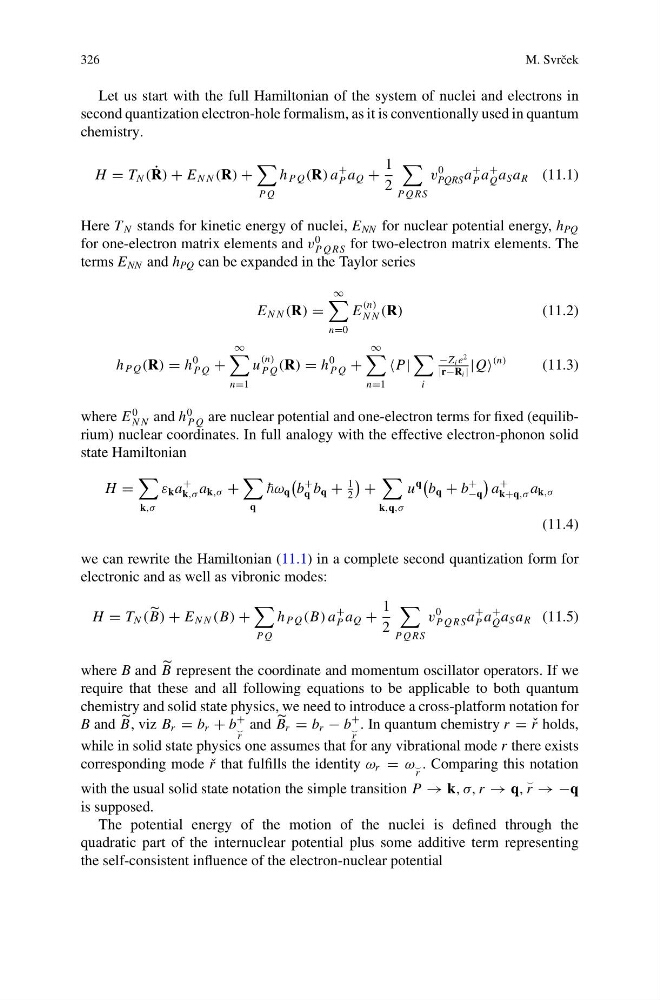
Let us start with the full Hamiltonian of the system of nuclei and electrons in
second quantization electron-hole formalism, as it is conventionally used in quantum
chemistry.
H = T N ( ˙
R) + E N N (R) +
P Q
h P Q (R) a
+
P a Q +
1
2
P Q RS
v
0
PQRS a
+
P a
+
Q a S a R (11.1)
Here T N stands for kinetic energy of nuclei, E NN for nuclear potential energy, h PQ
for one-electron matrix elements and v
0
P Q RS for two-electron matrix elements. The
terms E NN and h PQ can be expanded in the Taylor series
E N N (R) =
∞
n=0
E
(n)
N N (R)
(11.2)
h P Q (R) = h
0
P Q +
∞
n=1
u
(n)
P Q (R) = h
0
P Q +
∞
n=1
P|
i
−Z i e
2
|r−R i |
|Q
(n)
(11.3)
where E
0
N N and h
0
P Q are nuclear potential and one-electron terms for fixed (equilibrium) nuclear coordinates. In full analogy with the effective electron-phonon solid
state Hamiltonian
H =
k,σ
ε k a
+
k,σ a k,σ +
q
ω q
b
+
q b q +
1
2
+
k,q,σ
u
q
b q + b
+
−q
a
+
k+q,σ a k,σ
(11.4)
we can rewrite the Hamiltonian (11.1) in a complete second quantization form for
electronic and as well as vibronic modes:
H = T N ( B) + E N N (B) +
P Q
h P Q (B) a
+
P a Q +
1
2
P Q RS
v
0
P Q RS a
+
P a
+
Q a S a R (11.5)
where B and B represent the coordinate and momentum oscillator operators. If we
require that these and all following equations to be applicable to both quantum
chemistry and solid state physics, we need to introduce a cross-platform notation for
B and B, viz B r = b r + b
+
r
and B r = b r − b
+
r
. In quantum chemistry r = ˇ
r holds,
while in solid state physics one assumes that for any vibrational mode r there exists
corresponding mode ˇ
r that fulfills the identity ω r = ω
r
. Comparing this notation
with the usual solid state notation the simple transition P → k, σ, r → q,
r → −q
is supposed.
The potential energy of the motion of the nuclei is defined through the
quadratic part of the internuclear potential plus some additive term representing
the self-consistent influence of the electron-nuclear potential
M. Svrˇ cek
Let us start with the full Hamiltonian of the system of nuclei and electrons in
second quantization electron-hole formalism, as it is conventionally used in quantum
chemistry.
H = T N ( ˙
R) + E N N (R) +
P Q
h P Q (R) a
+
P a Q +
1
2
P Q RS
v
0
PQRS a
+
P a
+
Q a S a R (11.1)
Here T N stands for kinetic energy of nuclei, E NN for nuclear potential energy, h PQ
for one-electron matrix elements and v
0
P Q RS for two-electron matrix elements. The
terms E NN and h PQ can be expanded in the Taylor series
E N N (R) =
∞
n=0
E
(n)
N N (R)
(11.2)
h P Q (R) = h
0
P Q +
∞
n=1
u
(n)
P Q (R) = h
0
P Q +
∞
n=1
P|
i
−Z i e
2
|r−R i |
|Q
(n)
(11.3)
where E
0
N N and h
0
P Q are nuclear potential and one-electron terms for fixed (equilibrium) nuclear coordinates. In full analogy with the effective electron-phonon solid
state Hamiltonian
H =
k,σ
ε k a
+
k,σ a k,σ +
q
ω q
b
+
q b q +
1
2
+
k,q,σ
u
q
b q + b
+
−q
a
+
k+q,σ a k,σ
(11.4)
we can rewrite the Hamiltonian (11.1) in a complete second quantization form for
electronic and as well as vibronic modes:
H = T N ( B) + E N N (B) +
P Q
h P Q (B) a
+
P a Q +
1
2
P Q RS
v
0
P Q RS a
+
P a
+
Q a S a R (11.5)
where B and B represent the coordinate and momentum oscillator operators. If we
require that these and all following equations to be applicable to both quantum
chemistry and solid state physics, we need to introduce a cross-platform notation for
B and B, viz B r = b r + b
+
r
and B r = b r − b
+
r
. In quantum chemistry r = ˇ
r holds,
while in solid state physics one assumes that for any vibrational mode r there exists
corresponding mode ˇ
r that fulfills the identity ω r = ω
r
. Comparing this notation
with the usual solid state notation the simple transition P → k, σ, r → q,
r → −q
is supposed.
The potential energy of the motion of the nuclei is defined through the
quadratic part of the internuclear potential plus some additive term representing
the self-consistent influence of the electron-nuclear potential