

Megascopic Quantum Phenomena
321
Ginzburg-Landau theory including the Mexican hat were for the first time translated
into quantum field theory in 1961 by Nambu and Jona-Lasinio [90]. However, during
the same year, serious problems surfaced when Goldstone formulated his theorem
[91] stating: “The spontaneous breaking of a continuous symmetry can be associated
with a massless and spinless particle, the so called Nambu-Goldstone boson“. The
Goldstone theorem, proved one year later by Goldstone et al. [92], disqualified the
Nambu–Jona-Lasinio model. Since it is difficult to find, from the general proof
[92], the particles that could serve as ‘Goldstone bosons’, it was believed that the
application of spontaneous symmetry violations in field theory, such as the model of
Nambu and Jona-Lasinio, would be impossible.
In the same year, 1962, Schwinger [93] proposed the possibility of combining
mass with gauge fields. It caused an immediate revival of the old gauge theories
from 1954 of Yang and Mills [94], dealing with an extension of the concept of
gauge theory considered for Abelian groups used in quantum electrodynamics, to
non-Abelian groups, in an attempt to explain strong interactions. In order to preserve
gauge invariance, the Yang–Mills field must only give rise to massless particles.
One year later, Anderson being inspired by the Goldstone theorem, Schwinger’s
idea and the Yang-Mills theory, wrote an article [95] about the possible violation
of Goldstone’s theorem in superconductors: “Schwinger has pointed out that the
Yang-Mills vector boson implied by associating a generalized gauge transformation
with a conservation law… does not necessarily have zero mass… We show that the
theory of plasma oscillations is a simple nonrelativistic example exhibiting all of the
features of Schwinger’s idea… The boson, which appears as a result of the Goldstone
theorem and has zero unrenormalized mass, is converted into a finite-mass plasmon
by the interaction with the appropriate gauge field, which is the electromagnetic
field.” In his article Anderson suggested that a similar process in particle physics
could be responsible for giving mass to Yang-Mills gauge bosons, further adding: “It
is likely, then, considering the superconducting analogue, that the way is now open
for a degenerate-vacuum theory of the Nambu type without any difficulties involving
either zero-mass Yang-Mills gauge bosons or zero-mass Goldstone bosons. These
two types of bosons seem capable of “cancelling each other out” and leaving only
finite mass bosons.” It is symptomatic that Anderson’s statement became the hint
that soon led to the development of the Higgs mechanism.
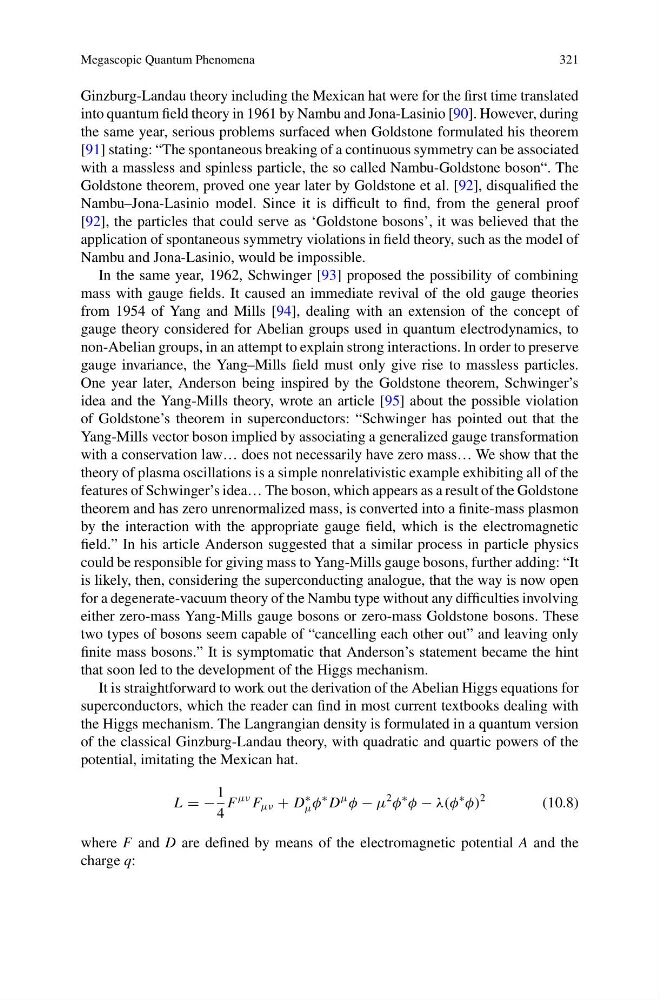
It is straightforward to work out the derivation of the Abelian Higgs equations for
superconductors, which the reader can find in most current textbooks dealing with
the Higgs mechanism. The Langrangian density is formulated in a quantum version
of the classical Ginzburg-Landau theory, with quadratic and quartic powers of the
potential, imitating the Mexican hat.
L = −
1
4
F
μν F μν + D
∗
μ φ
∗ D
μ
φ − μ
2
φ
∗
φ − λ(φ
∗
φ)
2
(10.8)
where F and D are defined by means of the electromagnetic potential A and the
charge q:
321
Ginzburg-Landau theory including the Mexican hat were for the first time translated
into quantum field theory in 1961 by Nambu and Jona-Lasinio [90]. However, during
the same year, serious problems surfaced when Goldstone formulated his theorem
[91] stating: “The spontaneous breaking of a continuous symmetry can be associated
with a massless and spinless particle, the so called Nambu-Goldstone boson“. The
Goldstone theorem, proved one year later by Goldstone et al. [92], disqualified the
Nambu–Jona-Lasinio model. Since it is difficult to find, from the general proof
[92], the particles that could serve as ‘Goldstone bosons’, it was believed that the
application of spontaneous symmetry violations in field theory, such as the model of
Nambu and Jona-Lasinio, would be impossible.
In the same year, 1962, Schwinger [93] proposed the possibility of combining
mass with gauge fields. It caused an immediate revival of the old gauge theories
from 1954 of Yang and Mills [94], dealing with an extension of the concept of
gauge theory considered for Abelian groups used in quantum electrodynamics, to
non-Abelian groups, in an attempt to explain strong interactions. In order to preserve
gauge invariance, the Yang–Mills field must only give rise to massless particles.
One year later, Anderson being inspired by the Goldstone theorem, Schwinger’s
idea and the Yang-Mills theory, wrote an article [95] about the possible violation
of Goldstone’s theorem in superconductors: “Schwinger has pointed out that the
Yang-Mills vector boson implied by associating a generalized gauge transformation
with a conservation law… does not necessarily have zero mass… We show that the
theory of plasma oscillations is a simple nonrelativistic example exhibiting all of the
features of Schwinger’s idea… The boson, which appears as a result of the Goldstone
theorem and has zero unrenormalized mass, is converted into a finite-mass plasmon
by the interaction with the appropriate gauge field, which is the electromagnetic
field.” In his article Anderson suggested that a similar process in particle physics
could be responsible for giving mass to Yang-Mills gauge bosons, further adding: “It
is likely, then, considering the superconducting analogue, that the way is now open
for a degenerate-vacuum theory of the Nambu type without any difficulties involving
either zero-mass Yang-Mills gauge bosons or zero-mass Goldstone bosons. These
two types of bosons seem capable of “cancelling each other out” and leaving only
finite mass bosons.” It is symptomatic that Anderson’s statement became the hint
that soon led to the development of the Higgs mechanism.
It is straightforward to work out the derivation of the Abelian Higgs equations for
superconductors, which the reader can find in most current textbooks dealing with
the Higgs mechanism. The Langrangian density is formulated in a quantum version
of the classical Ginzburg-Landau theory, with quadratic and quartic powers of the
potential, imitating the Mexican hat.
L = −
1
4
F
μν F μν + D
∗
μ φ
∗ D
μ
φ − μ
2
φ
∗
φ − λ(φ
∗
φ)
2
(10.8)
where F and D are defined by means of the electromagnetic potential A and the
charge q: