

320
M. Svrˇ cek
a first order differential equation with respect to the time variable. But the EulerLagrange equation of the Higgs boson is a second order differential equation with
respect to the time variable. Hence, the Bohr’s correspondence principle is violated
again.
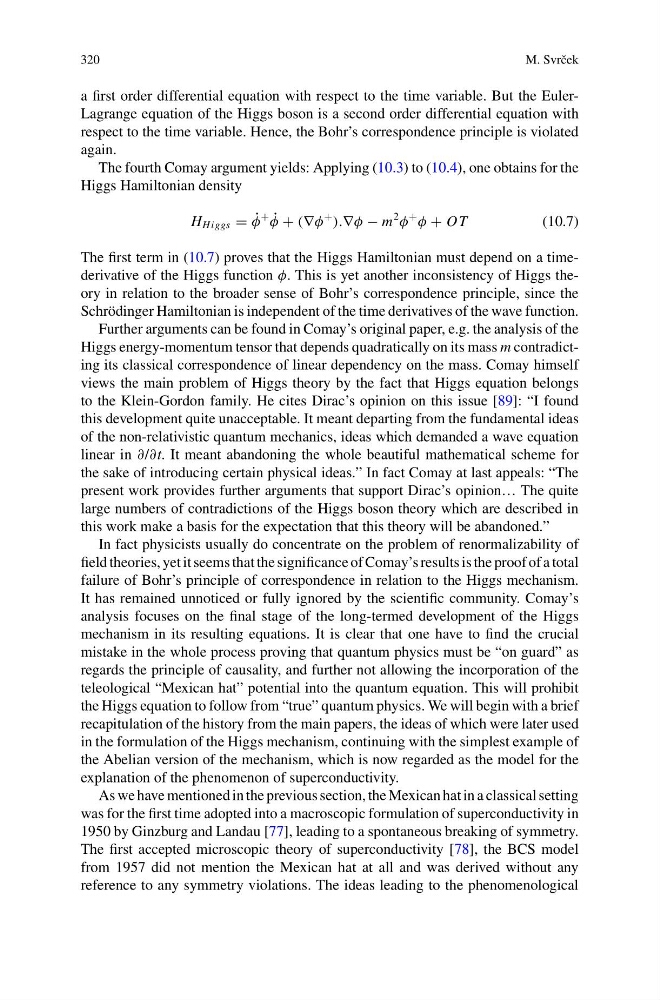
The fourth Comay argument yields: Applying (10.3) to (10.4), one obtains for the
Higgs Hamiltonian density
H Higgs = ˙
φ
+ ˙
φ + (∇φ
+
).∇φ − m
2
φ
+
φ + OT
(10.7)
The first term in (10.7) proves that the Higgs Hamiltonian must depend on a timederivative of the Higgs function φ. This is yet another inconsistency of Higgs theory in relation to the broader sense of Bohr’s correspondence principle, since the
Schrödinger Hamiltonian is independent of the time derivatives of the wave function.
Further arguments can be found in Comay’s original paper, e.g. the analysis of the
Higgs energy-momentum tensor that depends quadratically on its mass m contradicting its classical correspondence of linear dependency on the mass. Comay himself
views the main problem of Higgs theory by the fact that Higgs equation belongs
to the Klein-Gordon family. He cites Dirac’s opinion on this issue [89]: “I found
this development quite unacceptable. It meant departing from the fundamental ideas
of the non-relativistic quantum mechanics, ideas which demanded a wave equation
linear in ∂/∂t. It meant abandoning the whole beautiful mathematical scheme for
the sake of introducing certain physical ideas.” In fact Comay at last appeals: “The
present work provides further arguments that support Dirac’s opinion… The quite
large numbers of contradictions of the Higgs boson theory which are described in
this work make a basis for the expectation that this theory will be abandoned.”
In fact physicists usually do concentrate on the problem of renormalizability of
field theories, yet it seems that the significance of Comay’s results is the proof of a total
failure of Bohr’s principle of correspondence in relation to the Higgs mechanism.
It has remained unnoticed or fully ignored by the scientific community. Comay’s
analysis focuses on the final stage of the long-termed development of the Higgs
mechanism in its resulting equations. It is clear that one have to find the crucial
mistake in the whole process proving that quantum physics must be “on guard” as
regards the principle of causality, and further not allowing the incorporation of the
teleological “Mexican hat” potential into the quantum equation. This will prohibit
the Higgs equation to follow from “true” quantum physics. We will begin with a brief
recapitulation of the history from the main papers, the ideas of which were later used
in the formulation of the Higgs mechanism, continuing with the simplest example of
the Abelian version of the mechanism, which is now regarded as the model for the
explanation of the phenomenon of superconductivity.
As we have mentioned in the previous section, the Mexican hat in a classical setting
was for the first time adopted into a macroscopic formulation of superconductivity in
1950 by Ginzburg and Landau [77], leading to a spontaneous breaking of symmetry.
The first accepted microscopic theory of superconductivity [78], the BCS model
from 1957 did not mention the Mexican hat at all and was derived without any
reference to any symmetry violations. The ideas leading to the phenomenological
M. Svrˇ cek
a first order differential equation with respect to the time variable. But the EulerLagrange equation of the Higgs boson is a second order differential equation with
respect to the time variable. Hence, the Bohr’s correspondence principle is violated
again.
The fourth Comay argument yields: Applying (10.3) to (10.4), one obtains for the
Higgs Hamiltonian density
H Higgs = ˙
φ
+ ˙
φ + (∇φ
+
).∇φ − m
2
φ
+
φ + OT
(10.7)
The first term in (10.7) proves that the Higgs Hamiltonian must depend on a timederivative of the Higgs function φ. This is yet another inconsistency of Higgs theory in relation to the broader sense of Bohr’s correspondence principle, since the
Schrödinger Hamiltonian is independent of the time derivatives of the wave function.
Further arguments can be found in Comay’s original paper, e.g. the analysis of the
Higgs energy-momentum tensor that depends quadratically on its mass m contradicting its classical correspondence of linear dependency on the mass. Comay himself
views the main problem of Higgs theory by the fact that Higgs equation belongs
to the Klein-Gordon family. He cites Dirac’s opinion on this issue [89]: “I found
this development quite unacceptable. It meant departing from the fundamental ideas
of the non-relativistic quantum mechanics, ideas which demanded a wave equation
linear in ∂/∂t. It meant abandoning the whole beautiful mathematical scheme for
the sake of introducing certain physical ideas.” In fact Comay at last appeals: “The
present work provides further arguments that support Dirac’s opinion… The quite
large numbers of contradictions of the Higgs boson theory which are described in
this work make a basis for the expectation that this theory will be abandoned.”
In fact physicists usually do concentrate on the problem of renormalizability of
field theories, yet it seems that the significance of Comay’s results is the proof of a total
failure of Bohr’s principle of correspondence in relation to the Higgs mechanism.
It has remained unnoticed or fully ignored by the scientific community. Comay’s
analysis focuses on the final stage of the long-termed development of the Higgs
mechanism in its resulting equations. It is clear that one have to find the crucial
mistake in the whole process proving that quantum physics must be “on guard” as
regards the principle of causality, and further not allowing the incorporation of the
teleological “Mexican hat” potential into the quantum equation. This will prohibit
the Higgs equation to follow from “true” quantum physics. We will begin with a brief
recapitulation of the history from the main papers, the ideas of which were later used
in the formulation of the Higgs mechanism, continuing with the simplest example of
the Abelian version of the mechanism, which is now regarded as the model for the
explanation of the phenomenon of superconductivity.
As we have mentioned in the previous section, the Mexican hat in a classical setting
was for the first time adopted into a macroscopic formulation of superconductivity in
1950 by Ginzburg and Landau [77], leading to a spontaneous breaking of symmetry.
The first accepted microscopic theory of superconductivity [78], the BCS model
from 1957 did not mention the Mexican hat at all and was derived without any
reference to any symmetry violations. The ideas leading to the phenomenological