

Megascopic Quantum Phenomena
313
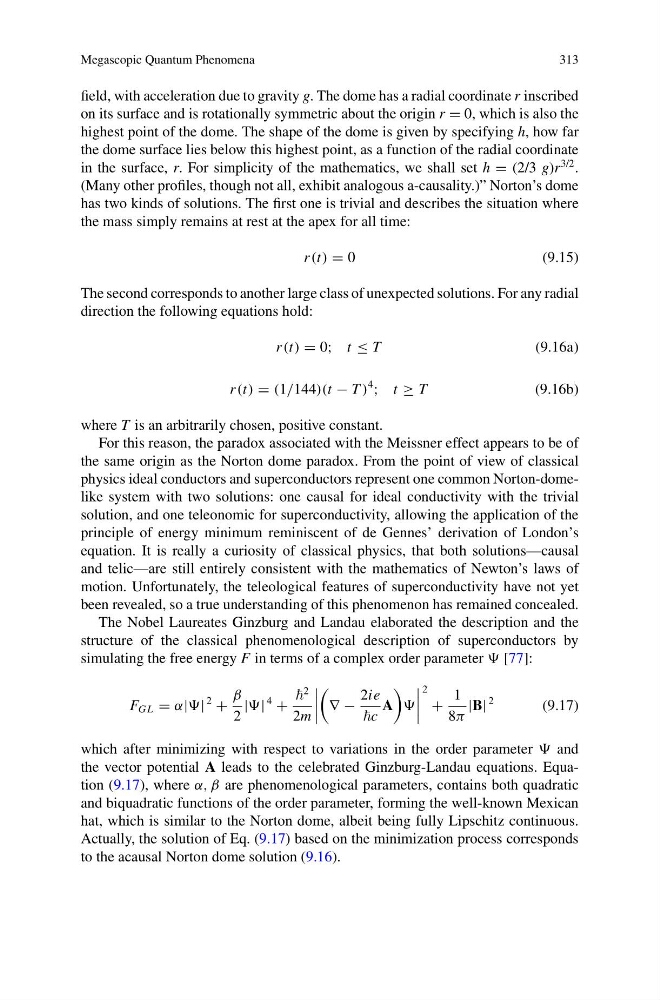
field, with acceleration due to gravity g. The dome has a radial coordinate r inscribed
on its surface and is rotationally symmetric about the origin r = 0, which is also the
highest point of the dome. The shape of the dome is given by specifying h, how far
the dome surface lies below this highest point, as a function of the radial coordinate
in the surface, r. For simplicity of the mathematics, we shall set h = (2/3 g)r
3/2 .
(Many other profiles, though not all, exhibit analogous a-causality.)” Norton’s dome
has two kinds of solutions. The first one is trivial and describes the situation where
the mass simply remains at rest at the apex for all time:
r (t) = 0
(9.15)
The second corresponds to another large class of unexpected solutions. For any radial
direction the following equations hold:
r (t) = 0; t ≤ T
(9.16a)
r (t) = (1/144)(t − T )
4
; t ≥ T
(9.16b)
where T is an arbitrarily chosen, positive constant.
For this reason, the paradox associated with the Meissner effect appears to be of
the same origin as the Norton dome paradox. From the point of view of classical
physics ideal conductors and superconductors represent one common Norton-domelike system with two solutions: one causal for ideal conductivity with the trivial
solution, and one teleonomic for superconductivity, allowing the application of the
principle of energy minimum reminiscent of de Gennes’ derivation of London’s
equation. It is really a curiosity of classical physics, that both solutions—causal
and telic—are still entirely consistent with the mathematics of Newton’s laws of
motion. Unfortunately, the teleological features of superconductivity have not yet
been revealed, so a true understanding of this phenomenon has remained concealed.
The Nobel Laureates Ginzburg and Landau elaborated the description and the
structure of the classical phenomenological description of superconductors by
simulating the free energy F in terms of a complex order parameter [77]:
F G L = α||
2
+
β
2
||
4
+
2
2m
∇ −
2ie
c
A
2
+
1
8π
|B|
2
(9.17)
which after minimizing with respect to variations in the order parameter and
the vector potential A leads to the celebrated Ginzburg-Landau equations. Equation (9.17), where α, β are phenomenological parameters, contains both quadratic
and biquadratic functions of the order parameter, forming the well-known Mexican
hat, which is similar to the Norton dome, albeit being fully Lipschitz continuous.
Actually, the solution of Eq. (9.17) based on the minimization process corresponds
to the acausal Norton dome solution (9.16).
313
field, with acceleration due to gravity g. The dome has a radial coordinate r inscribed
on its surface and is rotationally symmetric about the origin r = 0, which is also the
highest point of the dome. The shape of the dome is given by specifying h, how far
the dome surface lies below this highest point, as a function of the radial coordinate
in the surface, r. For simplicity of the mathematics, we shall set h = (2/3 g)r
3/2 .
(Many other profiles, though not all, exhibit analogous a-causality.)” Norton’s dome
has two kinds of solutions. The first one is trivial and describes the situation where
the mass simply remains at rest at the apex for all time:
r (t) = 0
(9.15)
The second corresponds to another large class of unexpected solutions. For any radial
direction the following equations hold:
r (t) = 0; t ≤ T
(9.16a)
r (t) = (1/144)(t − T )
4
; t ≥ T
(9.16b)
where T is an arbitrarily chosen, positive constant.
For this reason, the paradox associated with the Meissner effect appears to be of
the same origin as the Norton dome paradox. From the point of view of classical
physics ideal conductors and superconductors represent one common Norton-domelike system with two solutions: one causal for ideal conductivity with the trivial
solution, and one teleonomic for superconductivity, allowing the application of the
principle of energy minimum reminiscent of de Gennes’ derivation of London’s
equation. It is really a curiosity of classical physics, that both solutions—causal
and telic—are still entirely consistent with the mathematics of Newton’s laws of
motion. Unfortunately, the teleological features of superconductivity have not yet
been revealed, so a true understanding of this phenomenon has remained concealed.
The Nobel Laureates Ginzburg and Landau elaborated the description and the
structure of the classical phenomenological description of superconductors by
simulating the free energy F in terms of a complex order parameter [77]:
F G L = α||
2
+
β
2
||
4
+
2
2m
∇ −
2ie
c
A
2
+
1
8π
|B|
2
(9.17)
which after minimizing with respect to variations in the order parameter and
the vector potential A leads to the celebrated Ginzburg-Landau equations. Equation (9.17), where α, β are phenomenological parameters, contains both quadratic
and biquadratic functions of the order parameter, forming the well-known Mexican
hat, which is similar to the Norton dome, albeit being fully Lipschitz continuous.
Actually, the solution of Eq. (9.17) based on the minimization process corresponds
to the acausal Norton dome solution (9.16).