

312
M. Svrˇ cek
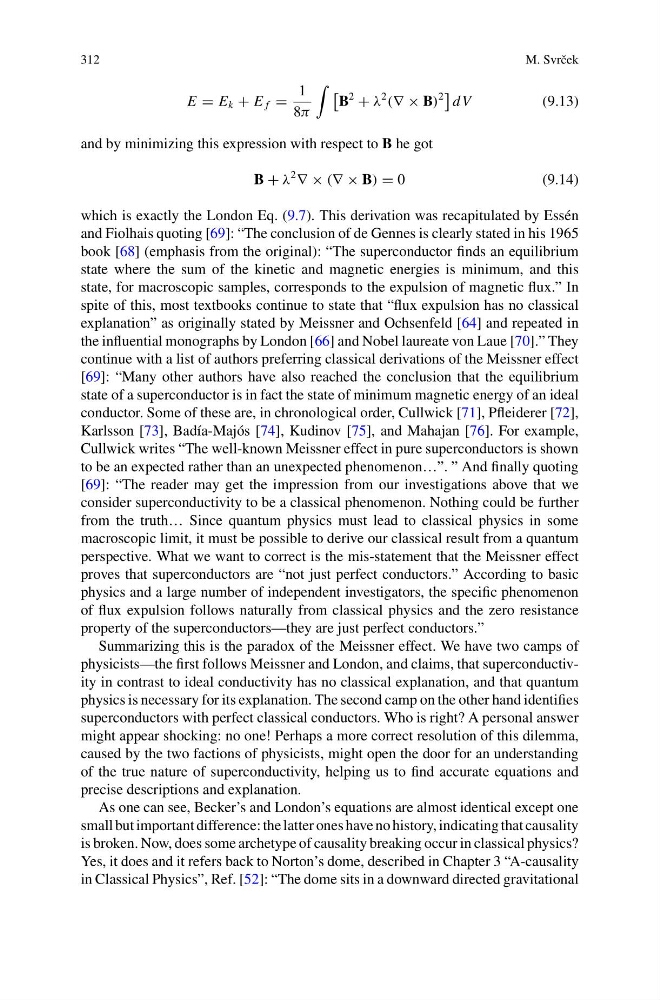
E = E k + E f =
1
8π
B
2
+ λ
2
(∇ × B)
2
dV
(9.13)
and by minimizing this expression with respect to B he got
B + λ
2
∇ × (∇ × B) = 0
(9.14)
which is exactly the London Eq. (9.7). This derivation was recapitulated by Essén
and Fiolhais quoting [69]: “The conclusion of de Gennes is clearly stated in his 1965
book [68] (emphasis from the original): “The superconductor finds an equilibrium
state where the sum of the kinetic and magnetic energies is minimum, and this
state, for macroscopic samples, corresponds to the expulsion of magnetic flux.” In
spite of this, most textbooks continue to state that “flux expulsion has no classical
explanation” as originally stated by Meissner and Ochsenfeld [64] and repeated in
the influential monographs by London [66] and Nobel laureate von Laue [70].” They
continue with a list of authors preferring classical derivations of the Meissner effect
[69]: “Many other authors have also reached the conclusion that the equilibrium
state of a superconductor is in fact the state of minimum magnetic energy of an ideal
conductor. Some of these are, in chronological order, Cullwick [71], Pfleiderer [72],
Karlsson [73], Badía-Majós [74], Kudinov [75], and Mahajan [76]. For example,
Cullwick writes “The well-known Meissner effect in pure superconductors is shown
to be an expected rather than an unexpected phenomenon…”. ” And finally quoting
[69]: “The reader may get the impression from our investigations above that we
consider superconductivity to be a classical phenomenon. Nothing could be further
from the truth… Since quantum physics must lead to classical physics in some
macroscopic limit, it must be possible to derive our classical result from a quantum
perspective. What we want to correct is the mis-statement that the Meissner effect
proves that superconductors are “not just perfect conductors.” According to basic
physics and a large number of independent investigators, the specific phenomenon
of flux expulsion follows naturally from classical physics and the zero resistance
property of the superconductors—they are just perfect conductors.”
Summarizing this is the paradox of the Meissner effect. We have two camps of
physicists—the first follows Meissner and London, and claims, that superconductivity in contrast to ideal conductivity has no classical explanation, and that quantum
physics is necessary for its explanation. The second camp on the other hand identifies
superconductors with perfect classical conductors. Who is right? A personal answer
might appear shocking: no one! Perhaps a more correct resolution of this dilemma,
caused by the two factions of physicists, might open the door for an understanding
of the true nature of superconductivity, helping us to find accurate equations and
precise descriptions and explanation.
As one can see, Becker’s and London’s equations are almost identical except one
small but important difference: the latter ones have no history, indicating that causality
is broken. Now, does some archetype of causality breaking occur in classical physics?
Yes, it does and it refers back to Norton’s dome, described in Chapter 3 “A-causality
in Classical Physics”, Ref. [52]: “The dome sits in a downward directed gravitational
M. Svrˇ cek
E = E k + E f =
1
8π
B
2
+ λ
2
(∇ × B)
2
dV
(9.13)
and by minimizing this expression with respect to B he got
B + λ
2
∇ × (∇ × B) = 0
(9.14)
which is exactly the London Eq. (9.7). This derivation was recapitulated by Essén
and Fiolhais quoting [69]: “The conclusion of de Gennes is clearly stated in his 1965
book [68] (emphasis from the original): “The superconductor finds an equilibrium
state where the sum of the kinetic and magnetic energies is minimum, and this
state, for macroscopic samples, corresponds to the expulsion of magnetic flux.” In
spite of this, most textbooks continue to state that “flux expulsion has no classical
explanation” as originally stated by Meissner and Ochsenfeld [64] and repeated in
the influential monographs by London [66] and Nobel laureate von Laue [70].” They
continue with a list of authors preferring classical derivations of the Meissner effect
[69]: “Many other authors have also reached the conclusion that the equilibrium
state of a superconductor is in fact the state of minimum magnetic energy of an ideal
conductor. Some of these are, in chronological order, Cullwick [71], Pfleiderer [72],
Karlsson [73], Badía-Majós [74], Kudinov [75], and Mahajan [76]. For example,
Cullwick writes “The well-known Meissner effect in pure superconductors is shown
to be an expected rather than an unexpected phenomenon…”. ” And finally quoting
[69]: “The reader may get the impression from our investigations above that we
consider superconductivity to be a classical phenomenon. Nothing could be further
from the truth… Since quantum physics must lead to classical physics in some
macroscopic limit, it must be possible to derive our classical result from a quantum
perspective. What we want to correct is the mis-statement that the Meissner effect
proves that superconductors are “not just perfect conductors.” According to basic
physics and a large number of independent investigators, the specific phenomenon
of flux expulsion follows naturally from classical physics and the zero resistance
property of the superconductors—they are just perfect conductors.”
Summarizing this is the paradox of the Meissner effect. We have two camps of
physicists—the first follows Meissner and London, and claims, that superconductivity in contrast to ideal conductivity has no classical explanation, and that quantum
physics is necessary for its explanation. The second camp on the other hand identifies
superconductors with perfect classical conductors. Who is right? A personal answer
might appear shocking: no one! Perhaps a more correct resolution of this dilemma,
caused by the two factions of physicists, might open the door for an understanding
of the true nature of superconductivity, helping us to find accurate equations and
precise descriptions and explanation.
As one can see, Becker’s and London’s equations are almost identical except one
small but important difference: the latter ones have no history, indicating that causality
is broken. Now, does some archetype of causality breaking occur in classical physics?
Yes, it does and it refers back to Norton’s dome, described in Chapter 3 “A-causality
in Classical Physics”, Ref. [52]: “The dome sits in a downward directed gravitational