

16
A. V. Glushkov
When calculating the widths of autoionization resonances, the important question
is the correct calculation of the normalization factor. It is worth to remind about
the correct calculation of the normalization factor N for the continuum functions.
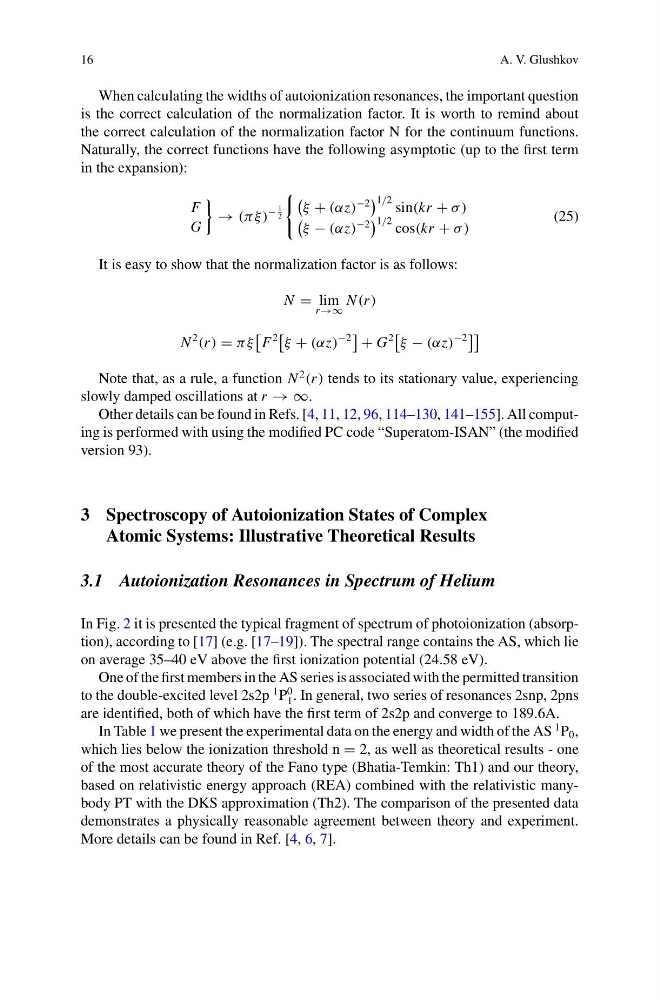
Naturally, the correct functions have the following asymptotic (up to the first term
in the expansion):
F
G
→ (π ξ )
−
1
2
ξ + (αz)
−2
1/2 sin(kr + σ )
ξ − (αz)
−2
1/2 cos(kr + σ )
(25)
It is easy to show that the normalization factor is as follows:
N = lim
r →∞
N (r )
N
2
(r ) = πξ
F
2
ξ + (αz)
−2
+ G
2
ξ − (αz)
−2
Note that, as a rule, a function N
2
(r ) tends to its stationary value, experiencing
slowly damped oscillations at r → ∞.
Other details can be found in Refs. [4, 11, 12, 96, 114–130, 141–155]. All computing is performed with using the modified PC code “Superatom-ISAN” (the modified
version 93).
3 Spectroscopy of Autoionization States of Complex
Atomic Systems: Illustrative Theoretical Results
3.1 Autoionization Resonances in Spectrum of Helium
In Fig. 2 it is presented the typical fragment of spectrum of photoionization (absorption), according to [17] (e.g. [17–19]). The spectral range contains the AS, which lie
on average 35–40 eV above the first ionization potential (24.58 eV).
One of the first members in the AS series is associated with the permitted transition
to the double-excited level 2s2p
1 P
0
1 . In general, two series of resonances 2snp, 2pns
are identified, both of which have the first term of 2s2p and converge to 189.6A.
In Table 1 we present the experimental data on the energy and width of the AS
1 P 0 ,
which lies below the ionization threshold n = 2, as well as theoretical results - one
of the most accurate theory of the Fano type (Bhatia-Temkin: Th1) and our theory,
based on relativistic energy approach (REA) combined with the relativistic manybody PT with the DKS approximation (Th2). The comparison of the presented data
demonstrates a physically reasonable agreement between theory and experiment.
More details can be found in Ref. [4, 6, 7].
A. V. Glushkov
When calculating the widths of autoionization resonances, the important question
is the correct calculation of the normalization factor. It is worth to remind about
the correct calculation of the normalization factor N for the continuum functions.
Naturally, the correct functions have the following asymptotic (up to the first term
in the expansion):
F
G
→ (π ξ )
−
1
2
ξ + (αz)
−2
1/2 sin(kr + σ )
ξ − (αz)
−2
1/2 cos(kr + σ )
(25)
It is easy to show that the normalization factor is as follows:
N = lim
r →∞
N (r )
N
2
(r ) = πξ
F
2
ξ + (αz)
−2
+ G
2
ξ − (αz)
−2
Note that, as a rule, a function N
2
(r ) tends to its stationary value, experiencing
slowly damped oscillations at r → ∞.
Other details can be found in Refs. [4, 11, 12, 96, 114–130, 141–155]. All computing is performed with using the modified PC code “Superatom-ISAN” (the modified
version 93).
3 Spectroscopy of Autoionization States of Complex
Atomic Systems: Illustrative Theoretical Results
3.1 Autoionization Resonances in Spectrum of Helium
In Fig. 2 it is presented the typical fragment of spectrum of photoionization (absorption), according to [17] (e.g. [17–19]). The spectral range contains the AS, which lie
on average 35–40 eV above the first ionization potential (24.58 eV).
One of the first members in the AS series is associated with the permitted transition
to the double-excited level 2s2p
1 P
0
1 . In general, two series of resonances 2snp, 2pns
are identified, both of which have the first term of 2s2p and converge to 189.6A.
In Table 1 we present the experimental data on the energy and width of the AS
1 P 0 ,
which lies below the ionization threshold n = 2, as well as theoretical results - one
of the most accurate theory of the Fano type (Bhatia-Temkin: Th1) and our theory,
based on relativistic energy approach (REA) combined with the relativistic manybody PT with the DKS approximation (Th2). The comparison of the presented data
demonstrates a physically reasonable agreement between theory and experiment.
More details can be found in Ref. [4, 6, 7].